
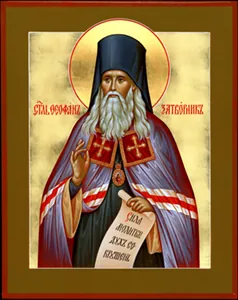
St Theophan the Recluse (+1894)
Saint Theophan the Recluse (in the world George Vasilyevich Govorov) was born in the village of Chernavsk in the Oryol governorate on 10 January 1815. His father Vasily served as priest in the church of Saint Vladimir in the same village. His mother Tatiana came from a priest’s family.
Little George’s father often took him to church, where during the service he either stood in the choir or helped his father in the sanctuary. Once, after Vespers, the watchman accidentally locked the boy in the bell tower. George did not think twice: he slid down to the ground on the rope tied to the clapper of the bell. To the miraculously saved child Vasily said prophetically: “Oho, Yegorushka, you will be either a bell-ringer or a bishop.”
The future saint received his elementary education at home, and then, in 1823, was sent to the Livny theological school. Distinguished by his understanding, the boy with God’s help mastered the school course easily; he also successfully completed first the Oryol seminary and then the Kiev Theological Academy. His contact with the monks of the Kiev Caves Lavra and other ascetics awakened in George, who was inclined to solitude, the desire for monasticism. On 15 February 1841, in his last year at the academy, he took monastic vows with the name Theophan (which means “Theophany”). On 6 April of the same year Theophan was ordained hieromonk in the Dormition Cathedral of the Kiev Caves Lavra.
The saint travelled a long and fruitful road in life: he worked at the Kiev-Sophia theological school and at the Novgorod and Olonets theological seminaries, served in the Russian Ecclesiastical Mission in Jerusalem and in the embassy church in Constantinople; on 9 May 1859 the venerable father was consecrated bishop and appointed to the see of Tambov and Shatsk, and then transferred to the diocese of Vladimir. The grace-filled hierarch watered with his word the souls of people that had become a desert. The holy father’s sermons so gripped the attention of his hearers that a wonderful silence fell over the whole church, and his weak voice could be heard well even in the farthest corner of the church.
The blessed hierarch’s word and deed were inseparable, and by his life too he gave an example of piety: he dressed simply, ate little and prayed much; no one ever heard a rude or haughty word from him; he considered mistrust an insult to a person, trusted those under him without limit, and often asked their advice.
Saint Theophan restored churches, cared for the education of the common people, opened parish schools, and helped the helpless and the needy: when terrible fires broke out one after another in Tambov and a great many people were left homeless, he came to the help of those in distress, especially the widows and orphans of poor clergy; he gave up his own apartment and the free rooms of the bishop’s house to those left homeless, and himself moved out of the city to live.
The true servant of God won great love and warmth everywhere, and he himself loved everyone without limit; but his soul no longer found relief in the earthly arena: the desire ripened in him to melt away before the Lord like a burning candle, in solitude, in reclusion. On 17 July 1866, at his own request, Saint Theophan was released from the governance of the diocese of Vladimir and appointed superior of the Vysha hermitage. At his last Liturgy in Vladimir he addressed his flock thus: “For God’s sake, forgive me for leaving you. I am going because I am compelled to go. I will pray for you. Trust in the Lord.”
During the first six years of his life in the Vysha hermitage Saint Theophan’s chief occupation was prayer and divine service. He received his friends openly, listened attentively to those who wished to receive counsel and instructed them, and sometimes even went outside the monastery; but little by little he became convinced that all this distracted him from the main work for which he had come to the monastery.
In 1872, after Pascha, Bishop Theophan distributed all his property to the poor and began the life of a recluse. He broke off all contact with people, receiving only his confessor, the superior of the hermitage, Hegumen Tikhon, and his cell-attendant, Father Eulampius. In one of his cells the saint arranged a church dedicated to the Theophany, where he celebrated the Divine Liturgy every Sunday and on feast days, and for the last eleven years every day. The saint’s chief work was prayer: sometimes he prayed without a break through a whole day and night. The venerable father kindled eternal remembrance in himself by reading divine books: in his cell he had a rich library, which he constantly added to; he spent the greater part of his pension precisely on buying books. In this library you could also find secular books. “Stories and novels? There are good ones among them too,” the saint wrote. He considered “good” those fruits of the human mind which point to the traces of divine wisdom, grace and truth in nature and history, and to the Lord’s care for people.
The Venerable Theophan the Recluse also laboured in the fields of scholarship, literature and theology. He acquainted himself with a great many works in Russian and foreign languages, thought critically about what he had read, then prayed for a long time, and only after this began to write.
The Venerable Theophan was an unselfish labourer. For his works he received no payment; he was only sent a certain number of copies, intended as gifts.
In his reclusion Bishop Theophan received no visitors, but every day the post brought him twenty to forty letters, in which those afflicted in spirit revealed their pain to him and asked for counsel. The saint did not leave even short and insignificant letters unanswered.
In the intervals between prayer and mental work the saint did handiwork. In his cell there turned out to be a microscope, a telescope and a camera; the saint also tried to relax by playing first the harmonium and then the violin.
The saint foretold his own death a year beforehand; he reposed on 6 January 1894 — a wonderful coincidence! — on the very feast of the Theophany of the Lord. When his cell-attendant went into his cell, he was lying peacefully on his bed, his left hand laid on his breast, and the fingers of his right hand as though folded for a hierarch’s blessing. When the saint, who had reposed in the hope of eternal life, was being vested in a hierarch’s vestments, everyone clearly saw a smile flicker across his face.
The holy father’s cell-attendant Eulampius could not bear the grief of parting from his teacher: two weeks later he too reposed.



