
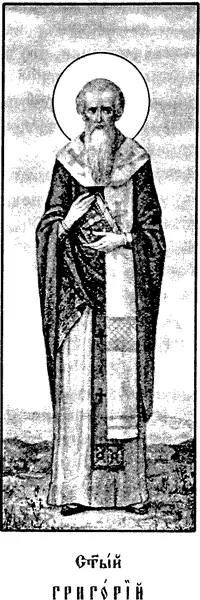
Our Father among the Saints Gregory, Bishop of Nyssa (+395), and His Sister Theosebia the Deaconess (+385)
Saint Gregory of Nyssa was the brother of Basil of Caesarea (commemorated 1 January). He too “was such a man as the great Basil, his brother”.
Following the family tradition, Gregory of Nyssa received both a classical and a Christian education. After his elementary education the boy, seeking the truth, went deeply first into ancient Greek literature, and then into rhetoric and philosophy too. A great part in filling his being with love for the Christian faith was played by his mother and especially by his sister Macrina (commemorated 19 July). Gregory described the life of Saint Macrina in detail and preserved it for us.
The withdrawal from worldly vanities of his mother, his sister, and then of his brother Naucratius had a great influence on the saint. Saint Gregory was made a reader in the church, but in 364 he gave up church service and returned to the work of a rhetor. His brother reproached him: “You have preferred the name of rhetor to Christianity?!”
It seems it was just at this time of spiritual struggle and wavering that Gregory married. Afterwards he wrote: “Blessed are those who are able to choose the better and are not cut off from it, entangled in common life, as we are, who are cut off from virginity as if by an abyss; for one who has once set foot in worldly life can no longer rise to virginity.”
In 370 Basil the Great was consecrated Bishop of Caesarea, and in 372 he consecrated Gregory Bishop of Nyssa, or, in Old Georgian, Nossia.
In 371 Gregory wrote his famous work “On Virginity”; he gave himself wholly to Christian asceticism, and his life became an unending upward striving towards God.
At that time the Arian Valens (364–378) was reigning, and the heretics held sway in the empire. Saint Gregory, together with his brother Basil the Great, faithfully defended Orthodoxy, for which he suffered cruel persecution and oppression. In 376 he was slanderously accused of squandering church property, removed from his see and exiled to Ancyra; the following year a council of Arian bishops condemned him again, but Saint Gregory still did not break in spirit and strengthened his flock from afar. These years were a time of spiritual soaring for him. At this time he composed those choicest monuments of Christian mysticism, “The Life of Moses” and “Commentary on the Song of Songs”.
After the death of Valens (378) Gregory was restored to his see, and his flock met him with joy; but very soon, in 379, Basil the Great died, which greatly grieved the saint. He dedicated a funeral oration to his brother, and afterwards completed his work “On the Six Days”, explaining that part of the sixth day which concerns the creation of man (“On the Making of Man”).
Gregory of Nyssa tried to fill the void that Basil’s repose had left in Christendom, and from then on played a leading part in the life of the Church. In 379 he took part in the work of the Council of Antioch and condemned the heresies, some of which denied the virginity of the Theotokos while others declared her a deity. The council charged Gregory to travel to Arabia and Palestine, to visit the churches there and strengthen in them the Orthodox teaching about the Theotokos. On his way back the saint visited the holy places of Jerusalem.
In 381 Saint Gregory of Nyssa was one of the chief forces at the Second Ecumenical Council held in Constantinople, which finally condemned all the heresies that had sprung from the heresy of Arius. At this council, on Saint Gregory’s initiative, an addition was made to the Nicene Creed. Together with other bishops Gregory of Nyssa installed Gregory the Theologian as Archbishop of Constantinople.
In 394 the saint took part in the work of the local council of Constantinople, which was convened to settle church questions in Arabia. Not long after this council Gregory of Nyssa, in deep old age, reposed in peace.
The blessed Theosebia the deaconess was the sister of Basil the Great, Gregory of Nyssa and Peter of Sebaste. The holy virgin served as a deaconess in the church; she cared for the sick, fed wanderers, brought up orphans, and prepared women for the Mystery of baptism. For three whole years she accompanied her brother, Saint Gregory of Nyssa, in exile and shared his hard lot. Saint Theosebia died in 385.



