
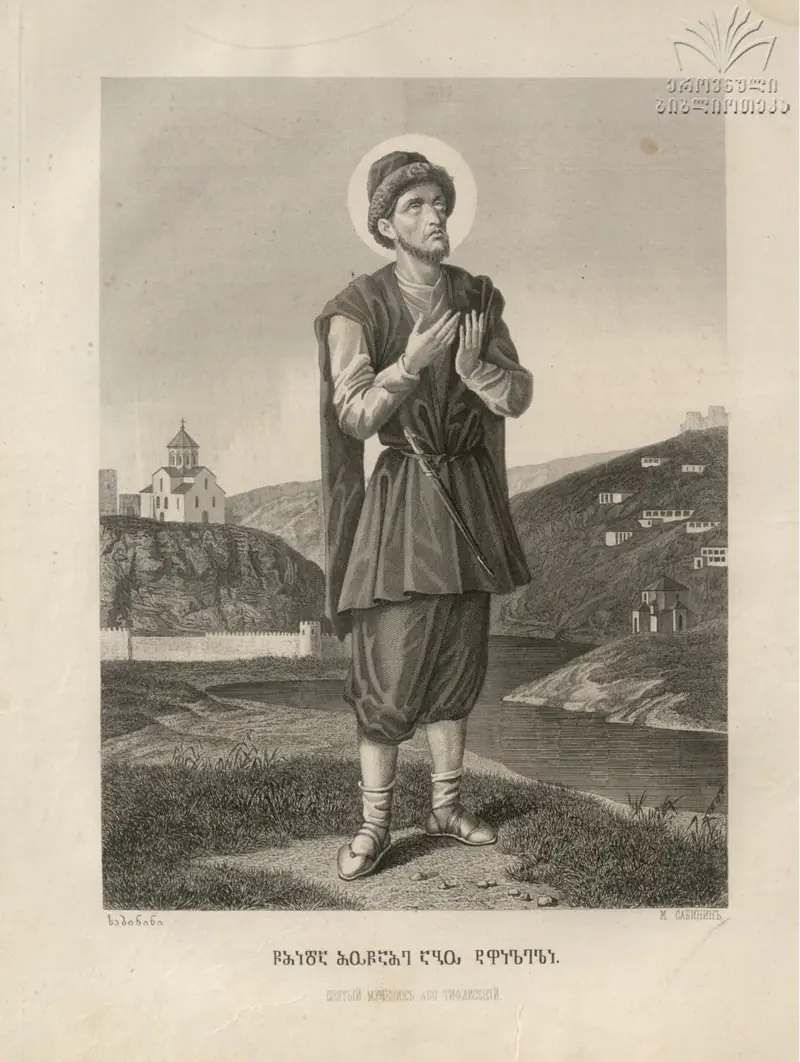
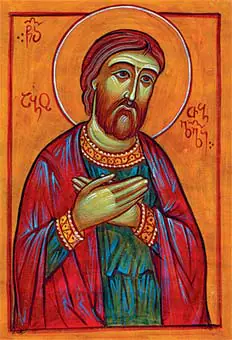
Holy Martyr Abo of Tbilisi (formerly an Arab), martyred in Tbilisi (+786)
The holy martyr Abo of Tbilisi. In the eighth century the yoke of the Saracens brought hard days upon Kartli. The Arabs used every means to crush the Georgians. The enemy held the uprooting of the Christian faith to be the best means of destroying us, and indeed by force and cunning they turned many aside from the truth. The land, worn down by fear, wavered “like a reed before strong winds”. The clergy and the best sons of the nation were seeking a way out. In 766 the enemy drowned the uprising of Kakheti in blood, and the rebellious Kartli too was defeated. The leadership of the uprising of Kartli and Kakheti was laid at the door of Nerse, the eristavi of Kartli, and the Arab emir Mumni Abdilam summoned him to Baghdad.
Nerse spent three years in Arab captivity. There he came to know Abo, a seventeen-year-old maker of perfumes, who after his release followed the eristavi to Georgia. Despite the misfortunes of the nation, Abo was amazed at the moral life of the Georgians; he learned the Georgian language, went to church, talked with the clergy, prayed with them and fasted. Abo strove with all his soul and heart to receive Christianity, and while he was with Nerse in Khazaria he was indeed baptised. Abo followed the eristavi, who had withdrawn from the wrath of the Arabs, to Abkhazia. He thanked God that he had seen a place where all were Christians and glorified the Creator with one mouth and one heart. Later political events allowed Nerse to return again to Kartli. The king of the Abkhaz asked Abo to stay in Abkhazia: “I fear for you, lest they turn you again from the faith of Christ, willingly or unwillingly, and you lose all your great labour,” he said to Abo. “Let me go, so that my Christianity may be made plain to those haters of Christ,” answered the blessed one.
For three years Abo laboured in Tbilisi and preached Christianity. His former fellow countrymen denounced him, seized him and threw him into prison, but at the request of the eristavi Stephanoz he was soon released.
A new emir was set over Tbilisi. The Christians learned that the emir meant to seize the blessed Abo; they warned him and advised him to hide, but he answered joyfully: “I am prepared not only for torments for Christ, but for death as well.”
The emir’s servants seized the blessed Abo and brought him before the judge. He proposed to the saint that he revile Christ and return to the faith of his fathers and forefathers. They tried in every way to win Abo over, but the saint stood firm. At the order of the enraged judge Abo was put in fetters hand and foot and cast into prison. The affliction endured for Christ filled the blessed one with still greater love; he asked the Christians to sell his clothing, buy candles and incense and give them to the churches of the city.
On the day of his martyrdom Saint Abo washed his face, anointed himself with oil, received Holy Communion and so made himself ready for martyrdom as for a feast. “Do not weep over me, but rejoice, for I am going to my Lord; send me on my way with prayer, and may the peace of the Lord keep you,” he encouraged the Christians who grieved at his coming death. The emir ordered him to be killed. Saint Abo crossed his hands upon his breast and joyfully bowed his neck to the sword.
The executioners struck lightly three times with the sword in the hope that for fear of death the saint would deny Christ, but even in his last minutes Abo stood courageous and unbending. Put to shame and defeated, the lawless took vengeance even on the saint’s body: they put his holy body, together with his clothes and the earth soaked with his blood, into a sack, carried it out of the city and burned it on the bank of the Mtkvari; they wrapped the ashes in a sheepskin and threw them into the Mtkvari.



