
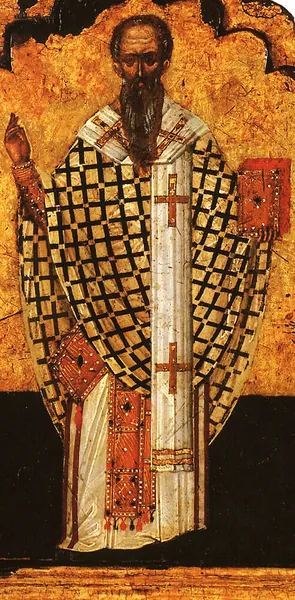
St Dionysius the Areopagite and Simeon Niger (I)
Saint Dionysius the Areopagite lived in Athens and received his classical Hellenic education there, and then studied astronomy in Egypt, in the city of Heliopolis. Together with his friend Apollophanes the saint witnessed the eclipse of the sun at the time of the crucifixion of Jesus Christ. “Now either the Lord, the Creator of the whole world, is suffering, or the visible world is coming to an end,” he said then. After Dionysius returned to Athens he was elected a member of the Areopagus, the supreme court of Athens. When the Apostle Paul, standing before the Areopagus, announced to the pagans the becoming man of the “unknown God” and preached the Orthodox teaching, the saint believed in the true God and became a faithful disciple of the chief of the apostles. For three years he preached the word of God together with his teacher, and then Paul consecrated him Bishop of Athens. In 57 Dionysius was present at the burial of the Theotokos.
While the Most Holy Virgin was still alive, Dionysius, who had come from Athens to Jerusalem expressly to see her, wrote to the Apostle Paul: “God is my witness, there is nothing else in the whole world so filled with divine power and grace. The human mind cannot comprehend what I have seen. I confess before the Lord: when I, together with John, who shines among the apostles like the sun in the firmament, was brought before the Most Holy Virgin, I experienced something beyond words. A kind of divine light shone before me. It illumined my soul. I sensed a wonderful fragrance, and I was so enraptured that neither my feeble body nor my spirit could contain these signs and first-fruits of eternal blessedness and heavenly glory. Had I not remembered your instructions well, I would have taken her for the true God Himself. It is impossible to imagine a blessedness greater than that which I then experienced.”
After the death of the Apostle Paul, Dionysius, wishing to continue his work, set out to preach in the countries of the West. He was accompanied by the presbyter Rusticus and the deacon Eleutherius. The saint converted many people to the law of Christ, first in Rome, and then in Germany and Spain. During the persecution of the Christians by the pagan authorities in Gaul, all three confessors were seized and thrown into prison. At night Saint Dionysius celebrated the Divine Liturgy together with angels of the Lord, and in the morning the martyrs were beheaded. Dionysius picked up his severed head, walked as far as the church, and only there fell down. His body was buried by a pious woman, Catulla.
The teaching of Dionysius the Areopagite has come down to us in four books, “On the Divine Names”, “On the Celestial Hierarchy”, “On the Ecclesiastical Hierarchy” and “On Mystical Theology”, and in ten epistles.
The works of Saint Dionysius the Areopagite (the so-called Areopagitic writings) are of immeasurable importance for the theology of the Orthodox Church. For almost four centuries, until the first half of the sixth century, the holy father’s teaching was preserved only in secret tradition, mostly by the theologians of the Church of Alexandria. It was known to Clement of Alexandria, Origen and Dionysius the Great, who headed the school of Alexandria in succession, and to Gregory the Theologian.
In the second half of the eleventh century the works of Dionysius the Areopagite were translated in full into Georgian by Ephrem Mtsire.
Saint Simeon Niger advanced so far in the apostolic labour that he is ranked with the seventy chosen disciples of the Lord. Information about him is found in the Acts of the Apostles: “Now there were in the church that was at Antioch certain prophets and teachers; as Barnabas, and Simeon that was called Niger, and Lucius of Cyrene, and Manaen, which had been brought up with Herod the tetrarch, and Saul” (Acts 13:1).



