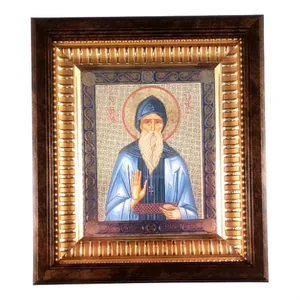
Venerable Father David of Gareji (6th c.)
The venerable and wonder-working Father David of Gareji came from Syria in Mesopotamia. The exact date of his birth and the names of his parents are not known. While still a boy he became the spiritual son of his fellow countryman, the holy Father John of Zedazeni. Fleeing the glory of men, the wonder-working Venerable Father John came with his disciples to Mtskheta, and after venerating the Life-giving Pillar he stopped on a mountain to the north of the capital. From there, with their teacher’s blessing, some of the disciples made their way to the borders of Kakheti and others to Dvaleti.
Father David at first chose Tbilisi for his ascetic labours. Together with the monk Lukiane, his disciple and spiritual son, he settled in a cave on the slope of a mountain that rose to the west of the city, and made a small chapel there. The monks ate nothing but mountain plants and spent their days in prayer.
The dwelling of the holy fathers drew the people of Tbilisi and its surroundings like a magnet. A great many people went to the monks to make their confession. Father David listened to them and called them to repentance and forgiveness, and on Thursdays he went down into the city, encouraged the people with his preaching and strengthened them in the faith.
Through Father David’s prayer a wonder-working spring gushed out near his cave. By the grace of this spring many of the Orthodox were healed of childlessness.
The Tbilisi of that time was in the hands of the fire-worshippers. By his tireless teaching and the zeal of his angelic life Father David converted many fire-worshippers to the true Orthodox faith of Christ.
The magi saw that David was winning ever greater love among the people, and tried in every way to stain his name. One Sunday, when the holy father had come down into the city to preach, they brought a harlot to him as a witness to a slander they had made up against him beforehand. Before the assembled people the harlot accused Father David of fornication. The teacher, who trusted in the Lord, touched the woman’s womb with an iron staff bearing the sign of the cross and commanded the unborn child to name its true father. And the child miraculously declared a certain smith to be its father. The magi, the instigators of the affair, put to shame, rained stones on the woman. The people followed them. Venerable David could not stop them, and the slanderer was stoned to death. After this, heartbroken, he left the city with the monk Lukiane. On the place where the holy father loved to preach there now stands the church of Saint George called Kvashveti.
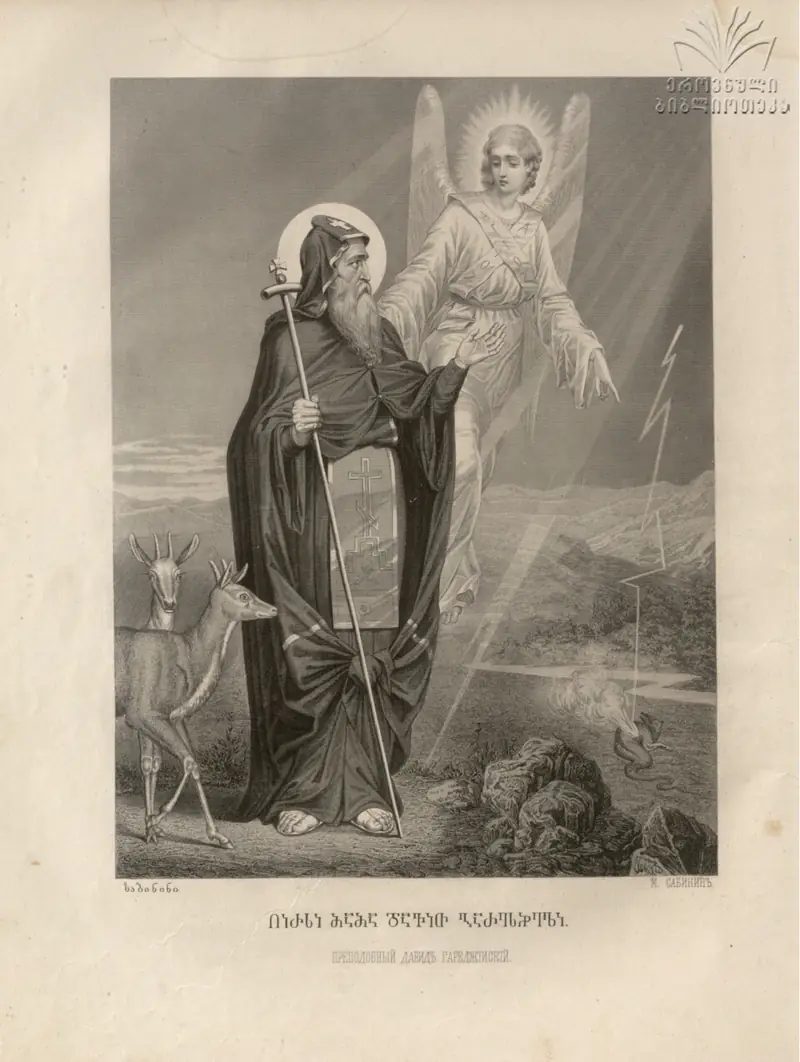
The venerable father, in the manner of hermits, wished to settle far from people. For this he chose in Kakheti, on the plain of Karaia, the wide desert of Gareji — a rocky place scorched by the sun and full of reptiles — and with Lukiane made a cell in a small cave cut in the rock. When Lukiane was distressed by the lack of water in the scorching heat, Father David comforted him with hope in God. For food the venerable fathers had the greens that grew nearby. In summer their food dried up, and Lukiane grew anxious. The holy teacher comforted him once more with hope in God’s help, and indeed two hinds soon appeared before them with a fawn. Lukiane milked the hinds and handed the bowl of milk to Father David. He made the sign of the cross over it, and the milk turned into cheese. Lukiane gave thanks to God who worked in the holy elder, and vowed to Him: “Should my flesh waste away with hunger and my soul fail with thirst, I will no longer take thought for this mortal and unstable flesh, for this vain and passing world, nor will I murmur for food like disobedient and unbelieving Israel, who remembered the flesh and the dainties of Egypt.”
On Wednesdays and Fridays they took no food at all and only prayed, and on those days of the week the deer did not come to them. Below the cell where the ascetics lived there was a cave. In this cave dwelt a dreadful beast, shaggy, with huge horns and eyes that glowed like fire. One day the deer, coming as usual to serve the fathers, passed in front of the beast’s cave, and it snatched their fawn and ate it. The terrified deer ran to Father David. The holy father took his iron staff bearing the sign of Christ’s cross and followed the deer’s tracks to find the dreadful beast. Setting the beast at naught, he raised his staff and commanded it to go far away from that place. The beast obeyed the saint’s command, but just as it was about to go down into the Mtkvari, a thunderbolt hurled from heaven burned it up in an instant. An angel told David that the beast had meant to go from the river into the sea, where it would have done great harm to people, and therefore the wrath that befell it was the providence of God.
In the desert where the holy father settled there were many different wild animals. Once some huntsmen from Kakheti were chasing deer. Their amazement knew no bounds when they saw the deer standing before the holy elder as quietly as sheep. Lukiane was milking them at that very moment. They fell at Father David’s feet and begged him to let them stay with him. The saint asked them, as his children and brothers: “Go back to your own place and your villages, and there serve God, keeping yourselves from evil and filling the want of the poor and the helpless, for he who shows mercy to the poor lends unto God.”
When they returned, the huntsmen spread the story of Father David among the people. So people who longed to bear the sweet yoke of Christ set out for the desert of the ascetics. The holy elder blessed them to cut large cisterns in the rock to collect drinking water, and to hew out cells to protect themselves from the bitter winter.
The lavra of the holy Father David of Gareji
The fathers of Gareji were joined by the monk Dodo, renowned for his virtue — in the world a Kakhetian prince of the house of Andronikashvili — who after becoming a monk had laboured in solitude at Ninotsminda. When Father David saw “the keenness of Dodo’s mind in divine things”, he proposed that he build cells on the summit of the rock opposite and take part of the desert-dwellers with him.
Venerable Dodo built more than two hundred cells on the summit of the rock, and later built a church of the Theotokos as well. So one of the branches of the Gareji complex came into being: Dodo’s Rka, Dodo’s Horn.
David of Gareji loved solitary prayer. For this the saint would go into a cleft in the rock, and, soaking the earth with his tears, lift up his prayers to the Heavenly Father. Once, as he was praying alone, a partridge flew to him, fleeing a huntsman’s hawk. The hawk followed the partridge, and soon a barbarian came galloping up, carried away by the excitement of the hunt. The holy father told the unknown horseman that the partridge was asking for protection and that he must give up killing it. The barbarian not only paid no heed to his words but even raised his sword to kill the saint. Then his hand went stiff in the air. He came to himself at once and with tears of repentance begged Father David to heal him in soul and body. Through the holy father’s prayer this came to pass. Bubakar — that was the barbarian’s name — now begged the saint to heal his paralysed son as well. And indeed, when Bubakar returned home, the child came skipping to meet him full of joy. He had been completely healed at the very time when Father David was praying for him in the desert.
Bubakar loaded donkeys with bread and greens and, accompanied by all three of his sons, came back to the desert-dwellers. Part of the provisions they left with Father David, and the rest, at the saint’s word, they took to Venerable Father Dodo, so as to receive his prayers and blessing too. Bubakar and all who came with him were baptised. The newly baptised cut a church in the rock for the ascetic monks. Later this church was finished by the venerable monk Hilarion.
Father David made it a rule that anyone who wished to settle with them should cut a cell in the rock and live three years in solitude. This was a kind of testing for them, and also a road toward the Lord. After the time of testing many did not return to the monastery again, but chose the hermit’s life and stayed in their cells to the end of their lives.
So the number of desert monks grew. Because of this Lukiane established yet another monastic branch in the desert of Gareji — Natlismtsemeli, the Baptist’s.
Some time later David of Gareji decided to go and venerate the holy places. He called Lukiane and charged him with the care of the flock after his departure. Father David taught him to be of good courage in the good race, and with a few brethren set out for the holy city. When they drew near to the mountain called the Ridge of Grace, the holy city came into view. When Father David saw Jerusalem, giving thanks he first lifted up his hands to heaven, and then fell to the ground sobbing. The holy father did not think himself worthy to enter the holy city, and while his companions went to venerate the holy places of Jerusalem he prayed fervently at the city gate. With great faith the saint took three stones from the Ridge of Grace.
That night an angel of the Lord appeared to Elias, the patriarch of Jerusalem, and said to him: “My own servant David has come as far as My house, and by his faith has carried away all the grace of Jerusalem.” Elias sent runners after Saint David and through them told him the Lord’s will — to take one stone and give back two, so that Christ’s city should not be wholly deprived of grace.
Father David did indeed give back two stones to Jerusalem, and the third, when he returned to Gareji, he placed in the church. A great many people went to the desert to venerate the holy thing. By the will of God the stone was filled with wonder-working power: touching it healed pilgrims of incurable diseases. The stone of grace that Father David brought to the desert of Gareji heals those who pray with faith to this day. After the saint had brought the stone of grace to the desert, the brotherhood grew in number.
To comfort and encourage them, Father David from time to time visited the monks who lived in solitary cells too. In the cell of one of them bitter water seeped from the rock. The greens watered with it were almost unfit to eat. The monk who lived there comforted himself with the thought that in return he would escape eternal torment. One day the monk told the saint, who had come to him, of his hardship. Father David was greatly gladdened by the monk’s meekness and obedience, and by his prayer to the Lord who had mercy on him he made the water sweet, and the greens became good food.
The grave of Father David in the lavra of Gareji
Some time passed. It was made known to the venerable and blessed David by the Lord that he would soon rest in the heavenly dwelling. The good shepherd called the brethren who lived in the desert and taught them for the last time: “Be not dismayed nor troubled, but rather be strengthened and made strong, and know the vanity of this unstable world; for all of us, as it is written, are passing, and nothing of what is reckoned to stand upon the face of the world remains; but the soul, as the receiver of immortality, remains for ever from God, and we are to receive good or evil according to what we have done in this life.”
He received the holy Body and precious Blood of the Lord, lifted up his hands to God, and, giving thanks, left the body that had laboured so much.
Grace shone out from the body of the reposed saint. Among those who venerated the body was a man blind from birth. The Lord Jesus Christ glorified His servant even after death. The saint’s body restored the blind man’s sight.
His disciples buried Saint David of Gareji in the same cell in which he had spent many years. For a long time the stone brought from Jerusalem lay on his grave and by its wonder-working grace healed those who came to it with faith.
Whoever venerates with faith the grave of the venerable and wonder-working Father David of Gareji is healed of ailments of soul and body to this day.