
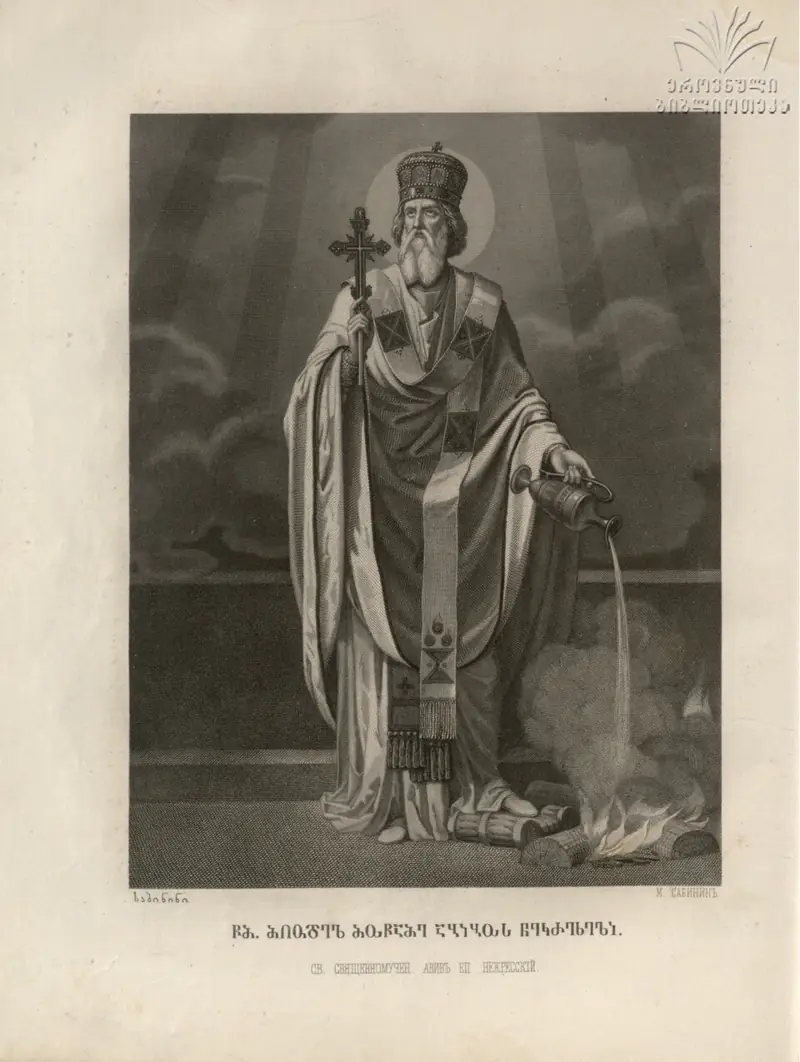
The Holy Hieromartyr Abibus of Nekresi (6th c.)
Saint Abibus of Nekresi came to Georgia in the sixth century together with the thirteen Syrian fathers. They were blessed and sent directly by the All-holy Theotokos. In their life it is written that they were “lights of the world pleasing to God, chosen vessels full of fragrant myrrh, men of heaven and angels of earth, enlighteners of the world, the images, the rule and the unerring canons of monasticism”, and among them Saint Abibus of Nekresi, “a spotless hierarch, a beautiful fruit, who brings us gladness and spreads our fragrance abroad for us. A candle burning on high, a luminary and enlightener of all who beheld him, who spotlessly offered the Body and Blood of Christ, and who offered himself too as a sacrifice to Him by the hand of the lawless marzpan”.
The father lived at first with Venerable John and the other brethren on Mount Zaden; then, with the blessing of Catholicos Evlavius and John of Zedazeni, Saint Abibus went down to Nekresi and set about his apostolic labour. For his grace-filled ministry Saint Abibus “became… bishop, the shepherd of Gagma-Mkhari together with the Didoi. He converted most of the mountain people,” writes Vakhushti Bagrationi in the Kartlis Tskhovreba.
At this time the fire-worshipping Persians ruled in Georgia and used every means to spread their false faith. In many places they built altars on which fire burned unquenched. The Mazdaeans performed their evil rites with great pomp and tried to turn the Georgians from their faith.
Saint Abibus of Nekresi went tirelessly about the villages and settlements of his diocese, preaching the truth to the Georgians and calling them to stand firm. Once the holy hierarch saw the magi forcing Georgians to worship fire; he could not bear such evil, poured water on the fire and put it out. The enraged magi seized Saint Abibus, beat him cruelly and threw him half dead into prison. Then they reported this to the Persian marzpan, who was in the village of Rekha at the time. The marzpan ordered Saint Abibus to be brought before him.
Saint Abibus was a friend of the wonderworker of the Black Mountain, Venerable Father Symeon the Stylite (commemorated on the 1st of September). It was made known to Venerable Symeon by God that Saint Abibus would suffer martyrdom, and he sent the holy father a letter, a blessing and a staff. When Abibus reached the village of Ialdo, a messenger who had come from Antioch met him and handed him Venerable Symeon’s gift.
The letter and the precious gift gladdened and strengthened the holy hierarch, who was ready for his sufferings. On the way Georgians met him and offered to set him free. Saint Abibus did not accept the offer.
The hieromartyr asked his tormentors to let him see Saint Shio of Mgvime. The Persians agreed. The holy fathers greeted each other and prayed together. Then the holy bishop asked the wonder-working desert-dweller to pray for him. Saint Shio said: “I know, master and father, that you have entirely quenched that fire of theirs in which the lawless trusted; but may the Lord grant you to quench easily that invisible fire too which the devil has kindled against you for a trial… Know that their tribulation shall become for you a glory that does not pass away, and this tribulation of yours their fall and their scattering…” The hieromartyr was brought to Rekha.
The marzpan asked the holy bishop, who stood before the court, with menace: “Why have you denied the authority of the king of kings and killed our god?” Saint Abibus calmly answered: “I know no one as king but our Lord Jesus Christ; and that fire I quenched so that I might dispel the delusion of the devil. And I beg you to turn away from that worthless service and to serve Him alone.” Irritated by this bold answer, the marzpan asked again: “I am asking you why you killed our god, and you want to lead us away to your God?” The blessed Abibus again answered calmly: I have not killed a god, I have only put out a fire. Fire is not a god, it is a part of nature; fire comes from the burning of wood, a little water put it out, because the water proved the stronger and killed it. “Now I marvel at such madness of yours — how are you not ashamed to give the name of God to a thing that has so little life?” This answer of the holy hierarch enraged the marzpan terribly, and he ordered him to be tortured.
The executioners tortured the blessed Abibus terribly and at last “stoned him to death”. His holy body was dragged outside the town and thrown down without honour to be torn by beasts and birds, and guards were set over it, so that none of the Christians might carry away the saint’s remains and bury them with honour.
By night the priests and monks of Rekha came and buried the body of the holy hieromartyr with great honour in the monastery of Samtavisi. In the time of Stephanoz, the eristavi of Kartli, the incorrupt relics of the holy hieromartyr were translated from Samtavisi to the Samtavro monastery in Mtskheta and buried beneath the holy altar table.



