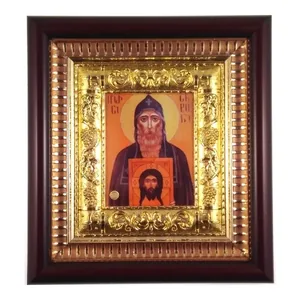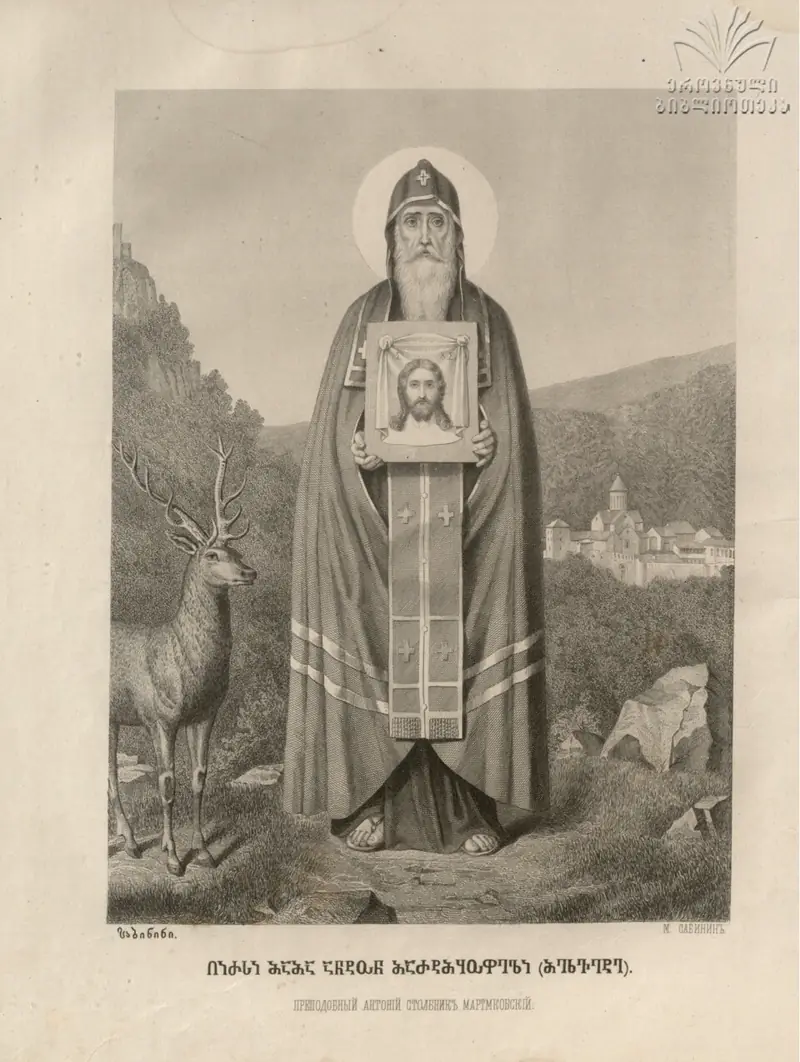
Our Venerable Father Anthony the Stylite, of Martqopi, One of the Thirteen Syrian Fathers (6th c.)
When Saint John of Zedazeni sent his disciples out to preach, Father Anthony went to Kakheti. Here he went round many places and preached to the people. Father Anthony wore on his breast a brick on which the image of Jesus Christ not made by hands was depicted. By the power of this icon he worked many wonders.
Then Saint Anthony settled in the Lonoati valley and began his ascetic labours there. In general Father Anthony dearly loved solitude and prayer to God. That is why he was called “martomqopeli”, that is, “the one who dwells alone”, or, for short, “martqopeli”. But because of his holy life and his wonders he saw so many people that they gave him no peace anywhere. Some of them did not leave him at all and settled near him. When the number of those who wished to do so had grown very large, Father Anthony built a monastery for them beyond the Alazani, while he himself withdrew from them, chose a remote place where Akhmeta now stands, and began his labours there.
But here too they soon found him and began to come to him. So he left this place as well and chose Mount Akriani, which was covered with dense forest, to live on. Here on the summit of the mountain he hollowed out a cave in the rock himself and settled in it. Day and night he prayed fervently before his wonder-working icon. At first he fed on plants, but afterwards God’s providence appointed him other food: deer came to him, as they did to Father David, and fed him with their milk.
Once the headman of the village, whose name was Norio, was out hunting with his men. That day Anthony’s deer were very late, and at last they came running in great fright, and one of them was wounded. Father Anthony was surprised, for he did not know that there was a village nearby. He got up, hung his icon on his breast and followed the deer back, wishing to find out what had frightened them. All at once Saint Anthony met the headman. The latter was greatly amazed to see an old monk with an icon hanging on his breast, standing among wild deer as though among tame cattle. They began to talk, but since Father Anthony did not know the Georgian language, the headman understood nothing. He took Anthony for a dangerous man, and so he made signs that he would cut off his right hand, with which Father Anthony was pointing to the mountain where he lived.
The Monastery of the Divinity
And indeed the headman ordered his men to take Anthony to the smithy and cut off his hand there. The smith heated the iron and meant to take off the hand with the red-hot brand, but suddenly the iron fell from his hand, and his hand went stiff. The smith was frightened and lost his speech, not knowing what to do; but Saint Anthony made the sign of the cross over him and healed him. This wonder astonished everyone. It was all reported at once to the headman. He summoned Saint Anthony and said to him: “Tell me what you wish, and I will do it.” Father Anthony made signs that they should give him a lump of rock salt. They brought it to him at once. Anthony returned to his cave. Soon his deer came back too, and he gave them the salt.
The name of Saint Anthony spread through the villages round about, and a great many people began to come to him. Here they saw still more wonders. Many were captivated by his way of life; some wished to imitate him and, with his blessing, began to live near him. When their number had grown very large, Father Anthony thought it necessary to build a monastery for them. The monastery was built on a level space on the wooded mountain, where the monastery of Father Anthony stands today. Anthony himself built for himself on the summit of the mountain a pillar, or tower, six sazhens high, shut himself up there and laboured for fifteen years. Only now and then did he come down to the monastery to instruct the brethren and celebrate the divine service.
At last, when he felt death drawing near, he called his disciples, gave them his instructions and blessed them. At his death Father Anthony was kneeling in prayer before the icon of the Saviour.
After his death the precious body of Father Anthony was brought down from the pillar to the monastery and buried with great reverence in the church, before the icon of the Theotokos.