
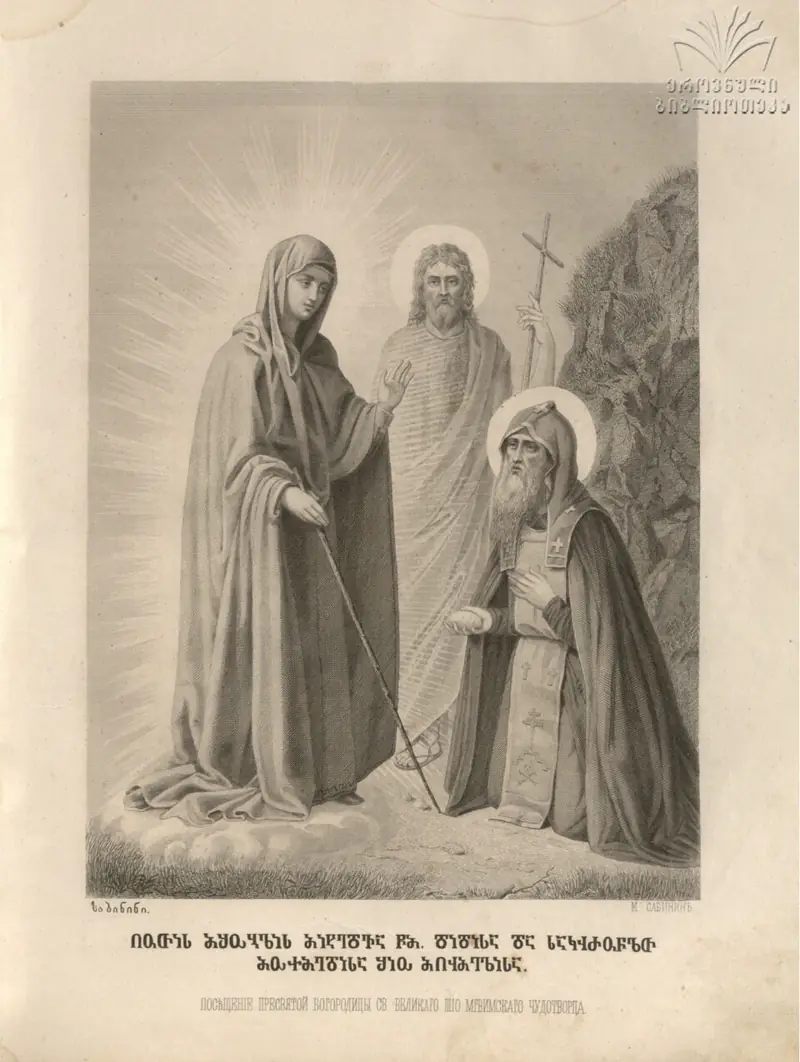
Venerable Shio of Mgvime (6th c.)
Venerable Shio of Mgvime, one of the thirteen Syrian fathers, was from Antioch. His parents, devout nobles, gave their only son an excellent education. The humble, kind and God-loving Shio especially loved to read the Holy Scriptures. At the age of twenty Shio heard of the great ascetic John (commemorated on the 7th of May), who lived with his disciples in the desert, and went secretly from his parents to see him. Saint John, who had been rewarded with the gift of foresight, received Shio with joy and blessed him, and said to his disciples: “Let this youth be a son of God and a father of many monks, for God has chosen him”; and he promised Shio that he would number him among his disciples on condition that he went home and received his parents’ permission.
Time passed. Shio’s parents went into a monastery for the ascetic life. Shio sold the house, set all the slaves free and went to Father John.
Venerable John received Shio with joy, tonsured him a monk and allowed him to remain in the desert.
For twenty years Venerable Shio stayed in the desert with Father John. For his selfless labours and his obedience he received the gift of healing.
Then Venerable John had a vision from on high, that he should choose disciples and go to Iveria to strengthen the faith of the Georgians. Among the twelve fellow strugglers whom the holy father took with him was Shio.
When the fathers came to Georgia they settled on Mount Zedazeni; then, with the blessing of Catholicos Evlavius and on the advice of Father John, they went out to preach in various regions.
Shio, a lover of stillness, asked his spiritual father for permission to go into the desert. Near Mtskheta, in the rock of Sarkineti, he found a cave and began his labours. At that time the place was inaccessible, waterless and full of wild beasts. Father Shio suffered many hardships and fears here, but he bore everything and overcame every temptation. As with the holy Elijah the Tishbite (commemorated on the 20th of July), birds brought the venerable father his food.
The monastery of Shiomgvime
Once, after fervent prayer through the whole night, at dawn a wondrous light spread over the whole gorge, and the All-holy Theotokos appeared to Saint Shio together with Saint John the Baptist. The All-holy Virgin promised the holy elder strength in his trials, and gave him for food something like snow. After this Venerable Shio laboured in that gorge, all alone, with even greater zeal.
Once Evagrius, the spaspet of King Parsman and ruler of Tsikhedidi (commemorated on the 4th of February), went hunting in the mountains of Sarkineti; here he came to know the venerable father and stayed with him for the ascetic life.
The whole country soon heard that the renowned spaspet had gone into the desert. Many pilgrims came to Venerable Shio and Evagrius. Many of them followed Venerable Evagrius’s example and began to labour in the desert.
Once Venerable Shio stood at prayer and besought God to show him the place for building a church. Instead of a censer the saint burned incense on the palm of his hand. The fire did not burn his hand. The saint followed the trail of the incense, and where the smoke rose straight up to heaven he marked out the place for the church with his staff. So the Lord showed Saint Shio where he was to build the church.
When King Parsman heard that Evagrius had become a monk, he was much displeased and went himself to Shio’s desert. The king saw such wondrous grace on Saint Shio’s face that he took off his crown and knelt before him. Father Shio reverently blessed the king, raised him up and set the royal crown on his head with his own hand. The king’s retinue too bowed down to Father Shio and received his blessing. Among them was a nobleman whose right eye had been injured by an arrow. He knelt before Shio, touched his eye to the saint’s foot, and was healed.
King Parsman asked the venerable father what the desert needed. Saint Shio answered: “My lord king! The hearts of kings are in the hand of God; do as seems right to you.” For the building of a church in the desert the king gave a great sum of money, four villages, a chalice and paten, a golden cross and the beautifully adorned Gospel of King Vakhtang Gorgasali (commemorated on the 30th of November).
When the building of the church was finished, King Parsman came to the desert again, this time with the catholicos and the bishops. Saint John of Zedazeni himself came too and consecrated the newly built church.
After this the number of desert brethren reached two thousand. Many people came to the desert to see the wonder-working hermit and to receive his blessing and healing.
The grave of Saint Shio of Mgvime
Saint Shio worked many wonders. Once a wolf took to attacking the monastery’s donkeys and tore many of them to pieces. When Saint Shio heard of this, he prayed and asked the Lord that this wolf should become the donkeys’ herdsman; and so it came to pass — after this the wolf faithfully herded the donkeys.
Once Saint John of Zedazeni called his disciples and commanded them to show what measure of spiritual life they had attained. Saint Shio laid a burning coal on the palm of his hand and heaped incense on it. The people who saw the wonder were amazed and glorified the Lord.
At last Saint Shio, with the prayers and blessing of his spiritual father John of Zedazeni and of the catholicos of Georgia, gathered his disciples, gave them a rule, appointed Venerable Evagrius their superior, and withdrew into the cave he had dug himself.
Buried alive for the love of Christ, Venerable Shio lived in the cave for fifteen years in fasting and prayer. At last, after God had revealed to him that his death was near, he received Holy Communion, lifted up his hands and peacefully gave his soul to the Lord with the words: “O Lord! Into thy hands I commend my spirit.”
During one of the Persian invasions the soldiers of Shah Abbas carried the holy bones of Shio of Mgvime off to Iran. That year a terrible plague struck Persia. The frightened Persians decided that the cause of it was their dishonouring of Saint Shio’s relics, and returned them to the monastery.



