
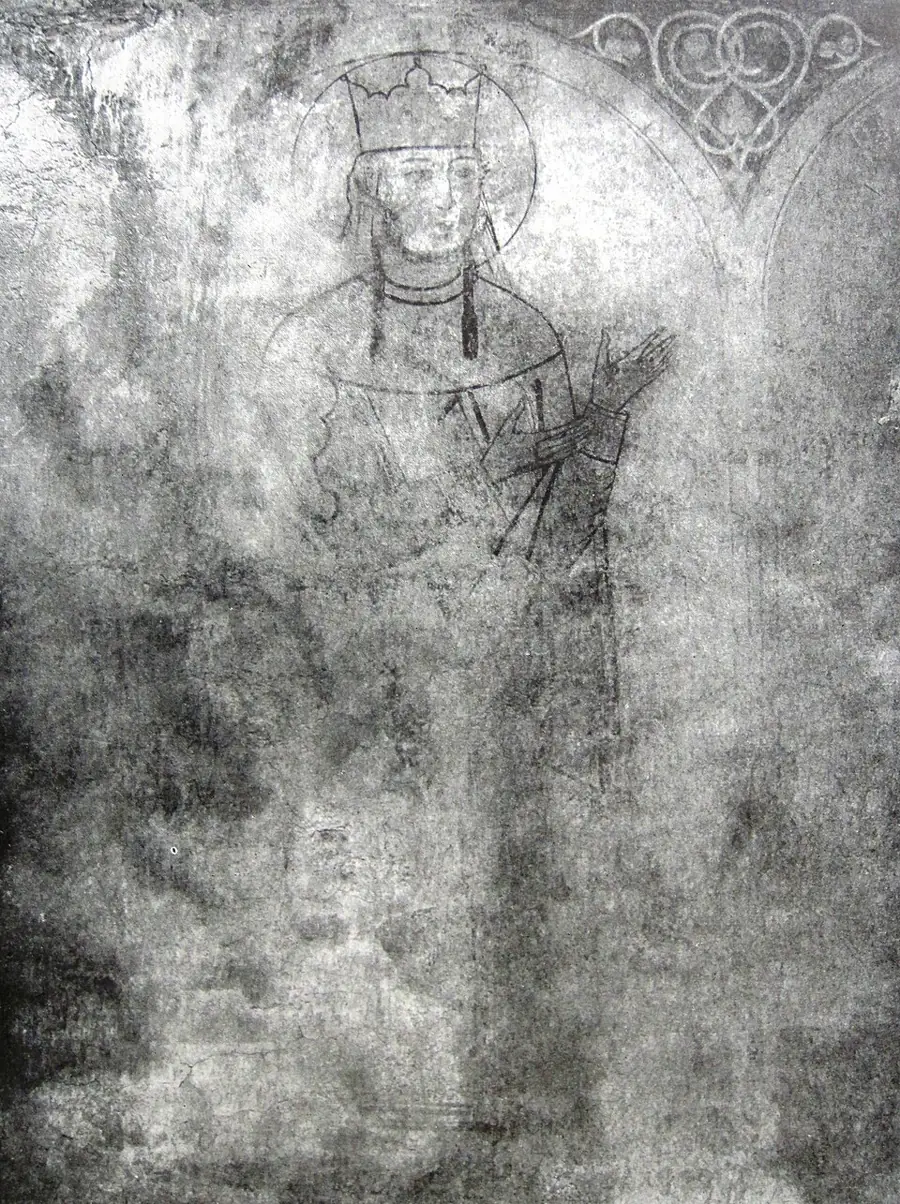
Holy Right-believing King Tamar (†1213)
Icon of St King Tamar from the upper convent at Vardzia
In 1166 a daughter, Tamar, was born to King Giorgi III and his wife Burdukhan. In his own lifetime King Giorgi proclaimed her king. The nobles swore an oath and knelt before the twelve-year-old monarch, to whom Providence had given the heavy cross of leading the nation.
Father and daughter ruled the kingdom together for five years. In 1184 King Giorgi died, and eighteen-year-old Tamar became the sole ruler and sovereign of Georgia. The country received “the sun of suns and light of lights” with loyalty and love. Keeping the order of the royal court, the worthy and grace-filled hierarch, Archbishop Antoni Saghirisdze of Kutaisi, and the eristavi of Racha and Takveri, Kakhaber Kakhaberisdze, set the royal crown on her head, and the Vardanisdzes, Saghirisdzes and Amanelisdzes girded her with the sword. All Georgia rejoiced. “They sounded trumpets, drums and cymbals, and there was clamour and tumult in the city — joy, delight and hope for those who had lost hope.” So began the reign of Tamar, chosen among monarchs, “the sun of suns and queen of queens, shining forth above all who bear a halo” — a path full of glory and victories, of building and labour, of sleepless nights and prayers with tears.
Tamar marked her coming to power with a work of God: she summoned a church council and addressed the multitude of hierarchs and fathers gathered there humbly, with a brilliant speech. Encouraged by the king's support, the council deposed unworthy bishops, “set up men of God” in their place and “set right other church rules loosened by the negligent”.
Tares were mixed with the good fruit. In the very year of Tamar's anointing the chief treasurer Qutlu-Arslan, who aspired to be commander-in-chief, demanded that a tent be set up at Isani, where by his plan all internal and external affairs were to be debated and the result reported to the king. The Isani tent was to take over the king's chief rights. This would not only have weakened the royal throne but would have threatened the unity of the country.
At Tamar's command Qutlu-Arslan was seized, but his followers demanded his release with weapons in their hands. The country faced the danger of civil war. The king turned to the noblest of means: she sent into the conspirators' camp two distinguished and honoured ladies — Khushak Tsokali, mother of Rati, eristavi of Kartli, and Kravai Jaqeli. The embassy of these honourable women worked on the rebels so that “they obeyed the command of the honourable ones and, coming before her, bowed down to the ground, received an oath from their sovereign, and gave her their word of loyalty and obedience”.
The country felt the king's strong hand. Tamar appointed her own supporters to the offices of state.
The clergy and the nobles demanded that Tamar marry, and chose as bridegroom a Russian prince, Yury, son of Andrei Bogolyubsky, Prince of Suzdal. The king tried to resist: “How is it fitting to do this without inquiry? We know nothing of this stranger's conduct and deeds, neither of his soldiering, nor of his nature, nor of his behaviour. Give me time, until all may see his goodness or his baseness.”
Her subjects did not heed the king's word, and soon the great merchant Zankan Zorobabeli brought to Georgia “a youth of comely face, of perfect build, and seen by beholders to be of noble birth”.
The handsome Giorgi the Russian lacked neither manliness nor courage. Under his leadership the Georgian host always came back victorious.
Unhappily, Giorgi soon showed his evil character. “Being Scythian by nature, in drunkenness he began many loathsome lawless deeds.” For two and a half years Tamar bore her husband's shameful conduct; at last she summoned the Catholicos, the bishops and the nobles and said: “Though I am taught by the divine law ‘not to put away the first bed’, yet one who does not keep his bed pure it is not right to bear with, for he defiles the temple of God; and I cannot straighten the shadow of a crooked tree, and I shake off, being blameless, even the dust that has clung to me from thee.”
Giorgi the Russian was given countless treasure and sent away to Constantinople.
Many kings of neighbouring states were captivated by Tamar's beauty and wished to marry her. The sovereign of the Georgians no longer wished to marry, but the men of the court “opposed her, spoke of her childlessness, murmured at the barrenness of her house”. So Tamar heeded the counsel of her aunt Rusudan and was wed to the son of the king of the Ossetians, a Bagrationi, a descendant namely of Giorgi I — David Soslan. David, “fine of complexion and build, broad-shouldered, handsome of face and of moderate stature, royal on both sides of his lineage”, had been brought up by Rusudan.
Giorgi the Russian could not accept the loss of Tamar and of Georgia; he came into Karnu-kalaki, won to his side Guzan, eristavi of Klarjeti, Botso, commander of Samtskhe, the Meskhian nobles, the men of Imereti and Svaneti, and in Kutaisi proclaimed himself king. “Oh, great outcry, amazing to the minds of men! Who, or whose successor, has sat upon the throne of David?” Tamar's loyal host repaid the disloyal.
In 1193 a son was born to Tamar and David, “in all things like his grandfather, and they named him Giorgi”; and because he was very beautiful, he was called by the byname Lasha (bright, the enlightener of the world).
At the end of 1193 Giorgi the Russian returned again from Constantinople and, with the help of the atabeg of Persia, took Ran and laid waste Kambechovani. Saghir Makhatlisdze of Khornabuji was the first to learn of the Russian's coming; he gathered a small troop and boldly fell upon the invaders. Tamar's righteousness gave the Georgians the victory. They cut down the enemy utterly and took back their plunder. Giorgi the Russian barely escaped with two servants.
The next year, 1194, a daughter was born to Tamar and David. Alarmed by the Georgians' victories, the Turks in 1195 organised a great campaign of a Muslim coalition under the command of Abu Bakr, atabeg of Azerbaijan.
Tamar at once ordered a general levy and at the same time charged Antoni of Chqondidi: “Write quickly and send out the command, that the army may gather swiftly; and send also to all the churches and monasteries, that unceasing vigils and litanies be held in every place; and send great sums and necessities for the poor, that they may be free to pray and make God merciful. Let not the heathen say anywhere: Where is their God?”
In ten days she gathered “the hosts from Imer and Amer”. Before the battle Tamar addressed the army: “My brothers, let not your hearts be dismayed at all by their multitude and your fewness, for God is with us. Have you heard of Gideon's three hundred and the countless multitude of Midianites slain by them, and again of the camp of the Assyrians struck down in a moment by the angel at the prayer of Hezekiah? Trust in God alone, keep your hearts upright before Him, and let all your hope be in the Cross of Christ. Hasten into their land with the help of the All-holy Mother of God, and go forth by the power of the invincible Cross.”
Then the King of Kings blessed the army, commended to God the host that was ready to lay down its life for Christ, “sent the Wood of Life before them and sent Antoni of Chqondidi with them”. She herself took off her shoes and “with bare feet went to the church of the Mother of God at Metekhi and, lying before that holy icon, did not cease to entreat with tears”.
The Lord looked with a merciful eye upon the God-loving king and upon Georgia, the lot of the Mother of God. The unequal battle at the fortress-town of Shamkor, where the Turks far outnumbered the Georgian host, ended in victory for the Christians. St Shalva of Akhaltsikhe (commemorated 17 July) seized the royal banner from the Hagarenes; afterwards Tamar offered this banner, together with a precious maniak, to the Mother of God of Khakhuli.
To mark this victory and to glorify God the holy king wrote an iambic poem:
“By Thee, O Virgin, before whom David danced, that Thou shouldst be Mother of God's Son, I, Tamar, Thy dust, am made worthy through Thee of anointing and of kinship. Ruling between, from Eden to Gadir, south and north, I bring Thee this spoil: the Caliph's banner I have joined to the maniak, the standard of the teacher of false laws, whom David, like the archer sons of Ephraim, overthrew, routing the sultan and the atabeg…”
In Tamar's time a very important dispute over the faith took place between the Georgians and the Armenians. Tamar's foremost courtiers, Zakaria and Ivane Mkhargrdzeli, were Armenianised Kurds and followed the Gregorian faith. Once, after the evening service, Zakaria wished to receive the prosphora, but Catholicos Ioane did not allow it.
The angry commander-in-chief brought the Armenian catholicos: “I am a soldier, I do not know the faith; argue with this one.” The dispute went on for a long time. At last Catholicos Ioane said: let us show our righteousness by deed. Let us starve dogs for three days. On the third day let us offer the bloodless sacrifice and set the Lamb before the dogs. Whichever Lamb the dog eats, that one's faith is false. When the king and the people heard this they were struck with dread. St Tamar said to the Catholicos: “What shall I say? Who is able to do this, to devise it, or to hear of it, for it is astonishing?” The Catholicos answered quietly: “This deed I do not do trusting in myself, but I do it in hope in Christ God, that He may show the faithful whose is the true faith, and who are the right-confessors, and by whose priestly ministry He accepts the bloodless sacrifice, and into whose hands the Lamb of God gives Himself to be slain.”
At the Sunday Divine Liturgy Catholicos Ioane, who was serving, took in his hands the Lamb offered in the Orthodox way. The king and the people watched the astonishing sight with dread. The Catholicos prayed: “O Christ the King, who wast made man for the salvation of men, crucified for us, buried and risen and ascended to heaven to the Father; who gavest us Thy Body that we might do this in remembrance of Thee: Thou, O King, knowest the faith of the Georgians, Thou knowest this faith of ours. Keep untouched and unapproached this awesome Body of Thine, offered in priestly ministry by us; Thou hast already accepted this unshakeable offering; show this people the true way, look upon this sacrifice and put to shame those who oppose us.” The dog, starved three days, as soon as it drew near the holy Gifts, fled the place yelping in fear, but the offering of the Armenians it swallowed at once. The people who saw this wonder glorified the Lord: “Great art Thou, O Lord, and marvellous are Thy works.”
The Armenian theologians went back put to shame. Ivane Mkhargrdzeli at once confessed Orthodoxy and was baptised by Catholicos Ioane, while Zakaria said: “The faith of the Georgians is sound”, but kept to the Gregorian faith all the same.
The Georgians defeated the Turks again and again in Azerbaijan and Armenia, at Khlat and at Erzurum. So at the turn of the twelfth and thirteenth centuries Georgia was a vast state stretched across the meeting-point of Europe and Asia, reckoned with by the Christian West and the Muslim East.
The growing might of Georgia struck terror into the Turks. This time Rukn ad-Din, sultan of Rum-Iconium, undertook a campaign against Christendom. He deceitfully swore love to King Tamar and sent her gifts, while secretly gathering an army. He assembled a vast host: “he gathered forty myriads, which is four hundred thousand”. Basili the Ezosmodzghvari writes that Rukn ad-Din brought out an army of 800,000. In his vast dominions “he left none in their villages except women, but mounted them all”. Nor did he spare gold and silver to win allies and pay for the war.
All the Turks gathered against Georgia. Rukn ad-Din camped his army near Basiani and sent an envoy to Tamar; made insolent by the size of his army, he offered to marry her at the price of changing her faith, and if Tamar remained a Christian, the sultan threatened to make her his concubine. Hearing these blasphemous words, Zakaria Mkhargrdzeli struck the sultan's envoy such a blow that he fell senseless to the ground.
From Nikopsia to Derbent all Georgia gathered: “in a few days they gathered, like leopards in agility and like lions in heart”.
At Tamar's command the envoy sent by Rukn ad-Din was richly rewarded, and a letter to the sultan was sent with him together with a Georgian envoy. “…You, trusting in the multitude of hirelings gathered with gold, are ignorant of the judgements of God. But I trust neither in riches, nor in the multitude of my hosts, nor in anything else human, but in the power of God Almighty and in the help of the Cross of Christ, which you blaspheme… Let the will of God be done, and not yours! His be the judgement, and not yours! And I know how slack your servants are. For this I have sent my servant, to bring you the answer to your letter soon and to warn you, for behold, the feet of the hosts I have sent stand at your gates,” the holy king wrote to the vile sultan.
Tamar commended the Georgian host to the Mother of God of Vardzia, then went barefoot before the army and saw it off as far as the city gate. “Then she herself took the precious… Cross in her hands, and over the mounted men on every side made the sign of the cross three times, blessed them, and so they went forth, trusting in God and in Tamar's tears.”
God heard the fervent prayer of the holy king and of His chosen people, and the Georgians utterly defeated the enemy at Basiani. The Georgians' victory in this war was of the greatest importance not only for Georgia but for the whole of Christendom.
Such victories made the King of Kings still more devout. By day, clothed in royal splendour, she wisely governed the affairs of the realm, and by night she prayed on bended knees, besought the Lord with tears for the strengthening of Christendom, spun, embroidered and sewed, and gave her work away to the poor.
Once Tamar, weary from prayer and handiwork, dozed off and saw a vision: she entered a fine and well-built house and saw a golden throne adorned with jewels and pearls, and thought: “I am the reigning king, and this highest and most honourable seat is mine.” She went to sit on it. Suddenly a man clothed in light stopped her and said: “That seat is not thine, for thou art not able to hold it.” Amazed, Tamar asked: “Who is more honourable than I, to hold a more honourable seat?” He answered: “That throne belongs to thy bondwoman, because with the work of her hands she clothed twelve priests when they stand before the awesome and dread table to offer the bloodless and precious sacrifice. Therefore she is higher than thou; though thou art king, this glory is enough for thee, though thy dwelling too is here” — and he showed her another place.
When she woke, Tamar began to spin and weave with her own hands, and clothed twelve priests.
The king, boundless in her care for the poor and the destitute, like her great forebear the right-believing King David the Builder (commemorated 26 January), gave alms from the work of her own hands.
History has kept for us a moving story from the life of the holy king. Once, they say, King Tamar was about to go to a festal Liturgy at Gelati and was fastening rubies to her royal robe, when people came and told her that a beggar standing by the monastery tower was asking for alms. The king told them to have the beggar wait. When she came out of the palace and wished to give alms, the beggar could no longer be found. The king, dismayed, reproached herself that in the person of this poor, destitute woman she had refused the Lord Jesus Himself; she took off what had held her back — the royal robe — and offered it to the icon of the Mother of God.
Tamar was never idle herself and did not let others be idle. In Tamar's time the rock-cut town of Vardzia was built, in whose monastery the God-clad king spent Great Lent. In that time Pitareti, Kvabtakhevi, Betania were built… The holy king not only enriched the churches and monasteries of Georgia but lavishly adorned lavras and houses of God in Palestine, on Cyprus, on Mount Sinai, in Greece, on Mount Athos, at Petritsoni, in Macedonia, in Thrace, in Romania, in Isauria, in Constantinople.
Once the king gave boundless treasure to monks of the Black Mountain who had come to ask for help, and sent them away in peace. When the monks reached Constantinople, the fratricidal Emperor Alexios Angelos seized them and took everything from them. When Tamar heard of it, she gave the monks more gold than before, and “by this shamed the devil the more”; and she sent her host against the emperor and took from him Lazia, Trebizond, Limnia, Samsun, Kerasunt, Kytyora, Amastris, Heraclea, Paphlagonia and the lands of Pontus. Afterwards she entrusted these lands, which she called the Kingdom of Trebizond, to Alexios Komnenos, a kinsman of the Georgians.
The God-loving king laid down a rule that was binding on the royal court: she herself prayed by the typikon of the Palestinian monasteries and required the same of others. “None who were at the court could be absent from the services: vespers, matins, the midday office, as it is said.”
In the domain of the merciful, good, wise judge there was no oppressor, no robber, brigand or thief. She herself used to say: “I am the father of orphans and the judge of widows.” The steadfast, God-illumined king strictly forbade the death penalty and mutilation. Ceaseless fasting, barefoot processions and lying on the monastery's stone bed shook the health of the beloved king. For a long time the king hid her illness, not wanting to trouble others; day by day the sickness grew heavier, and only when the pain became unbearable “did she at last make it known”.
The king was brought from Nacharmagevi to Tbilisi. Then she was taken out of the city, in the hope that the quiet and beauty of the forest might help her, but “that merciless sickness grew very grave”. They brought her back to Tbilisi, near to death.
All Georgia rose to pray, went in procession, kept vigil through the night, and with tears begged the Lord for the healing of the sun-like crowned one; the princes beat their faces, the poor tore their hair, and every Georgian offered himself and his children to the Lord and entreated: “that she alone may remain, and all of us be slain”.
Standing on the border of life and death, the king called the men of the court and said: “My brothers and my children! Behold, I am summoned by the dread Judge, more dread than the kings of the earth, who taketh away the spirit of princes.
You are all yourselves witnesses that I held you in love as my own self, and I did not withhold from you your benefit and your good, each according to his worth, while by God's providence I was king over you. Now I too go the way of our fathers, a way strange to me, by a dread command and a wondrous parting. I beseech you all always to remember me in good. Behold, as heirs of my house I leave you the children God gave me, Giorgi and Rusudan. Receive them in my stead, and may they fill up for you what I have left lacking.”
Then the King of Kings commended Georgia to the icon of the Saviour and to the Life-giving Cross, wished peace to those around her, looked for the last time upon her faithful subjects, crossed herself for the last time, and said for the last time: “O Christ, my only God, endless King of heaven and earth! To Thee I commend this kingdom entrusted to me by Thee, and this people purchased by Thy precious blood, and these my children whom Thou gavest me, and then my soul.”
To this day the place of King Tamar's grave remains wrapped in mystery. Some historical sources name Gelati as King Tamar's resting place, others the Monastery of the Cross in Jerusalem. And the people adorn their longing for their greatest monarch with legends, and by this express a bond of dreams with the holy crowned king and with the Georgia of that time.
Lives of the Saints, vol. II, Tbilisi, 2001
“O holy fathers, you are appointed by God as our teachers and as rulers of the holy Church, and it is fitting for you to give account for our souls. Search out all things well, confirm what is right and expose what is perverse. Begin with me, for this is the halo of kingship and not of fighting against God. Do not favour princes for their wealth, nor neglect the poor for their lowliness — you by word and I by deed, you by teaching and I by being taught, you by instruction and I by being instructed; let us together set our hands to keeping the divine laws undefiled, lest we be punished together: you as priests and I as king, you as watchmen and I as keeper.”



