
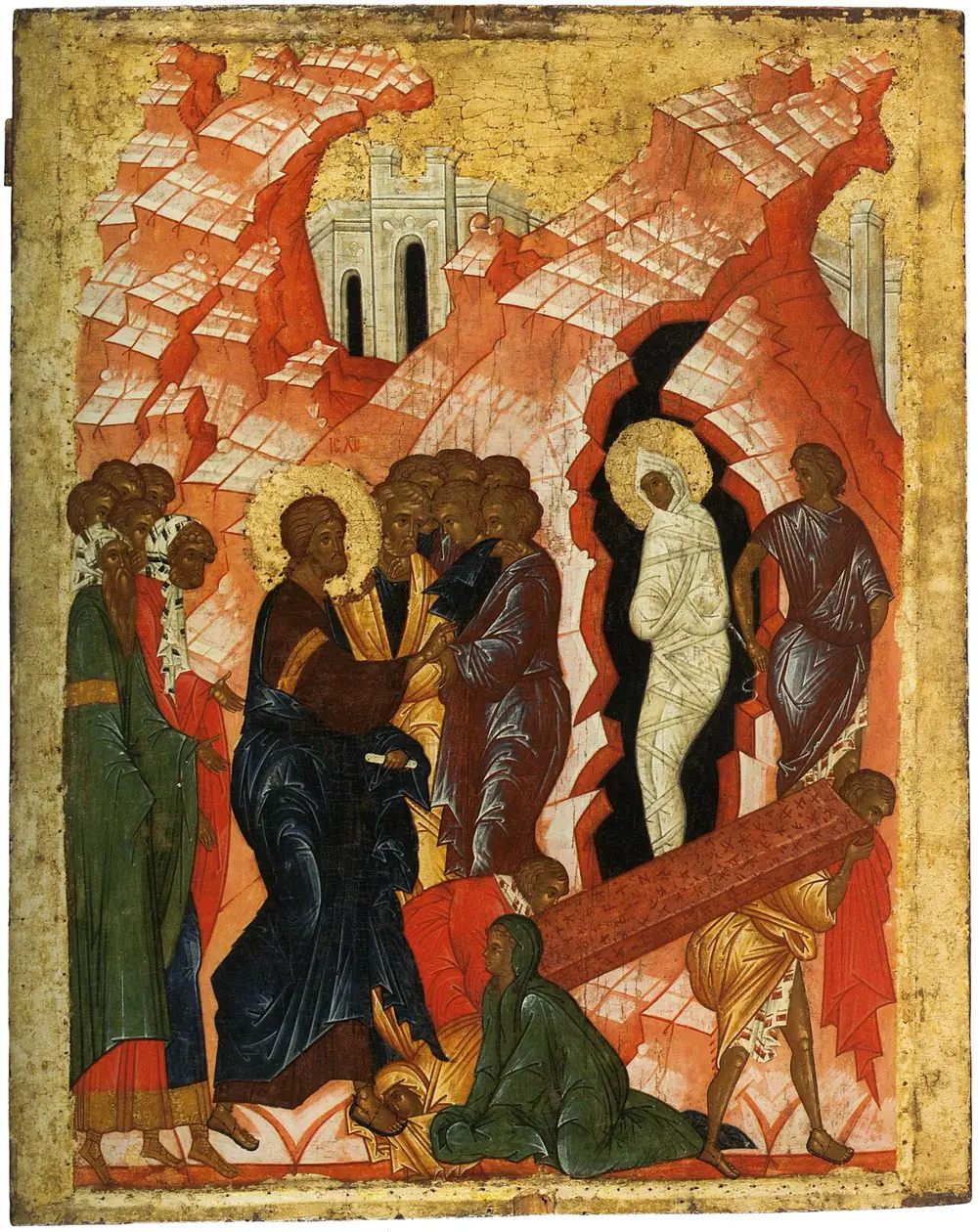
The Raising of Righteous Lazarus
Then when Jesus came to Bethany, he found that he had lain in the grave four days already. Now Bethany was nigh unto Jerusalem, about fifteen furlongs off: and many of the Jews came to Martha and Mary, to comfort them concerning their brother. Then Martha, as soon as she heard that Jesus was coming, went and met him: but Mary sat still in the house. Then said Martha unto Jesus, Lord, if thou hadst been here, my brother had not died. But I know, that even now, whatsoever thou wilt ask of God, God will give it thee. Jesus saith unto her, Thy brother shall rise again. Martha saith unto him, I know that he shall rise again in the resurrection at the last day. Jesus said unto her, I am the resurrection, and the life: he that believeth in me, though he were dead, yet shall he live: and whosoever liveth and believeth in me shall never die. Believest thou this? She saith unto him, Yea, Lord: I believe that thou art the Christ, the Son of God, which should come into the world. And when she had so said, she went her way, and called Mary her sister secretly, saying, The Master is come, and calleth for thee. As soon as she heard that, she arose quickly, and came unto him. Now Jesus was not yet come into the town, but was in that place where Martha met him. The Jews then which were with her in the house, and comforted her, when they saw Mary, that she rose up hastily and went out, followed her, saying, She goeth unto the grave to weep there. Then when Mary was come where Jesus was, and saw him, she fell down at his feet, saying unto him, Lord, if thou hadst been here, my brother had not died. When Jesus therefore saw her weeping, and the Jews also weeping which came with her, he groaned in the spirit, and was troubled, and said, Where have ye laid him? They said unto him, Lord, come and see. Jesus wept. Then said the Jews, Behold how he loved him! And some of them said, Could not this man, which opened the eyes of the blind, have caused that even this man should not have died? Jesus therefore again groaning in himself cometh to the grave. It was a cave, and a stone lay upon it. Jesus said, Take ye away the stone. Martha, the sister of him that was dead, saith unto him, Lord, by this time he stinketh: for he hath been dead four days. Jesus saith unto her, Said I not unto thee, that, if thou wouldest believe, thou shouldest see the glory of God? Then they took away the stone from the place where the dead was laid. And Jesus lifted up his eyes, and said, Father, I thank thee that thou hast heard me. And I knew that thou hearest me always: but because of the people which stand by I said it, that they may believe that thou hast sent me. And when he thus had spoken, he cried with a loud voice, Lazarus, come forth. And he that was dead came forth, bound hand and foot with graveclothes: and his face was bound about with a napkin. Jesus saith unto them, Loose him, and let him go.
Then many of the Jews which came to Mary and Martha, and had seen the things which Jesus did, believed on him.
John 11:1–45
The icon “The Praise and Glory of the Georgian Language”, iconographer Irakli Tsintsadze
And this language sleeps until this day, and in the Gospel this language is called Lazarus!
And the new Nino converted it, and Queen Helena; these are the two sisters, like Mary and Martha,
and “friend” was said for this reason, that every mystery is buried in this language.
And “four days dead” was said for this reason, for David the prophet said: “A thousand years are as one day”,
and in the Georgian Gospel, at the very head of Matthew, there stands Tsil, which is a letter and counts in all four thousand,
and these are the four days, and the four-days-dead, for it was buried together with Him through the death of His baptism.
And this language, adorned and blessed with the name of the Lord, lowly and despised, awaits the day of the Lord's Second Coming,
and has this as a sign: ninety-four years more than other languages, from the coming of Christ until this day.
And all this that is written I have set before you as a witness: this Tsil of the alphabet.
Ioane Zosime
“The Georgian language is music — not earthly music, but a spiritual music come down from heaven! It is the saviour of our nation and our land.”
“We are the children of the land where the most cherished holy thing of all Christendom is kept — the Robe of our Lord Jesus Christ; where the blood of many thousands of martyrs was shed, who at the price of their lives have kept our language and our faith for us to this day.”
“Ours is a crucified nation. Our land joins Europe and Asia. Many have wished to conquer us, to destroy us, but the enemy could not take from us what is most precious of all — the soul. They could not take our gifts, they could not take our Georgian language… Today heavenly and earthly Georgia, with one mouth and one heart, give thanks to the Creator, who saved our land in the whirlwind of evil times, who has kept for us our faith, our sweet language and our culture.”
“It is a wondrous and unspeakable mercy that when the whole world loses the faith, Georgia, as the Mother of God revealed to Gabriel, a monk of the Iviron monastery on Mount Athos, will shine forth. Many signs speak of the Lord's particular mercy towards our nation: the coming of the Saviour's Robe, the Mother of God's lot, and others. Perhaps this is how we should understand the words of Ioane Zosime, that at the Second Coming mankind will be judged by the Georgian language. This will perhaps be the reward for Georgia's keeping the true faith and love even in the very last times.”
“With particular love and warm feeling I turn to you, our brothers living beyond the borders of the homeland; I turn to you, Muslims and Christians. We are one in blood and flesh, despite our differing religious views. Remember that your forebears rest in the holy soil of Georgia. Do not forget who you are and where you come from; remember the Georgian language, blessed by God, and the Georgian traditions hallowed over the centuries.”
“Our national being, our national unity, as St Ilia the Righteous says, is fed by three mighty roots: our own land, Christianity and the Georgian language. We must guard them as the apple of our eye, for if the sense and feeling of this truth is lost among Georgians, we shall never find the path of salvation.”
“Our brave people, filled with a thirst for life and freedom, shaped our glorious, unique language over the centuries. In this language our most ancient literature was created; in this language were written The Martyrdom of the Holy Shushanik, The Knight in the Panther's Skin — renowned throughout the world — and much else. This language was spoken in the academies of Gelati and Ikalto; it sounded on Mount Sinai, on holy Athos and in the Monastery of the Cross in Jerusalem. In this language our wise scholars write their works in our renowned Academy of Sciences and in our blessed university and institutes. The Georgian people understand deeply that ‘if the language perishes, the nation falls too, and filth is smeared upon the holy temple!’ (Grigol Orbeliani). That is why the good-hearted children of Georgia love their language.”
“St Ilia the Righteous already, in his journalism, fought the anti-Georgian historiographical theory devised at the University of St Petersburg, according to which the one Georgian nation was presented as an artificial union of different tribes. A continuation of that campaign was that the imperial powers began to translate liturgical books into Megrelian and Svan and tried to hold services in them as well, but the children of those regions and the whole of Georgian society gave them the answer they deserved.”
“Most important of all, Georgia has always had a very great inner strength, in the persons of its martyrs, enlighteners, poets and artists, and of its fearless, freedom-loving people. One of the chief springs from which Georgians drew spiritual strength is the ancient and grace-filled Georgian language, in which an astonishingly rich literature was created — the language of which the venerable father Ioane Zosime said: ‘every mystery is buried in this language.’”
“There are values that are created and take shape over centuries in the life of a nation, and whose loss is a crime. For us these are: the Orthodox faith, given by the apostles; our music, which delights everyone; our language and literature, full of mystery and glorious; our astonishing art, iconography, architecture; our beautiful customs. Which traditions of East or West can compare with them? Sadly, we do not fully realise what riches we possess.”
“To labour for a better future for the homeland is the duty of each of us, so that ‘Iberia may rise strong and stand as a nation among other nations, with holy churches, with a rich language, lit by the light of learning!’ This concerns every sphere of our life, spiritual and material alike, and first of all it concerns the Georgian language.
The author of that splendid monument of Old Georgian poetry, The Praise and Glory of the Georgian Language, the venerable father Ioane Zosime, says: ‘And this language sleeps until this day, and in the Gospel this language is called Lazarus.’
According to the holy Four Gospels, Lazarus was a friend of Christ. The Saviour raised him from the dead, and to his sisters, as mourners for their brother, He promised eternal life. The meaning is clear: by God's will the Georgian language is likened to holy Lazarus raised from the dead, and the whole Georgian nation is counted as its mourner, bound day by day to guard it and care for it, as righteous Joseph shielded from enemies the infant Child, our Saviour Jesus Christ.
Thanks be to the Lord, in our blessed land we need not search with a candle for the traces of our forebears. From the mountains and plains of earthly Georgia more than fifteen thousand historical monuments cry out to heavenly Georgia!.. Of the rich history of each of them only a sparing inscription tells us. A Georgian stands before a glorious Georgian church, and how lamentable it is that he cannot read the inscription carved on it… Let us remember that by driving the Asomtavruli and Nuskha-khutsuri scripts out of use we are, of our own will, building a blank wall between the past and the future. Ancient Georgian editions are becoming gradually foreign and incomprehensible to the modern Georgian, though they, radiant with the same divine grace, tell in a calm and dignified Georgian of the sorrows and joys of the nation's past life. Already in the tenth century our great forebears had grasped in all its depth the theological nature and religious calling of the mother tongue: ‘The Georgian language is kept until the day of His Second Coming as a witness, that God may convict every language by this language.’ By God's inspiration the remarkable apologists of Christianity laid so immeasurable a mission upon the Georgian language, and this obliges every Georgian to know the ancient alphabets, Asomtavruli and Nuskhuri… Everyone who finishes secondary school should be able to read and write Asomtavruli and Nuskha-khutsuri. Teachers of Old Georgian can give invaluable help in this work for generations to come.
Today the holy Church is the only refuge where the Old Georgian script is reverently sheltered and read every day, for all the church books are printed in khutsuri…
I ask the Georgian faithful to show diligence and zeal and to learn the Asomtavruli and khutsuri scripts. Let them not tear down the bridge laid between a glorious past and a happy future, the only road by which the alphabet, the faith and the genius of the Georgian people have come down to us.”
“Every people over the centuries shapes its culture, its language, its character; the level of its art, science, literature… is the measure of its genius. But the clearest expression of a nation's soul is still its language. It is a mysterious and inexplicable treasure that needs particular care and keeping.
Deep, boundless, wise, humble and unfathomable is the Georgian language, like the mind and like love. Its source is as unknown as that of the patriarch Melchizedek. In it is the whole of Georgia… It is beautiful as the first rose blooming in spring and sweet as the life-giving ray of the newly risen sun; its garment is sky-blue, heaven is its beginning, the Lord its parent and protector. Its word is sharp as the sword of David the Builder, strong as Svetitskhoveli and tender as the morning dew hung like a pearl upon a flower.
Our writers sensed the unusual beauty of the Georgian language from the very first. That is why they dedicated many poems and hymns to adorn it. Among them the mysterious Praise and Glory of the Georgian Language shines out especially; let us not forget that language, this God-given treasure, must be kept and guarded with hope, as one of the pledges of our happiness.
God-blessed Iberians, sons and daughters of the Lord, the hour of blessing has come: may you be granted firmness in the true faith, purity of language, light of soul, many children, abundance and plenty. May peace reign in your hearts, your families and your homeland… May the All-holy Mother of God spread over you her motherly mantle, keep you and shelter you.”
Prepared by Sergo Kereselidze, the journal Karibche, no. 7, 2006
Once the young Euthymius fell gravely ill. His father lost hope of saving his son, sent a man to the priest asking him to give the dying boy Communion, and himself went to the church and fell down in prayer before the icon of the All-holy Mother of God.
When St John came back from the church to the cell, he at once caught the sweet scent of myrrh and saw that the boy, who a few minutes before had lain on his deathbed, was sitting up completely well. He told his father that while he was away at church a glorious Queen had appeared to him and asked him in Georgian: “What is it, what ails thee, Euthymius?” — “I am dying, my Lady,” Euthymius answered. Then the Queen took him by the hand and said: “There is nothing wrong with thee; arise, fear not, and speak Georgian freely.” After this miraculous healing Georgian “flowed from Euthymius's mouth like a spring, purer than that of any Georgian”.
The venerable John gave thanks to the Lord and explained to his son what this vision meant: “My son, the land of Kartli is in great want of books, and many books are lacking to it, and I see that God has granted you this grace. Now labour, that you may multiply your reward from God.”
As Catholicos Leonid Okropiridze says, St Euthymius “awakened in the Georgian a love for his native language. With this the foundation of learning was laid… Oh, how happy, how pure in morals, how flourishing in civic life, how renowned and honoured the Georgians would be even now if we all stood on the path of St Euthymius… May the unquenchable lamp of Euthymius's love for the mother tongue burn in all our hearts…”
In the ninth century, on Mount Olympus, the abbot of a monastery ordered the pilgrim and wanderer St Hilarion the Georgian to be driven out of the church, as a stranger and ignorant of the Greek tongue. That night in his sleep the abbot saw two horsemen drag him off and lead him into a great church, where the All-holy Mother of God sat upon a throne. The Mother of the Lord said to him sternly: “Why, wretched one, didst thou drive out the great ascetic Hilarion and his companions, and forget my Son's commandment of hospitality to strangers? Why dost thou mock their speech, and why dost thou think that only the Greek tongue is acceptable to God? Many who speak their tongue will dwell on this mountain and be saved, and whoever does not receive them is my enemy; for my Son gave this people to me for their unshaken Orthodoxy, because they believed in my Son and were baptised.” The frightened abbot fell at St Hilarion's feet, begged forgiveness for his insolence and besought him to stay and turn away from him the wrath of the All-holy Queen.
Niko Marr: Everything can be expressed in Georgian that can be expressed on earth in any language whatever. There is no thought in any language, of Russia or of Western Europe, that a Georgian could not only express in full but also cast in artistic form. The Georgian language, and especially living Georgian, renders every thought with high artistry and conveys it without distortion or corruption — so rich is the Georgian language. One may say that by its inner qualities it is a world language.
Professor Richard Meckelein, Kartvelologist: In its means of expression Georgian is one of the richest languages in the world. Nor does it fall behind the most developed languages in the size of its vocabulary.
Probably we all remember the ending of the film Roots, when its hero, a Georgian émigré in distant France, forgets foreign languages before his death and speaks only Georgian. The prototype of this émigré was Varlam Cherkezishvili, who had fled abroad. Grigol Robakidze tells of Varlam “the astonishing story of how deeply he had been rooted in those roots since childhood”: “Living outside the homeland, he had forgotten Georgian. He knew Russian, English, French. At the hour of his death he forgot Russian, English and French alike — and, they say, began to babble in Georgian. That, Georgians, is who Varlam Cherkezishvili was.”
Marjory Wardrop: The Georgian language yields wonderfully to rhythm and rhyme. In Georgia almost everyone is a poet by nature.
The Russian linguist P. K. Uslar (1816–1875): The Georgian alphabet satisfies without exception every condition that can be asked of an alphabet. It is the most perfect alphabet among alphabets. Every sound is expressed by a separate sign, and every sign always expresses one and the same sound.
Holy Hieromartyr Grigol Peradze: Man brings into this world other treasures too, other riches, and one of these riches is his language. The Georgian language — the mother tongue! How much has been written on this subject; and if we gathered all these writings, with few exceptions, and laid them on one pan of the scales, and on the other only one word of this language, that one word by its weight and meaning would toss all these writings into the sky like a feather. Sweet, fine, delightful, beautiful, delicate, plain, simple, rich, graceful — and God knows by what other names they speak of this Georgian language of ours. But our Church and our nation call this language by a higher name. For the Church this language, this word, is of divine origin: “In the beginning was the Word… and the Word was made flesh.” For our nation the word means at the same time thought, which distinguishes it from the beasts… We have a word that has been lived through, worked out, thought and pondered by our forebears, created by the nation, and that is why the Georgian word, two thousand years old, is as understandable to us today as it was two thousand years ago.



