
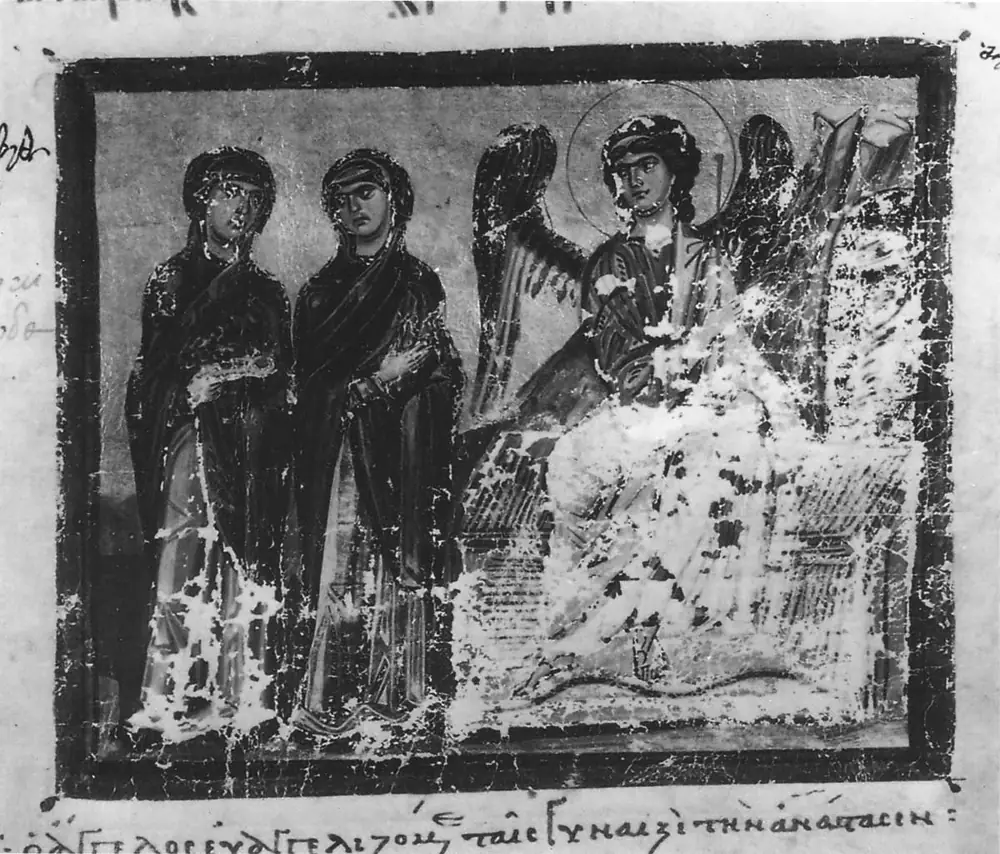
The Sunday of the Myrrh-bearing Women
Today is the feast of a woman's heart… Why do we call it especially blessed today?.. The holy myrrh-bearing women loved the Lord with all their hearts; they followed Him, listened to Him, served Him… Why after the Resurrection did He appear first to them and not to the Apostles? How does a woman's heart differ from a man's? A man's heart is often coarse, hardened and even cruel… while a woman's heart is warm and full of love… To understand this we must know that our heart is the highest organ of knowledge… The heart of women comes to know all that is exalted, mysterious and holy far more easily than the coarse heart of a man… The Lord knew the heart of men and the heart of women… He knew that the Apostles would believe in His rising from the dead with difficulty, and the myrrh-bearers easily and quickly… That is why He appeared to them before the Apostles…
The second Sunday after the Lord's radiant Resurrection is the day of the commemoration of the myrrh-bearing women: Mary Magdalene, Lazarus's sisters Martha and Mary, Salome, Joanna, Susanna and others… The honour the Church gives them was granted them for the faithfulness and love they showed the Lord in the days of His Passion.
The Saviour's word stirred up malice and wickedness in the souls of the high priests of Jerusalem. The hatred reached Christ's disciples and followers too — after the Saviour was seized, the persecution of them began as well. “But take heed to yourselves: for they shall deliver you up to councils; and in the synagogues ye shall be beaten: and ye shall be brought before rulers and kings for my sake, for a testimony against them” (Mark 13:8), Jesus had told them even before He was seized. The sight of this raging hatred terrified the Apostles; fear crushed their firmness of spirit, and they chose to hide rather than show themselves to the frenzied crowd.
The Saviour was left alone in the hour of His utmost trial. “Behold, the hour cometh, yea, is now come, that ye shall be scattered, every man to his own, and shall leave me alone: and yet I am not alone, because the Father is with me” (John 16:32). Forsaken by men, He stood before Caiaphas, Herod and Pilate; He was alone when they beat and humiliated Him, when they set the crown of thorns on His head. There was no one beside Him. The blinded crowd preferred a robber to the Lord, and with the cry “Crucify him” passed sentence on the Messiah.
But at the crucifixion the Lord's faithful women stood with the All-holy Mother of God before the cross raised on Golgotha, and gazed at Jesus weeping. They did not fear the wrath of the Sanhedrin or the mercilessness of the crowd; they did not hide, nor forsake their Teacher in the hour of trial. In their hearts the all-powerful strength of love for the Lord had overcome the greatest weakness of man — fear.
The women were faithful to the Saviour to the end. When Joseph of Arimathea begged the body of the crucified Jesus from Pilate, they mourned with bitter tears the Saviour taken down from the cross, did not leave His body for a moment, and left it only when the entrance of the tomb was shut with a stone.
The women wished to pay the Lord the last honour and, according to the Jewish custom, to anoint His body with spices. And so, when the Sabbath was past, on the first day of the week, at dawn, they went to the garden of Joseph of Arimathea, where the body of Jesus lay. Mary Magdalene went before the devout women. The women took no account of danger; they were troubled only that they would not be able to move the stone that closed the door of the tomb. They did not know that the stone was already rolled away and the tomb empty. The miracle had already come to pass.
The sight of the empty tomb dismayed the women. They thought someone had hidden the body of Jesus. Mary Magdalene ran back to Jerusalem and told Christ's disciples. “They have taken away the Lord out of the sepulchre, and we know not where they have laid him” (John 29:4), she complained to the Apostles. She returned to the tomb with Peter and John, and after they had gone she went in alone. And she saw “two angels in white sitting, the one at the head, and the other at the feet, where the body of Jesus had lain” (John 29:12). “Woman, why weepest thou?” they asked her. “Because they have taken away my Lord, and I know not where they have laid him” (John 29:13), Mary answered. Suddenly she felt that someone was standing behind her, and turned. At first she did not know Christ; she thought He was the gardener and begged Him: “Sir, if thou have borne him hence, tell me where thou hast laid him, and I will take him away” (John 19:15). “Mary,” Jesus said to her. For the Magdalene all became clear. “Teacher…” she breathed, and fell at the feet of the Saviour risen from the dead.
So He who trampled down death by death appeared first to Mary Magdalene. From Mary the Apostles learned of the Saviour's radiant Resurrection. On that day the faint flame of the Christian faith was lit in Jerusalem; it withstood merciless persecution, grew strong and shone forth, spread over all the world, and every spring millions of people, filled with joy, repeat the words first spoken by the holy Mary Magdalene, Equal to the Apostles: “Christ is risen! Truly He is risen!”
Prepared by Erekle Bibichadze, the journal Karibche, April 2004
“Now upon the first day of the week (at that time), very early in the morning, they (the myrrh-bearing women) came unto the sepulchre, bringing the spices which they had prepared, and certain others with them.”
So the holy Evangelist Luke begins his account.
Who were these women who hastened to the Lord's tomb early in the morning? They were the women who had come with Jesus from Galilee, as the Evangelist says (Luke 23:55). They always went with Jesus when He travelled round the towns and villages of Galilee preaching the Gospel. And now we see them in Jerusalem, where they had come up with Jesus and His Apostles for the feast of the Passover, and where they became witnesses of His Passion on the cross and His death. The time these women came to the Lord's tomb is marked by the holy Evangelist with the words “very early in the morning”, which means “at the break of day”. The other Evangelists, Matthew and Mark, mark this time more precisely. Comparing the accounts of these two Evangelists, it appears that the myrrh-bearing women came to the Lord's tomb just when day was breaking, and the first rays of the rising sun had coloured the east scarlet. The purpose of the myrrh-bearers' coming to the tomb was plainly to anoint the Lord's body with the fragrant spices they had prepared beforehand and were now bringing with them. Anointing the dead with spices was a custom of the Jews. The myrrh-bearing women had not been able to do this on the day of the Lord's death on the cross — on the one hand because the fury of the Jews against Jesus and His followers had not yet died down, and on the other because of the approach of the feast of the Passover, since at that time the Law forbade the doing of various everyday work. Yet what could be done before the festal rest began the myrrh-bearing women did: they marked the place where the body of Jesus was buried (Mark 15:47), and bought as many of the spices as they had time for (Luke 23:56), meaning to buy the rest the next day. Then the Sabbath came, which that year fell on the feast of the Passover, and the women had to wait for the next day again. And as soon as the time of the festal rest was over — that is, on the Sabbath evening, after sunset — they bought all the rest (Mark 16:1), and at dawn of the next day, which was the first day of the week, the “one of the Sabbath” (that is, our present Sunday), they set off for the Lord's tomb. By this time the obligatory festal rest was over, and the fury of the sleepless enemies of Christ's followers had subsided too. Their malice had fallen asleep, satisfied with the killing of Jesus, and the women could now carry out without hindrance their last duty to their dead Teacher.
Of this action of the myrrh-bearing women the blessed Theophylact writes: “They intend nothing great, nothing worthy of the divinity of Jesus, as they sit by the tomb with the spices they have bought; they wish, according to custom, to anoint the Teacher's body with them, so that it should give off no unpleasant smell, but that by the power of the spices, which would dry the body and absorb its moisture and wetness, the body might be kept from corruption. This alone was what the women thought of!” And this, of course, is natural and fits the truth. In any case it is wholly natural that their grief at the death of their Lord and Teacher made them forget every thought of Christ's rising from the dead, of which they had without doubt heard from Jesus Himself while He was still with them in Galilee (Luke 24:6–7).
“And they found the stone rolled away from the sepulchre. And they entered in, and found not the body of the Lord Jesus.”
From the very day of the Lord's burial the stone had been placed over the entrance of the cave where the body of Jesus lay. No doubt this was done so that beasts and birds of prey should not get into the tomb. Of course the myrrh-bearing women, when they left the tomb, knew of this stone, and knew too that it must be very large; so on the way they said to one another: how shall we roll the stone away from the entrance of the tomb? — a detail given only by the Evangelist Mark (16:3). And so, as soon as they came to the tomb, what first caught their attention was that, against their expectation, the great stone had been rolled away; but a still greater surprise awaited the women: when they went into the cave they did not find the body of Jesus, which had been laid here on the Friday evening, wrapped in linen.
“And it came to pass, as they were much perplexed thereabout, behold, two men stood by them in shining garments.”
The tomb of the Saviour
What the myrrh-bearing women saw when they came to the Lord's tomb naturally threw them into great confusion. But this was only the beginning of what they saw and heard here a little later: as the women stood astonished and wondering what could have happened, suddenly two men stood by them, clothed in shining raiment. It goes without saying that these were not ordinary men — as is plainly shown by the manner of their appearing, suddenly, in an instant, and by their radiant raiment — but dwellers in heaven who had taken the form of men, that is, angels of the Lord, as the Evangelist Matthew names them outright. The Evangelists give the number of the angels and the place of their appearing differently. Matthew speaks of one angel who sat on the stone that had been rolled away, while Luke does not mention that angel and tells us only what the myrrh-bearing women saw and heard inside the tomb. Mark mentions one angel; Luke speaks of two. By way of explanation it should be noted that there were several angels there. Some of the myrrh-bearing women saw one outside the tomb; others saw two inside the tomb; the rest saw one angel, also inside; and so the Evangelists give the angels' words about the Lord's rising from the dead with small differences, though their substance is one. The Lord's tomb — a cave that no doubt is kept in the same form to this day — is divided into two parts. Through a narrow door made on the east side we enter the first chamber. In its middle is a large square stone, part of the stone that the angels rolled away from the entrance of the tomb. Here too is a second, very low door, which leads into a cave hewn in the rock. There the body of the Saviour lay. So it was in these two chambers of the Lord's tomb that the different appearings of angels to the myrrh-bearing women took place then, on that Sunday. A certain Christian has said excellently of these differences in the Gospels: “O you cold-hearted seekers of contradictions in the account of the Gospel! Do you not see that the Evangelists are not counting the angels who appeared to the myrrh-bearing women? The whole of the Lord's tomb, the ground round about the cave, was full of angels, of unseen ranks of the dwellers in heaven. There were not three angels there but thousands, and it was not always one and the same angel, or always the same two angels, that appeared to the women! But now one, now two, now in one place, now in another; now they spoke to them one thing, now another — one and the same in substance and in agreement, though with small differences in the details of the event.” And indeed we must suppose that here too, as in many other places, they do not describe the event whole, but give this or that side of it, this or that detail; and it is quite possible that other details remained which they did not mention. So even from all their accounts together we still do not have a completely full account of the event. And when one tells of one particular side of an event, another of another, and the third and fourth of what the others left out, the holy Evangelists do not, of course, contradict one another, but complete one another.



