
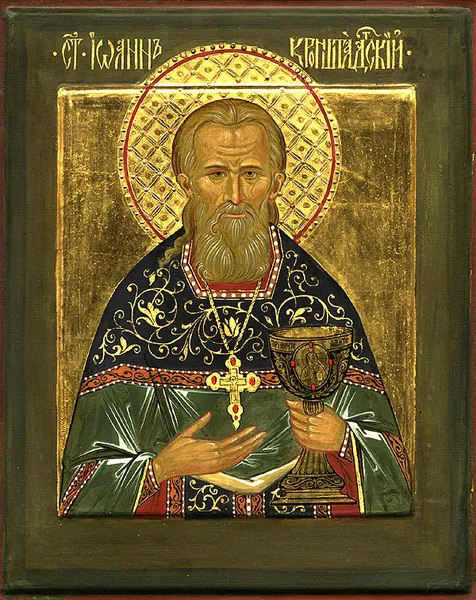
St John of Kronstadt (+1908)
Saint John of Kronstadt was born on 19 October 1829 in the village of Sura in the Pinega district, into the poor family of the reader of the local church. The newborn was so weak that his parents did not even think he would live until morning, and so he was baptised that same night.
The saint learned to read and write at home, and at the age of ten was sent to the local school. At first the boy found learning very hard, but by God’s mercy afterwards everything went well.
In 1851 John finished the theological seminary and went on to study at the St Petersburg Theological Academy. At the same time he worked as a clerk in a chancery, and with the small sum he earned there he helped his widowed mother. In 1855 the saint also finished the academy with the degree of candidate of theology; that same year he married Elizabeth, the daughter of Archpriest Nesvitsky of Kronstadt, and then was ordained priest and began his ministry in the Cathedral of Saint Andrew the First-called in Kronstadt.
Kronstadt was a very poor town. The saint went gladly to the hovels of the poor, talked with them, comforted them and helped them: he often brought a doctor to a sick person himself and brought the medicines himself, and gave bread to the hungry and the infirm. And little by little the people came to set great hope on the venerable father. Every morning a countless number of vagrants waited for alms from his hand, and he gave everything away without self-interest. It often happened that Saint John gave his boots to someone in need and went home barefoot. “I am a priest. That means there is nothing to discuss: I belong not to myself but to others,” the blessed one would say.
“A Christian outside the Church, like a fish without water, cannot live a true life: the Church is his element,” wrote the righteous John; “those who are torn away from the Church and divine worship become the victims of their own passions and perish.” The holy father celebrated the Divine Liturgy every day and every day received the Body and Blood of Christ. During the services he hardly ever opened the service book, but prayed by heart. His supplication had wonderful power. The blessed one also read, sang and conducted in the choir. At the proskomedia thousands of prosphoras were carried into the sanctuary in big baskets; a great many people asked the saint to commemorate their relatives and friends.
The righteous John was also a great benefactor: he generously accepted donations for building churches and parish schools and for other good works.
The holy father had been granted by God the grace of healing and clairvoyance. Through his prayer both the bodily sick and those sick in soul were healed. The blessed one helped the non-Orthodox too: he considered the healing of followers of other religions the best means of converting them.
The Lord’s chosen one foresaw the approach of his own end, received the Body and Blood of Christ, and on 20 December 1908 committed his soul to the Lord in peace. His body was carried with honour from Kronstadt to St Petersburg.



