
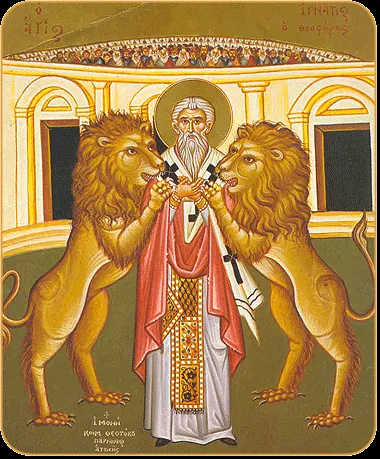
Hieromartyr Ignatius the God-bearer (+107)
The Hieromartyr Ignatius the God-bearer was born in Syria. The blessed one was that very child whom the Saviour set among His disciples, saying: “Except ye be converted, and become as little children, ye shall not enter into the kingdom of heaven” (Matt. 18:3). Later Ignatius became a disciple of Saint John the Theologian, and by decision of the council of the apostles was appointed Bishop of Antioch (the saint was the second hierarch of Antioch, after Evodius, one of the Seventy Apostles). For four decades the Lord’s chosen one laboured for the Church of Christ with apostolic zeal. Once Saint Ignatius was caught up into heaven and in a divine vision saw two choirs of angels praising the All-holy Trinity in turn. After this he introduced antiphonal singing into the Church of Antioch, and little by little it became established in other Christian Churches too. During the persecution of the Christians the hierarch strengthened his flock, and himself burned with the desire for martyrdom. His flock loved their hierarch greatly and called him “the God-bearer”.
In 106 the Emperor Trajan (98–117) ordered pagan sacrifices to be held throughout the country to celebrate his victory over the Scythians, and Christians who refused to worship the idols to be put to death. In 107 the emperor, on his way to campaign against the Armenians and Parthians, passed through Antioch. To protect the Church of Antioch from persecution and plunder, the holy hierarch presented himself to the lawless ruler of his own accord. Trajan tried hard to persuade the blessed one to offer sacrifice to the idols, but could do nothing. Then the enraged emperor ordered Saint Ignatius to be thrown to the lions in Rome to be torn to pieces. The hierarch met the sentence with joy.
The blessed Ignatius, together with other imprisoned confessors, was sent off to the place of execution escorted by ten soldiers. On the way the holy hierarch endured a great many humiliations and sufferings. In the city of Smyrna the Lord’s chosen one met his friend, Bishop Polycarp of Smyrna. Representatives of the other Churches of Asia also came here to visit the confessor, comfort him and show their love for him.
Ignatius the God-bearer saw how the Orthodox sympathised with him and grieved over his approaching end, and he was afraid that the Roman Christians might wish to rescue him. So the saint wrote them a letter, in which he said: “I fear your love, lest I be overcome by it. Willingly shall I die for God, if only ye hinder me not. Wherefore I beseech you, show me no unseasonable kindness, but suffer me to become food for the beasts, through whom it shall be granted me to attain unto God.”
The Roman Christians met the Lord’s chosen one with great joy. Saint Ignatius knelt down with hope and together with the other believers prayed fervently for the Church, for love among one another, and for an end to the persecution of the Christians. On 20 December, on a pagan feast day, Ignatius was led out into the arena of the circus. He addressed the Romans gathered there: you know that I am being put to death not for any evil deed, but because of my one God, whose love possesses me and towards whom I hasten: “I am the wheat of God, and I am ground by the teeth of wild beasts, that I may become the pure bread of God.” No sooner had he spoken these words than the furious beasts were let loose. According to tradition, Saint Ignatius, on his way to death, repeated the name of Jesus Christ without ceasing. When he was asked why he did this, the blessed one answered: I bear this name in my heart, and Him who is imprinted in my heart I confess with my lips too. When the lions had torn the saint to pieces, his heart was found unharmed. The pagans cut it open and saw that on its inner sides “Jesus Christ” was inscribed in golden letters.
When Trajan learned of the hierarch’s wonderful end, he stopped the persecution of the Christians. The holy relics of the Lord’s chosen one were translated to Antioch (for this, see the reading for 29 January), and afterwards were brought back again with honour.



