
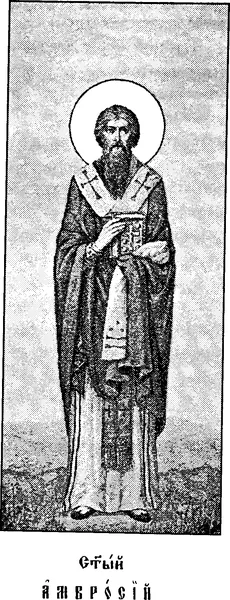
St Ambrose, Bishop of Milan (+397)
Saint Ambrose of Milan was born in 340 in the city of Trier (Gaul). His father was the emperor’s deputy in the region of Gaul (present-day France) and other western provinces. Ambrose’s election by God was miraculously made known while he was still an infant: once the face of the sleeping baby was entirely covered by bees, which left honey on his tongue.
After his father’s death Ambrose’s family moved to Rome. Here the future hierarch received what was for that time a brilliant legal education. Around 370, after completing his course of studies, the saint was appointed governor of the regions of Liguria and Aemilia. In 374 Auxentius, Bishop of Milan, died. This caused a sharpening of relations and unrest between the Orthodox and the Arians, since each side wished to raise its own representative to the widowed see. The prefect of Rome charged Ambrose with calming the disorder. On arriving in Mediolanum (present-day Milan), Ambrose went at once to the cathedral church, where the election of the hierarch was under way, and urged those gathered to calm down and settle the disputed question peacefully. In the silence that fell for a moment in the church, a small child’s voice suddenly rang out: “Ambrose is bishop!” The people took up this cry, and everyone, Orthodox and Arians alike, shouted with one voice: “Let Ambrose be bishop! Ambrose is bishop!” Ambrose was alarmed, for he considered himself entirely unsuited to this rank. He reminded those gathered that he had not even been baptised yet, but had only been made a catechumen; he tried to create a bad impression of himself among the people. He even tried to flee the city, but the people would not give way. At last they appealed to the Emperor Valentinian the Elder (364–375) for help. Ambrose did not dare to disobey him and was forced to agree. The blessed one was baptised, passed through all the degrees of the church hierarchy in seven days, and on 7 December 374 was consecrated Bishop of Milan. As soon as he was enthroned in the see, Ambrose gave away all his property for the furnishing of churches and the support of orphans and the poor, and himself took up a strict ascetic life: he celebrated divine services every day, instructed his flock wisely and with love, and shared his people’s sorrows and joys. The hierarch Ambrose laboured diligently for the unity of the Church.
Saint Ambrose also intervened actively in affairs of state. For example, at the holy hierarch’s direction the Emperor Gratian (367–383) removed from the hall of the Roman senate the altar of Victory, on which oaths used to be sworn. Full of a chief shepherd’s boldness, the hierarch imposed a severe penance on the Emperor Theodosius I (379–395) for the slaughter of the innocent inhabitants of Thessalonica. For the saint there was no difference between a king and a simple layman: after lifting the penance he did not let Theodosius into the sanctuary, and made him wait with the people for the bringing out of the Holy Gifts. Ambrose sternly denounced the Arian Empress Justina.
The hierarch’s severity was joined with wonderful kindness and compassion. Granted the gift of wonderworking, he healed many of their illnesses.
Once, in Florence, the Lord’s chosen one raised a dead child to life. Saint Ambrose foresaw the approach of his own end and said to his clergy: “I shall remain with you only until the radiant Resurrection of the Lord!”
Shortly before his death the ailing hierarch was dictating commentaries on the forty-third Psalm to his disciple, the presbyter Paulinus. Suddenly Paulinus clearly saw the Holy Spirit in the form of fire descend upon Ambrose’s head and vanish between his lips.
On 4 April 397, on the night of Pascha, the blessed Ambrose received the holy Body and Blood of Christ from the hand of Bassianus, Bishop of Lodi, and committed his soul to the Lord in peace.
Saint Ambrose is also known as a church writer. To him belong five books on the faith, three books on the Holy Spirit and two on repentance; an exposition of the Creed, and discourses on the Saviour’s becoming man and on the holy Mysteries. In his works on Christian morals the saint shows clearly the superiority of Christian moral teaching over pagan moral teaching. The hierarch’s famous work “On the Duties of the Clergy” bears clear witness that he had a profound understanding of the rights and duties of pastors.
The blessed Ambrose was also a reformer of church singing. In imitation of the eastern, Syrian Church he introduced into the Western Church antiphonal singing, which is known as the “Ambrosian chant”.



