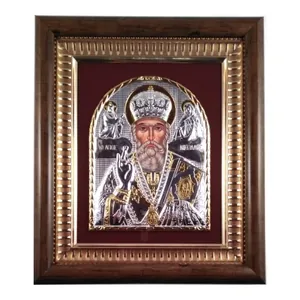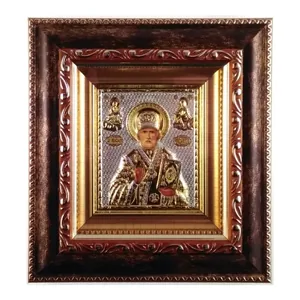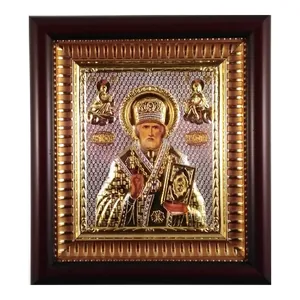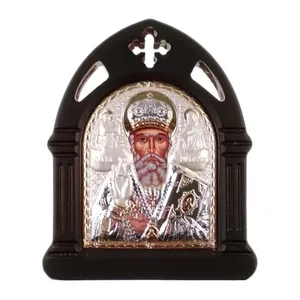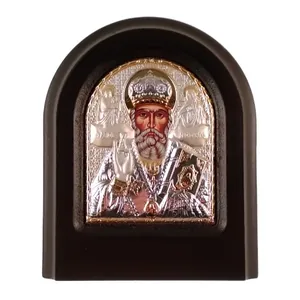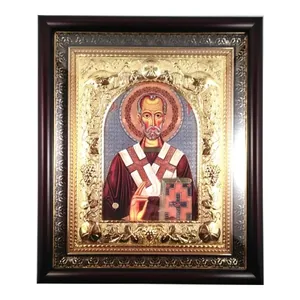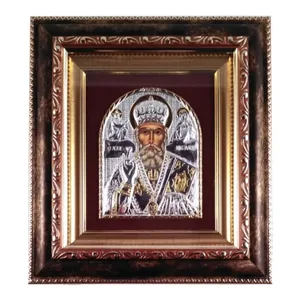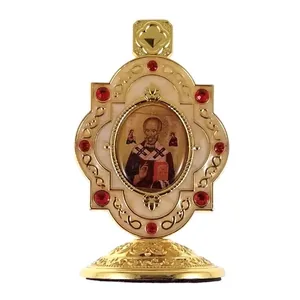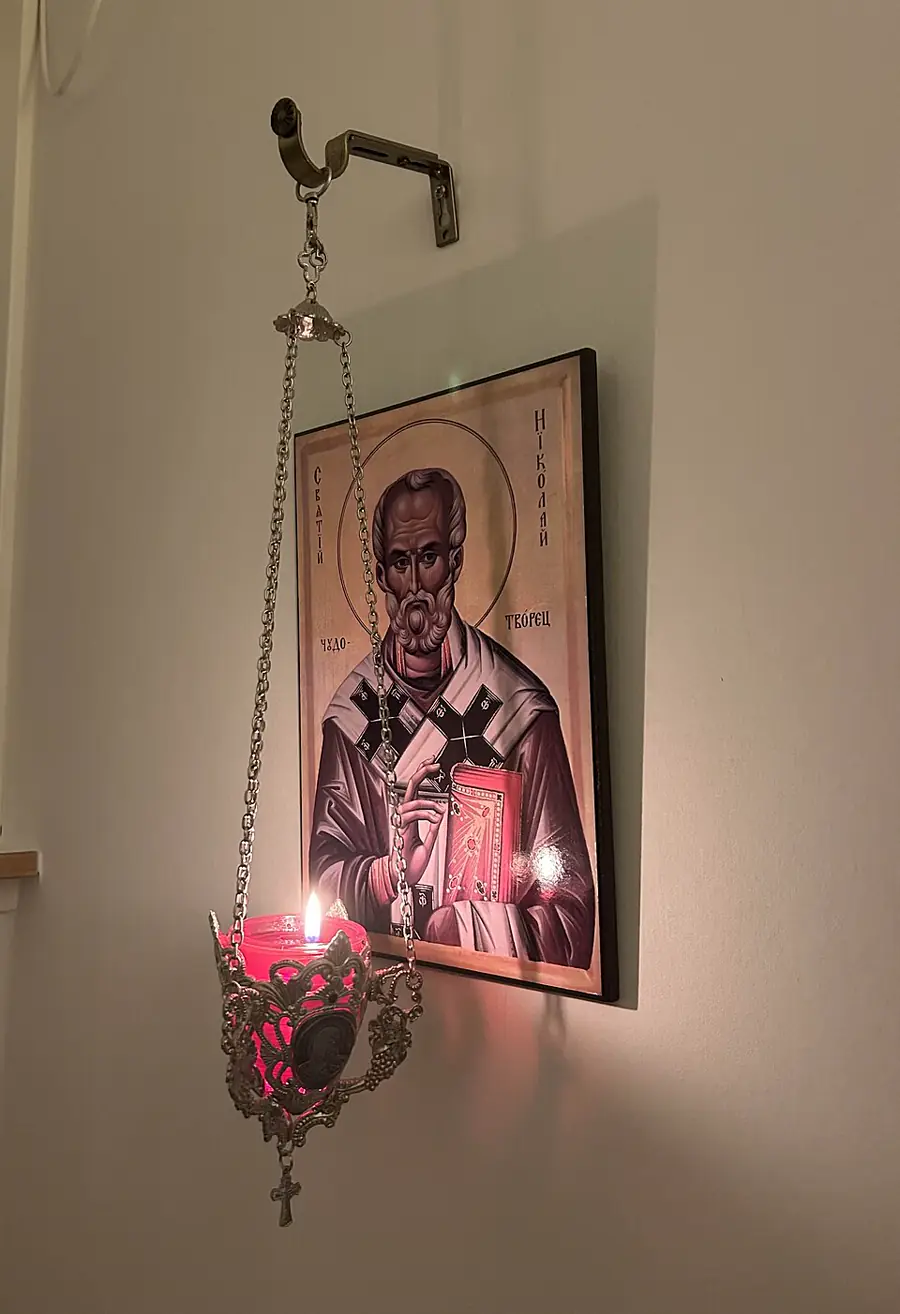
St Nicholas the Wonderworker, Archbishop of Myra in Lycia (+c. 345)
Saint Nicholas the Wonderworker, Archbishop of Myra in Lycia, was born in the city of Patara in the region of Lycia (on the southern coast of the peninsula of Asia Minor). His pious parents, Theophanes and Nonna, were for a long time not granted a child, and they fervently besought the Lord to give them an heir, making a vow that if their request were granted they would dedicate the longed-for child to the Lord. At last the prayer offered with a sincere heart was heard, and Nonna bore a son, who was named Nicholas. The saint worked his first miracle as soon as he was born: after giving birth his mother was healed of a long illness. At his baptism the newborn child stood on his feet in the font without anyone’s help. Saint Nicholas began to fast in infancy too: on Wednesdays and Fridays he took his mother’s milk only once, after his parents had completed their evening rule of prayer.
From childhood Nicholas was trained in Holy Scripture; by day he was in church, and by night he prayed and read the holy books. The saint’s uncle, Bishop Nicholas of Patara, who greatly rejoiced at his nephew’s spiritual progress and fear of God, first made him a reader and then ordained him priest. On the day of his ordination the hierarch, filled with the grace of the Holy Spirit, pointed his flock to Saint Nicholas and said: “Brethren! I see a new sun rising over the earth for the consolation of all who mourn. Blessed is the flock whose shepherd he shall become.”
His uncle made the blessed Nicholas his assistant and charged him with preaching to the people. Distinguished by remarkable faith and good sense, the young man inspired deep respect among the faithful.
Saint Nicholas was exceedingly compassionate: after his parents’ death he spent all his property on the poor. Once a very well-to-do man lost all his wealth and, to escape from extreme want, decided to give his three grown daughters over to a house of ill fame. When the hierarch learned of this, he was horrified; at night, secretly, he threw three purses of gold in through the man’s window, and saved the family from ruin and spiritual perdition. Saint Nicholas always tried to do his good deeds quietly. He wished them to be known to the Lord alone.
Once the Bishop of Patara set out on pilgrimage to Jerusalem and entrusted the care of the flock to the blessed Nicholas. The Lord’s chosen one fulfilled this obedience with love, and after the hierarch’s return asked for a blessing to go on pilgrimage to the Holy Land.
On arriving in Jerusalem Nicholas went first of all to Golgotha, and then visited the other holy places connected with Christ’s earthly life. When the father went up Mount Zion at night, the locked doors of the church opened before him of their own accord. At last the blessed one decided to go out into the desert to labour, but a heavenly voice stopped him and commanded him to return to his homeland. Seeking solitude, the venerable father entered the brotherhood of a monastery in Lycia called Holy Sion; but the Lord again showed him that this was not the field of labour prepared for him, and commanded him to go out into the world. In a divine vision the Saviour handed the blessed one a Gospel bound in a precious cover, and the Most Holy Theotokos an omophorion.
At that time the archbishop in the city of Myra had died, and the election of a new hierarch was under way. The bishops gathered from various cities had given themselves to strict fasting and intensified prayer before this important event. Then the Lord appeared to one of them and commanded him to stand at the doors of the church at night: “The first who comes in is My chosen one; his name is Nicholas.” Meanwhile the blessed Nicholas came to Myra, and that night, as was his custom, went to the church to hear Matins. When the bishop standing at the doors learned the name of the first to enter the church, he took him by the hand and set him among the other hierarchs who had gathered there awaiting the Lord’s chosen one. The news of what had happened quickly spread through the city, and very soon a countless multitude of people thronged to the church. “Receive, brethren, your chief shepherd, whom the Holy Spirit Himself has anointed and to whom He has entrusted the care of your souls; who has been appointed not by an assembly of men, but by God’s own providence!” said the bishop, inspired by the heavenly vision, to those gathered.
Even after his appointment as helmsman of the Church of Myra in Lycia, Saint Nicholas continued his ascetic life and gave his flock an example of humility, meekness and love for mankind. Meanwhile the Emperor Diocletian (284–305) began a cruel persecution of the Christians. Saint Nicholas did not waver: he went on boldly preaching the word of God, for which he was seized and thrown into prison with other Orthodox believers. Here he was shut up for a long time; he bore his sufferings patiently and strengthened his fellow prisoners. At last the persecution ceased. The holy Constantine the Great, Equal to the Apostles (306–337), ascended the throne, after which the blessed chief shepherd returned to his flock.
In 325 the saint took part in the First Ecumenical Council, which adopted the Nicene Creed. It is related that Saint Nicholas, drawn into theological debate with Arius, could not bear to hear the heretic’s blasphemous words, and in the presence of the whole assembly struck the foul heretic with his staff. For this the saint was deprived of his rank; but several fathers of the council saw in a divine vision that on one side of the blessed one stood the Saviour with a Gospel in His hand, and on the other the Theotokos with an omophorion, and, because of the divine vision, the Lord’s chosen one was restored to the dignity of hierarch.
Saint Nicholas worked many miracles in his lifetime. Of these the blessed one became especially famous for saving three men unjustly condemned to death by a money-loving head of the city. Strengthened by the grace of the Holy Spirit, the hierarch rushed boldly at the executioner, snatched the already raised sword from his hand and threw it to the ground. The head of the city, convicted of injustice by Saint Nicholas, fell into repentance and asked forgiveness. These events were witnessed by the military commanders Nepotian, Ursus and Herpylion, sent by the Emperor Constantine to put down unrest in Phrygia. At the time it did not even occur to them that they themselves would soon need Saint Nicholas’s help. When the commanders returned victorious from Phrygia, other generals, moved by envy of them, accused them of preparing a conspiracy against the royal throne and denounced them to the emperor. The enraged Constantine ordered Nepotian, Ursus and Herpylion to be arrested at once and put to death. Shut up in a cell, the desperate condemned men remembered the holy hierarch of Myra in Lycia and with fervent prayer begged his intercession. The supplication offered with a sincere heart did not go unanswered: Saint Nicholas appeared to Constantine in a vision in his sleep and commanded him to release the unjustly imprisoned commanders.
The hierarch Nicholas reached a deep old age and reposed in peace between 345 and 351. His myrrh-streaming holy relics were placed in the local cathedral church and healed many sick people. In 1087 this holy treasure was translated to the Italian city of Bari (see the reading for 9 May).
Even after his repose Saint Nicholas works countless miracles: “No one is able to number them: how many sick he hath healed, or how many possessed he hath set free, and how many in affliction he hath swiftly helped, and those shut up in prison and grieving he hath at once delivered, and to how many shut in by the sea and given up for lost he hath swiftly become a helper and deliverer, and to how many in the desert who call upon him he hath appeared, and to wayfarers he hath become a fellow traveller and a guard.”
“Lives of the Saints”, vol. IV, Tbilisi, 2003.
The extended version of the Life of St Nicholas