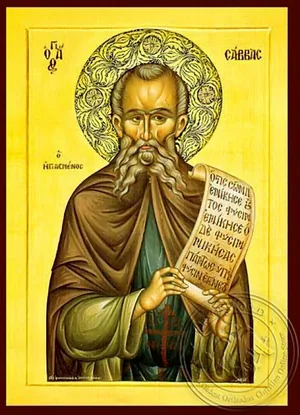
Venerable Sabbas the Sanctified (+532)
The Venerable Sabbas the Sanctified was born in the fifth century in Cappadocia, into the family of the pious Christians John and Sophia. The saint’s father was a military commander. Once he was sent to Alexandria on official business and took his wife with him. They left their five-year-old son with his uncle to be brought up.
Time passed. Strife and enmity broke out among the saint’s relatives over his father’s property, but Sabbas, who had loved the Lord from childhood, counted it all vanity and took refuge in the nearby monastery of Flavianae. At that time he was eight years old. His relatives tried hard to bring the boy back to worldly life, but in vain.
The perceptive boy quickly learned Holy Scripture “and all the rule of monks”; at seventeen he became a monk, “humbled his soul with fasting, wore down his flesh with labour”, and surpassed all the monks in humility, obedience and devotion to divine service. For his holy life Sabbas was granted by the Lord the grace of working miracles.
After ten years spent in the monastery of Flavianae, Sabbas set out for Jerusalem, and from there went to the lavra of Euthymius the Great (commemorated 20 January). The Venerable Euthymius advised the saint to go to the monastery of Abba Theoctistus. The Lord’s chosen one answered humbly: “As thou commandest me, so will I do.”
Saint Sabbas remained in this monastery as a novice until the age of thirty, and after the death of the superior, Theoctistus, he settled in a cave near the monastery. Five days a week he ate nothing. He prayed and worked unceasingly, and on Saturdays and Sundays took part in divine services with the brotherhood and shared their meal. Some time later the saint was permitted not to come out of his seclusion at all, and so he spent five years in complete solitude.
The Venerable Euthymius followed the young monk’s labours attentively. And after Euthymius’s death (+473), Saint Sabbas settled near the monastery of the blessed Gerasimus (+475; commemorated 4 March) and “shone forth like a star in the desert of the Jordan”.
Once a radiant angel of the Lord stood before the blessed Sabbas and commanded him to settle in a cave by the gorge of Siloam. The ascetic obeyed the heavenly blessing. Sabbas’s new cell was hard to reach: he went up and down by a rope. Little by little disciples multiplied around the saint. First they built a small chapel, and then in a cave miraculously pointed out by the Lord with a pillar of fire they arranged a small church as well; cells were built too. So the Great Lavra came into being. For this monastery Sabbas composed the first typikon, known by the name “of Jerusalem”, which was afterwards adopted by all the monasteries of Palestine.
Saint Sabbas did not wish to be ordained priest, but the Lord’s will was otherwise: the archbishop summoned the saint to Jerusalem as if for some other, outside reason, and ordained him presbyter.
In imitation of Euthymius the Great, Saint Sabbas too used to go out into the desert during Great Lent. Once he caught sight of a small island in the Dead Sea and decided to spend the days of the fast there; but as soon as he set out towards it, by the devil’s machinations he “fell into a place of that sea, dark and fiery, and a flame came forth from it and burned his face and beard”, and he lay unconscious for several days; then the Lord helped him and strengthened him, but his singed beard never grew again after this, and he remained beardless. “An angel on earth and a man of heaven, a wise and faithful teacher”, Saint Sabbas was a tireless ascetic. He “made the desert a city by the multitude of monks”: besides the Great Lavra he founded six more monasteries.
The Lord’s chosen one fought courageously to defend the purity of the Orthodox Church. For example, the heretic Severus found great favour with the lawless king Anastasius and was appointed Bishop of Antioch. When Saint Sabbas heard of this, he went to Jerusalem accompanied by the monks who laboured in the desert, and publicly anathematised Severus and his heretical teaching: “Anathema be to Severus and to those that communicate with him!”
Anastasius sent a detachment of soldiers to Jerusalem, deposed Elias, the Orthodox hierarch there, and put in his place John, who was inclined to heresy. Sabbas and the other desert fathers gathered in Jerusalem again and again publicly anathematised the heretics. Anastasius decided to drive the fathers who championed Orthodoxy out of the city, but “all the monks of the desert” rose up to defend their leaders and forced the godless ruler to calm his wrath.
The blessed Sabbas lived an exceedingly ascetic life. The valiant ascetic was also an experienced teacher. Once he was walking with one of his disciples from Jericho towards the Jordan, when they met some lay people, and among them a beautiful woman. The saint wished to test his disciple and said to him: “How beautiful is this woman who hath passed by, and she is one-eyed.” The disciple replied: “No, father, she hath both her eyes.” The elder repeated: “Verily, my son, she is one-eyed”; but the disciple insisted: “She is not one-eyed, but is very beautiful in her eyes.” Then Sabbas said: “And where is it written that thou shouldst fix thine eyes upon her and look at her with thine eye? For it is as a consuming fire.” For his unguarded eyes the blessed one punished his disciple, drove him out of the cell, and took him back only after he, filled with sincere repentance, “had greatly afflicted himself”.
Saint Sabbas was a strict faster: throughout the whole fast he took no bread, yet showed not the slightest weakness; “many times he endured the burning heat, and all the days of his life he passed the weeks in fasting”; but if a guest came and they broke the fast, “he would eat twice in the day, and be filled and more than filled, and out of love his stomach took no harm”. Once, while visiting Archbishop John, Sabbas, as was his custom, is said to have accepted with a simple heart everything that was offered him, “and for God’s sake questioned nothing”. Then Theodosius the Great jested lovingly with John and his brother, Bishop Antony of Ascalon: “Ye two, who after God have fed all Palestine in the time of famine, I marvel how ye have filled this one with food.” In answer the archbishop is said to have replied: “Forgive us, fathers, for we can bear neither hunger nor fulness; but this man of God hath the grace of the apostle: he knoweth both how to be abased and how to abound, he knoweth fulness and hunger, abundance and want, and in all things he is strengthened by the power of Christ.”
Granted by the Lord the gift of wonderworking, Saint Sabbas worked many miracles: through his prayer a spring welled up in the desert, heavy rain came down during a terrible drought, many sick and possessed people were healed, and many escaped mortal danger. Even wild beasts obeyed and served the blessed father without resistance, and often they too received healing from him.
Saint Sabbas foresaw the approach of his own end: having fallen ill, for four days he “tasted nothing, nor spoke with anyone”, and on Saturday evening he received the Body and Blood of Christ, and on 5 December 532 committed his soul to the Lord in peace.