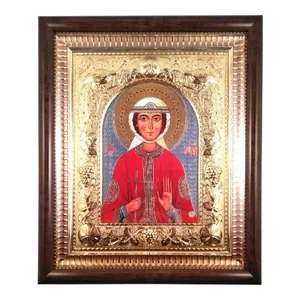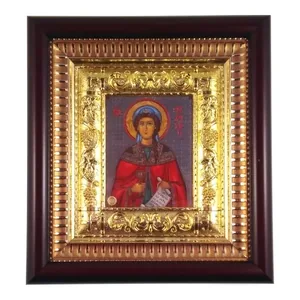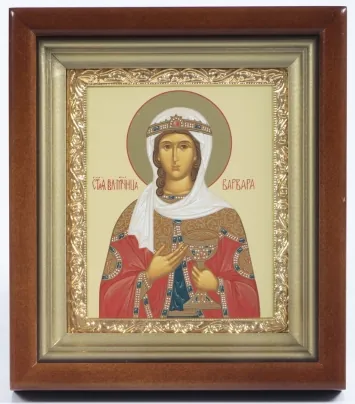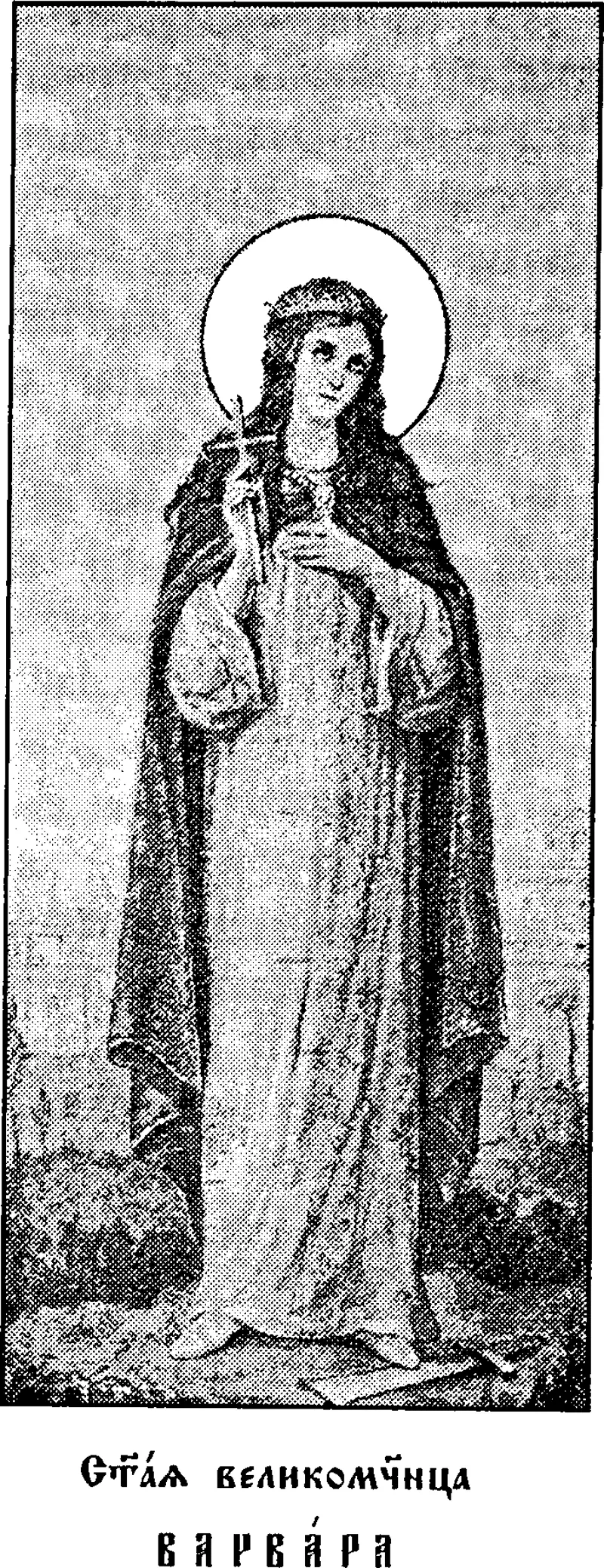
Holy Great Martyr Barbara and the Martyr Juliana (+c. 306)
In the time of the lawless Caesar Maximian (4th century) there lived in the Phoenician city of Heliopolis a rich man of distinguished birth named Dioscorus. He was a pagan and worshipped idols. Dioscorus had an only daughter, Barbara, whom he doted on, pampered and guarded like the apple of his eye. Barbara’s mother had died early.
Barbara grew up and became so beautiful that no one could compare with her in loveliness. Dioscorus considered that common, immoral people were not worthy to see her, and so he built a high tower, shut the girl up in it, and assigned faithful servants and maids to her.
Barbara lived shut up in the tower, finding relief only in contemplating the divine beauty of nature. She felt that the maker of this extraordinary beauty must be an almighty being whom no one could surpass in wisdom, goodness and virtue, and she wished to learn who was the beginning and cause of all things. Her heart told her that the Creator of the world must be one, and not many, as her pagan tutors taught.
Once, when her whole being was seized by an especially strong desire to see the Creator, she felt an unknowable divine grace, enlightening the mind and heart, pour over her, and Barbara exclaimed: “No! God must be one, not made by hands, and Himself the Creator of all things.”
Shut up in the tower, she longed with all her heart and soul to have beside her a teacher of the true way, but there was no such person around her, and God Himself, who is “not far from every one of us” (Acts 17:27), became her teacher and guide. Little by little the maiden was filled with the Lord’s grace and grew strong in spirit; one love burned in her heart, the true love, the love of God, and she gave no thought to marriage, nor to costly clothes and ornaments, nor to earthly well-being at all.
But Dioscorus greatly wished to marry off his daughter; once he raised the matter with her and proposed that she choose, as she wished, someone to her liking from among the many who sought her hand. But the maiden answered sternly: “Knowest thou not, father, that this world is of no use to me?”
Having received a firm refusal from Barbara, her father decided to give her somewhat more freedom, in the hope that after getting to know other people and their way of life she would herself wish to marry. Dioscorus ordered a rich bath-house to be built for Barbara, which was to have two windows as a sign of the worship of the sun and the moon.
A little later Dioscorus had to travel far away on business. Now free, Barbara got to know some Christian maidens, from whom she heard the name of Jesus Christ, His teaching, His miracles, His Crucifixion and Resurrection. Barbara longed with her heart to become a Christian, and lo, by God’s will, a presbyter came to Heliopolis from Alexandria; she invited him to her, talked with him openly, confessed the Christian teaching with her heart, and was baptised.
After this Barbara was continually in fasting and prayer; she made a vow of purity and virginity and offered herself to God.
Once Barbara was walking in the garden where the bath-house was being built by her father’s order. Barbara went up, traced a cross on the marble with her finger, and behold, a miracle! Water gushed out there, which afterwards healed many sick people and worked many miracles. The cross remained as if carved in the marble, and Barbara’s footprint remained too.
Barbara saw the two windows and asked the builders to cut a third as well, so that the Trinity of God might be imprinted in the work of human hands. But at first they refused, for they were afraid of Dioscorus. Then Barbara instructed them thus: “Do as I have told you; and when my father cometh, and when he asketh you why ye opened the third window, answer and say unto him: Thy daughter willed that there be three windows.” After this the builders cut the third window too. Barbara returned to her tower. On the way she caught sight of the idols that her father worshipped. Filled with the Holy Spirit, the maiden said: “Like unto you be they that make you, and every one that trusteth in you.”
A few days later Dioscorus returned from his journey. When he visited the bath-house, he angrily asked the builders the reason for cutting the third window. And they answered in fear that they had done it at Barbara’s insistent demand.
Dioscorus was surprised and asked his daughter to explain what she meant by the three windows. And she answered: “The two are of the One, and from them we look for life, mercy and forgiveness of sins.” “Let me make it known unto thee, father, and teach thee justice from injustice, and lead thee out of darkness into light.” ... “I desire thy turning unto the truth; knowest thou not that those three windows are they that give light to the whole world”, “these are the three that give light to the whole world”, “these three are the Father, the Son and the Holy Spirit”.
Dioscorus changed colour; he grew angry and furious, the devil took hold of him, he drew his sword and wanted to cut off his daughter’s head. Barbara managed to flee; she left Heliopolis and took refuge in a cave near the city. Her father searched for her everywhere. At last he came to the mountain where Barbara was.
Dioscorus dragged his daughter down from the mountain by her hair, locked her up in the house and set guards over her, so that no one should go in to her. He himself went to Martian, the governor of that country, and, his mind darkened, reported that his only daughter had been won over by the Christians and converted to their religion, and so she deserved death by torture.
Martian ordered Barbara to be brought to him. When Barbara learned that she was being taken to the governor, she asked God for help.
Barbara was brought to Martian. Amazed at the maiden’s beauty, the governor tried to win her over with sweet words; he coaxed her and advised her to repent of her apostasy from the gods and to offer sacrifice to them as a sign of obedience. And in case of resistance he threatened her that she would be punished most severely.
Barbara answered him: “Knowest thou not, O godless one, that I am of the law of Christ; and thy gods, as the Prophet David said: Mouths have they, but they speak not; eyes have they, but they see not. They that make them are like unto them; so is every one that trusteth in them.”
This answer enraged Martian, and he ordered the maiden to be beaten with leather whips. Blood flowed from Barbara like a stream. Martian thought she had died. Then she was thrown into prison and guards were set over her.
At midnight a light shone forth, the cell was lit up, and Christ God appeared with angels to the holy maiden, healed her beaten body, cured her wounds, and said to her: “Barbara, My martyr, heaven and earth greatly rejoice at thy festival, while thou art fearful of that lawless judge whom the devil hath strengthened. But I will stand by thee and deliver thee from every evil that shall befall thee.”
Saint Barbara was filled with joy; healthy and unharmed, she prayed and gave thanks to the Lord. In the morning Martian ordered the maiden to be brought on a stretcher, for he was sure that Barbara would not be able to walk. The servants came to fetch her and saw that she was standing on her feet and praying. Astonished, they cried out with one voice: “Great is the God of the Christians, and there is no other God greater than He, who hath strengthened her.”
Martian too was greatly amazed when he saw Barbara coming towards him on her own feet, without anyone’s help. The lawless and foolish governor attributed this miracle to the great mercy of his idol-gods, and advised the holy maiden to offer sacrifice now at least to the gods, who had dealt so mercifully with one who insulted them and had healed her after her beating.
When she heard this foolish exhortation, the maiden spat at the governor and said to him: “O lawless and foul one of the devil, behold, thou art blind, and thy gods are blind like thee, who can neither see nor help them that trust in them. How can they help me, who cannot help themselves? But Christ, who was crucified, was buried, and rose again the third day, as the Scriptures said, hath by His life-giving Cross strengthened me against thee.”
The servants who had tortured Barbara, on hearing these words, cried out with one voice: “We too believe in Jesus Christ of Nazareth, that there is no other God beside Him.”
Martian ordered them to be beheaded without delay. And indeed they were led out of the city and put to death. By this martyr’s end they inherited eternal life in heaven.
Then Martian ordered the maiden to be stripped and led about the city in this state.
With God’s help an angel appeared to Saint Barbara and covered her holy body with a spotless garment. The whole city turned out to see the naked maiden, but no one could see her nakedness.
Martian realised that the torment had done the maiden no harm; he was afraid that many citizens who saw this would be converted to the law of Christ, and so he ordered Dioscorus, Saint Barbara’s father, to take his daughter out of the city and cut off her head.
Dioscorus led his daughter away. When they reached the place where he was to put her to death, the holy maiden asked her father to show regard for his only daughter for the last time and to give her a little time for prayer. The lawless Dioscorus answered with laughter and scorn: “What art thou? Or who is thy God? Call upon Him as much as thou art able, that I may see whether He will come this day and deliver thee out of my hands.” Then Saint Barbara lifted up her hands to heaven.
No sooner had she finished her prayer than a voice rang out from heaven: “Come, holy Barbara, with thy sister Juliana, into the Kingdom of heaven. Behold, the angels rejoice at thy coming with them; and all that thou hast asked I have given thee, and more than this will I give thee.”
Hearing this greatly astonished Dioscorus and the others who were there, but Saint Barbara was filled with joy; she bowed her head to the sword and said to her father: “Now fulfil what hath been commanded thee, O godless one.”
The holy relics of St Barbara (Kiev)
Dioscorus brought down the sword and cut off Saint Barbara’s precious head. That same moment a terrible fire fell upon him from heaven and burned him up entirely; a fierce wind arose and scattered the ashes.
Martian too was punished in the same way: as he was entering his palace, lightning struck him, and not even dust was left of him.
The martyr’s holy body was brought down to Heliopolis by a pious citizen, Valentinian, who buried it with fitting honour and afterwards built a church on that spot.
The Great Martyr Barbara was counted worthy of the Kingdom of Jesus Christ on the fourth day of December (17 December New Style).
The holy relics of the Great Martyr Barbara were afterwards translated from Heliopolis to Constantinople, where they remained for quite a long time; and at the end of the eleventh century Barbara, the daughter of the Byzantine Emperor Alexius Comnenus, after her marriage to the Kievan Prince Michael Sviatopolk, translated them to Kievan Rus’. At present the holy relics are in the city of Kiev, in the Cathedral of Saint Vladimir, in the middle of a chapel, in a raised place. Many miracles are connected with her holy relics.
Saint Barbara is especially besought for the healing of children, for childbearing, and for protection from sudden death without Holy Communion.