
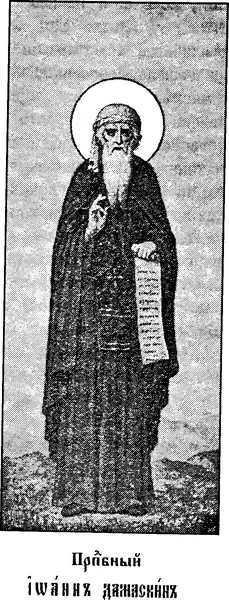
Venerable John of Damascus (VIII)
The Venerable John of Damascus was born in 680 in Damascus, the capital of Syria, into a family of Orthodox Christians. His father, Sergius Mansur, was treasurer at the caliph’s court. Besides John he also had an adopted son, Cosmas, who had been orphaned in early childhood. John and Cosmas received a brilliant education at home under the guidance of a monk from Calabria, also named Cosmas, whom Sergius had ransomed from captivity at the slave market of Damascus. The boys, and John especially, showed remarkable talent and easily mastered rhetoric, dialectic, philosophy, arithmetic, astronomy, music, poetry and Holy Scripture. So educated, John became the caliph’s first adviser after his father’s death, and also received the office of head of the city.
At that time the iconoclast heresy arose in Byzantium, and with the support of the Emperor Leo III the Isaurian (717–741) it began to spread rapidly. To defend the purity of Orthodoxy John wrote three treatises against the iconoclasts. The saint’s God-wise writings enraged the emperor, but since their author was not a Byzantine subject, he could neither arrest him nor put him to death. Then the lawless Leo resorted to slander: by his order skilled calligraphers wrote a letter in John’s handwriting, in which the Damascene minister supposedly promised the emperor his help in capturing the Syrian capital. The godless autocrat sent this letter to the caliph together with a letter of his own full of flattery and fawning. Without investigating the matter, and without giving the saint a chance to justify himself, the enraged caliph ordered the blessed one to be removed from office, his right hand to be cut off and hung up in the market square to frighten others. The severed hand was returned to John that same evening for burial, after which the saint fell down before an icon of the Theotokos and fervently besought the All-holy one to heal his hand. In this supplication John fell asleep. In a vision in his sleep the Queen of heaven stood before him and said to him: “Behold, thy hand is healed and eased of its pains; henceforth make haste to offer thy prayers unto God.” On waking the saint saw that the severed hand had indeed been joined to his arm at the wrist; he was filled with joy and gratitude and cried out to the Lord: “Thy right hand, O Lord, is become glorious in power: Thy right hand, O Lord, hath dashed in pieces the enemy” (Exod. 15:6). On the icon of the Theotokos before which he had been healed, John fastened a silver hand as a thank-offering (see the reading for 28 June).
When the caliph learned of the miracle that had taken place, he believed in his vizier’s innocence and restored his honour to him; but John, eager for the angelic life, resolved to break his ties with this world; he asked the ruler not to oppose his decision, and persuaded him.
Returning home, the Lord’s chosen one gave away all his property in alms, freed his slaves, and set out with Cosmas, with whom he had grown up, to pray in Jerusalem. Here, in the Lavra of Sabbas the Sanctified, John became a simple novice, but the hegumen found it very hard to find a spiritual guide for him: many did not believe that this man, famous for his birth and wisdom, would show the obedience fitting for a monk. At last there appeared an old, God-wise monk who declared that he would take on the care of John. The teacher took the saint to his cell and instructed him thus: “Boast not of the wisdom and knowledge that are in thee, nor of the learning thou hast learned; for the learning of monks is in no way inferior to it, but their philosophy is something far greater and higher.” Then the elder commanded his blessed disciple not to write even a letter to anyone without his counsel, and never to recall or speak of what he had read in secular books. John obeyed this blessing without murmuring. A little later the teacher decided to test his spiritual son in humility and charged him to take baskets made in the monastery to Damascus to sell. The elder set a price on the brothers’ handiwork far above its worth, and Saint John, a son of the best family in Damascus, dressed in rags like a beggar, began to sell the monks’ handiwork in the streets of his native city. When passers-by learned the price of the saint’s wares, they mocked him; but at last a former servant recognised him and, without making himself known, bought up all the baskets.
Time passed. A monk living in the Lavra of Saint Sabbas lost his brother, and asked John to compose something to comfort him. For a long time the saint refused, but at last compassion for his neighbour prevailed, and he wrote his famous troparia for the departed. “Truly all passing things are vanity, and this life is more fleeting than a shadow and a dream, for every one born of earth is troubled in vain,” we read in one of them. His spiritual son’s disobedience greatly angered John’s teacher, and he drove him out of the cell. The saint’s tearful entreaties were in vain, and the brothers’ intercession did not help either. Then one of the ascetics asked the teacher to correct the offender with a penance, and the latter charged John with cleaning all the unclean places of the monastery. The Lord’s chosen one set about the task given him with joy, and his spiritual father, seeing such humility and obedience in the blessed one, joyfully embraced him and forgave his sin.
That same night the Most Holy Theotokos appeared to the teacher and commanded him not to forbid John to write: “Henceforth bid him speak whatever he will, for the Comforter, the All-holy Spirit, shall speak by his tongue.”
When the Patriarch of Jerusalem learned about the venerable father, he ordained him priest and charged him with preaching in his cathedral church; but John, eager for the solitary life, soon returned to his monastery, and until his end composed God-inspired books and hymns. After this the blessed one left the lavra only once: in 754 he went to the local council of Constantinople and exposed the iconoclast heresy. For this he was thrown into prison and tortured, but by God’s will he survived. Saint John died around 780 (according to other information, before 754), at the age of 104.
To John of Damascus belong many hymns, theological works, and an epistle and an apology directed against the iconoclast heresy; among his works a special place is held by the “Fount of Knowledge”, which consists of three parts: “Dialectic” (“Philosophical Chapters”), “On Heresies” and “An Exact Exposition of the Orthodox Faith”. Among the hymns we should single out “In thee rejoiceth, O thou who art full of grace”, which he composed in thanksgiving for the miraculous healing of his right hand.
On icons John of Damascus is depicted with a cloth bound round his head. This is the cloth in which his severed right hand was wrapped, and which he afterwards wore bound round his head in remembrance of the great mercy of the Theotokos.



