
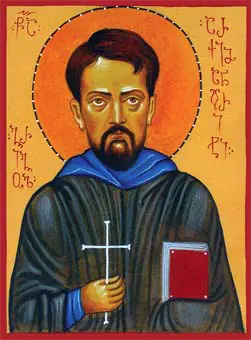
Holy Hieromartyr Archimandrite Grigol, Who Died in the Camp of Auschwitz (+1942)
The Hieromartyr Grigol Peradze was born on 31 August (13 September) 1899 in the village of Bakurtsikhe in the Sighnaghi district (now the Gurjaani district), into the family of the priest Romanoz Peradze and Mariam Samadalashvili.
In 1905 Father Romanoz died suddenly, and Mariam was left with three orphans to raise: Archil, Grigol and Vasili. Mariam found things very hard, and Grigol was taken in by his uncle, Giorgi Peradze, the pastor of the church at Kvareli.
When Grigol reached school age, his mother placed him in the Tiflis theological school. On finishing the school, Grigol began his studies at the theological seminary, whose rector at the time was the well-known scholar Korneli Kekelidze.
In 1918 Grigol enrolled in the faculty of philosophy of the newly opened University of Tiflis. At the same time he worked as a teacher in the village of Zemo Khandaki in the Gori district.
In 1919 Grigol was called up for compulsory military service in the army of the independent Republic of Georgia.
In 1921 Grigol returned to the university; that same year, when the Bolsheviks attacked Georgia, Grigol, together with his two brothers, joined the ranks of the defenders of the homeland.
In the autumn of 1921 the clergy of Gare-Kakheti sent Grigol Peradze as their representative to the church council held at Gelati. At the intercession of the Hieromartyr Nazari (Lezhava) and Korneli Kekelidze, this council decided to send Grigol to study in Europe.
In May 1922 Grigol Peradze became a student of the faculty of theology at the University of Berlin.
In 1925 Grigol transferred to the faculty of philosophy at the University of Bonn, where he deepened his knowledge of religion and of oriental languages, and received the degree of Doctor of Philosophy for his work “Questions of the Beginnings of Monasticism in Georgia”. From that time until 1927 he continued to study theology, attending lectures at the University of Louvain.
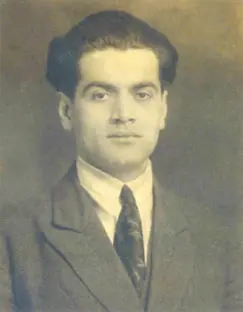
Grigol Peradze during his years of work in Europe
From 1927 Grigol Peradze did research in England, where he studied the most ancient manuscripts of the works of the Fathers of the Church kept in the libraries of the British Museum and of the University of Oxford. In July 1927 Grigol was appointed Privatdozent at the University of Bonn.
In 1932 Grigol was invited to Oxford to lecture on the history of the Georgian Church. In 1931 Grigol was tonsured a monk, was soon ordained priest, was raised to the rank of archimandrite and was given charge of the Georgian parish in Paris. In Paris Grigol Peradze founded the Georgian church of Saint Nino and the parish journal “Jvari Vazisa” (“The Cross of the Vine”).
In 1932 Father Grigol was elected professor at the Orthodox theological school in Warsaw. Grigol Peradze’s immense learning was joined to a deep faith. His lectures were imbued with the creative spirit of the Fathers of the Church. Father Grigol often read papers at scholarly conferences and at various academic centres in Europe. He spent all his means searching for Georgian church manuscripts and for information on the history of the Georgian Church in Syria and Palestine, Greece, Bulgaria, Austria, Romania, Italy and England. Through his labour and effort many Georgian manuscripts were discovered. Two qualities, love of work and humility, marked Father Grigol Peradze all his life long. Georgian society, with rare exceptions, knew almost nothing of his work.
At that time the treasures of the Georgian Church were kept in France, and through Grigol Peradze’s self-sacrificing action they escaped confiscation by the German fascists. As an expert, in spite of mortal danger, he stated in his report that this finest part of Georgian culture was of no material value whatever and had only a national value.
In May 1942 Father Grigol was arrested by the Gestapo in Warsaw. The immediate cause of his arrest was that Father Grigol had been helping and sheltering people of various nationalities persecuted by the fascists. Grigol’s flat was searched, and as a result the precious ancient manuscripts on which he was working disappeared, together with the precious church objects he had been acquiring on his travels in order to return them to Georgia.
According to official German records, Grigol Peradze died on 6 December 1942 at 16:45. Such is the certificate issued by the administration of the Auschwitz camp on 30 December 1942; and in the notes of the then representative of the Polish government at Auschwitz, concerning the events of December 1942, it is recorded: “Camp Oświęcim. Here died Grigol Peradze, brought here a few weeks ago, professor, theologian, Orthodox, Georgian, an eminent scholar.” As it turns out, Archimandrite Grigol, out of love for his neighbour, took upon himself a punishment meant for others and died in their place: the fascists killed him in the gas chamber.



