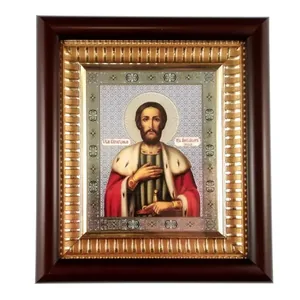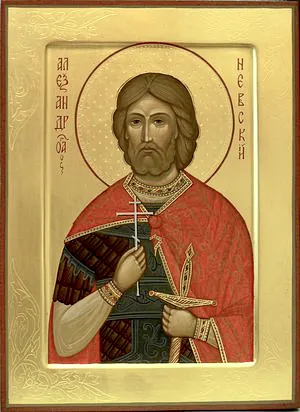
Right-believing Prince Alexander Nevsky (+1263)
The right-believing Prince Alexander Nevsky was the son of the Grand Prince of Vladimir, Yaroslav II. The saint was born in 1220. From his youth he took the Christian teaching to heart. The blessed one greatly loved the hymns of the Church and was always reading the writings of the holy fathers. All-night vigils and prayer to God were his favourite occupation. In 1236 Alexander was chosen Prince of Novgorod. Soon, in 1240, his principality was attacked by the Swedes, who were trying to establish themselves on the shore of the Gulf of Finland and to spread the Catholic faith there. Trusting in God, Alexander with a small force inflicted a crushing defeat on the countless enemy army on the banks of the River Neva, for which the people called him “Nevsky”. In 1242 the blessed one fought the German crusaders and, with the Lord’s help, won again.
Alexander understood well that at that time a clash with the Tatar-Mongols was senseless, and in his relations with the Golden Horde he kept to a careful, far-sighted policy. In 1250 he received the title of Grand Prince of Novgorod and did many good deeds for the Church and the country. By interceding with the khans the saint managed to free bishops and priests from the Tatar taxes. Saint Alexander was a firm confessor of Orthodoxy: when he first came to the Tatar camp, the priests demanded that he worship the idols. The Lord’s chosen one firmly refused and declared: “I worship only the one true God, Creator of heaven and earth, glorified in Trinity.” Batu Khan, who respected the Russian prince’s courage and wisdom, looked on his conduct with indulgence.
Pope Innocent IV offered the saint to accept Roman Catholicism, to which Alexander replied: we hold the teaching handed down from the apostles, and we do not wish to accept your teaching. In 1262 the people, oppressed by Tatar tyranny, rose in revolt. The enraged khan made ready an army to punish them. Alexander went to the Horde to soften the Tatar ruler’s heart, and he achieved this, but, worn out by long labours, he fell mortally ill on the way back. The dying prince was clothed in the schema with the name Alexis, received the Holy Mysteries, and on 14 November 1263, at the age of forty-three, committed his soul to the Lord.
On 23 November the holy body of the right-believing prince was buried with honour in the Monastery of the Nativity of the Theotokos in Vladimir. According to tradition, when the funeral service was being sung over the blessed Alexander, a miracle took place: as if alive, he stretched out his hand to receive the letter of absolution.
In 1380 the incorrupt relics of the God-pleaser were uncovered (the Church marks this event on 30 August).