
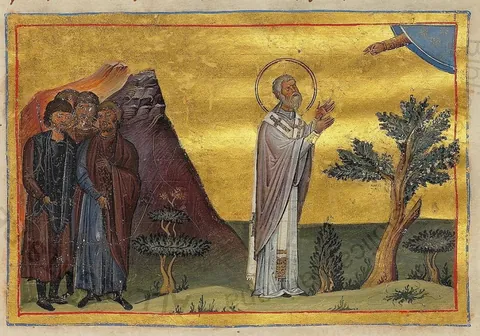
St Gregory, Bishop of Agrigentum (VI–VII)
Saint Gregory, Bishop of Agrigentum, was born on the island of Sicily, in the village of Praetoria near the city of Agrigentum, into the family of the pious Christians Chariton and Theodote. At his baptism his sponsor was Bishop Potamion of Agrigentum. His parents sent the perceptive child to school; he mastered reading, writing and singing so quickly that at the age of twelve the saint was enrolled in the ranks of the clergy. The blessed Gregory served for ten years in the Church of Agrigentum. Once, when the holy youth greatly desired to go on pilgrimage to Jerusalem, an angel appeared to him and told him that the Lord had blessed his intention.
In Jerusalem Saint Gregory was presented to Patriarch Macarius (563–574), who ordained him deacon and kept him to serve in his cathedral church. Here the blessed father found no peace: he longed for the harder labour of the monastic life. Patriarch Macarius blessed the God-loving young man in this too, after which he settled in a monastery on the Mount of Olives. After a year the Lord’s chosen one left the monastery and went to a desert-dwelling monk, who for four years diligently taught him the rules of the ascetic life. The hermit foresaw the young man’s future and blessed him to leave his seclusion.
Gregory stayed in Jerusalem for some time, and then set out for Constantinople, to the Monastery of Saints Sergius and Bacchus. The holy father’s ascetic life, spiritual experience and theological learning drew the attention of Patriarch Eutychius of Constantinople (552–565). At his request Gregory took part in the work of the Fifth Ecumenical Council (553). After the council had ended, the saint set out for Rome to venerate the tombs of the Apostles, Saints Peter and Paul.
When the Bishop of Agrigentum died, the senior clergy and leading citizens of the city appealed to the Pope of Rome with a request to appoint to the widowed see one of the candidates they put forward; but the pope rejected all the proposals made to him and appointed Saint Gregory hierarch.
Even in the rank of hierarch the saint lived the life of an ascetic monk. His flock loved their hierarch and trusted him, but the blessed one also had enemies, who resolved to stain his name with slander. While Saint Gregory was in church, the envious men secretly brought a bribed woman into his cell, and then, in front of the people who were accompanying the chief shepherd home after the service, they brought her out and accused Gregory of the sin of fornication. The holy bishop was arrested. The people tried to defend their hierarch, but in vain. At the trial the harlot came forward as a false witness against Gregory, but as soon as she had spoken the slanderous words she became possessed. Then the judges accused the saint of sorcery, sent with him a slanderous list of his “crimes”, and dispatched him to the Pope of Rome for judgement. When the helmsman of the Church of Rome had read the false accusations, he did not even wish to see the “culprit”, but ordered the Lord’s chosen one to be thrown straight into prison. The blessed one bore the humiliation without murmuring and prayed unceasingly. The report of his labour of prayer and his gift of wonderworking quickly spread through the whole city and region. Many pious Romans came to the Lord’s chosen one, and the imprisoned saint taught them to live righteously.
Two years later the monk Mark, who had the gift of clairvoyance and had known Gregory since his youth, came to the pope. He did not believe the slander and asked the pope to convene a special council to examine the saint’s case. At the pope’s summons many clergy of the city of Agrigentum came to the council; the holy hierarch’s slanderers came too, and among them the possessed harlot. From Constantinople three bishops and the imperial courtier Marcian hastened to Rome. On the way Marcian fell gravely ill. On the advice of people who had been healed through the prayers of the hierarch Gregory, the dying man was brought to Saint Gregory’s cell, and the sick man was healed at once.
At the council the slanderers tried to prove their accusation. As their chief evidence they presented to the judges the harlot, who had lost her reason, as supposedly a victim of Gregory’s sorcery. The hierarch prayed and drove the demon out of the harlot, after which the healed woman declared the whole truth to those taking part in the council. The slanderers were defeated. Marcian wished to have the slanderers put to death, but Saint Gregory begged mercy for them.
The Lord’s chosen one returned to his see and, surrounded by universal love, wisely governed his flock until his end (VI–VII).



