
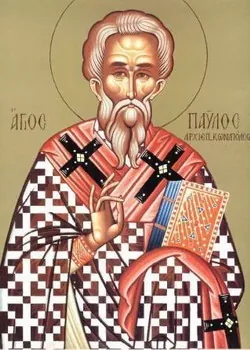
Saint Paul the Confessor, Patriarch of Constantinople (+350)
Saint Paul, archbishop of Constantinople, was chosen to govern the Church of Constantinople after the death of Patriarch Alexander (+340), when the Arian heresy flared up again. Many Arians attended the council that was to elect the new patriarch. They opposed the hierarch Paul’s candidacy, but the majority of the votes went to the Orthodox. The Emperor Constantius (337–361), who ruled the eastern part of the Roman Empire, was an Arian. At the time of the patriarchal election he was not in Constantinople. When he arrived, he summoned a new council, which declared the hierarch Paul deposed. The Lord’s chosen one was driven out of the capital, and in his place the Arian Eusebius of Nicomedia was enthroned. Patriarch Paul went to Rome, where other Orthodox bishops driven out by Eusebius had also found refuge.
Eusebius did not remain long on the patriarchal throne. After his death the hierarch Paul returned to Constantinople. His flock received the blessed one with love, but Constantius’s persecution forced him to go back to Rome again.
The Emperor Constans (337–350) wrote to his eastern co-ruler Constantius, asking him to restore the persecuted hierarch to his see. Saint Paul was restored to the patriarchal throne, but soon, in a palace coup, the pious Emperor Constans, the champion of the Orthodox, was treacherously killed. After this the hierarch Paul was again driven out of the capital and exiled to Cucusus in Armenia, where he died a martyr: while the patriarch was celebrating the Divine Liturgy, the Arians burst into the church and strangled the saint with his omophorion. This happened in 350. In 381 the holy Emperor Theodosius the Great (379–395) translated the blessed confessor’s incorrupt relics with honour to Constantinople. In 1326 the holy relics were taken to Venice.



