
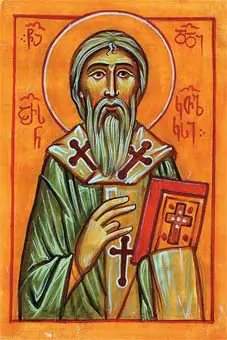
Saint Arsenius the Great, Catholicos (+887)
Saint Arsenius the Great, the catholicos, was born around 820 into the family of Mirian, a well-known and influential nobleman of Samtskhe.
Theodore and Christopher (commemorated 5 October), fellow ascetics of Saint Grigol, travelling to Abkhazia, passed Mirian’s house on the way through Samtskhe, and Mirian invited the monks into his house. In the morning he and his wife had the monks bless their children, and then, amazed at their virtue, gave them their youngest son, the six-year-old Arsenius, to bring up. The monks promised the parents to present the boy to Grigol, archimandrite of the deserts of Klarjeti.
When the Venerable Grigol sought out his chosen brethren Theodore and Christopher in Abkhazia and returned with them to Klarjeti, he took with him the boy Arsenius, the future “catholicos of Kartli and unfading crown of the throne of Mtskheta”, and the youth Ephrem, afterwards the wonderworking bishop of Atskuri.
The monks of the monastery rejoiced at the return of their teacher and the brethren, but met the bringing of the boys with murmuring, for the monastic rule forbade it. The Venerable Grigol told the brotherhood that this was the one exception, prompted by the will of God Himself, so that “as Ephrem the Syrian and Arsenius the Roman, withdrawn from men and drawn near to God, so these worthy boys should be brought up without blemish at Khandzta until the time of their honour”.
When Arsenius came of age, his father, the aznaur Mirian, without the consent of a church council or of the hierarchs, with the help of the laymen of Samtskhe and the support of a few bishops, installed him as catholicos. This was a gross violation of the church canons and a presumptuous interference of a layman in the Church’s affairs.
To settle the disputed question, the clergy of Kartli and Klarjeti called a church council in Javakheti. Ephrem of Matskveri presided over the council. Church law was on the side of the fathers. Arsenius was threatened with deposition, but Grigol of Khandzta, the father of all the desert-dwellers, came to the council and convinced everyone, Ephrem among them, that Arsenius’s installation on the throne of the catholicos had come about by the will of God: “God ordained the catholicosate of Arsenius for his perfection, but Mirian his father made it blameworthy by untimely haste, as Adam ate that fruit which was not yet ripe.”
The agitation died down. The love between Ephrem and Arsenius was renewed too.
Catholicos Arsenius consecrated the old church of Khandzta; by his God-pleasing life and love in Christ he filled the churches of Kartli with joy; “he adorned the patriarchal throne completely and was himself adorned with grace”.
Saint Arsenius was a remarkable hagiographer and historian. To him belongs the most important historical and polemical work “On the Separation of Kartli and Armenia”, which sets out the history of the church schism between the Armenians and the Georgians.
“The Life and Martyrdom of Abibus of Nekresi” is also ascribed to Arsenius the Great.
Saint Arsenius governed the Church of Kartli for twenty-seven years. He died in 887, and “went with gladness to Christ, and has grace to help us”.



