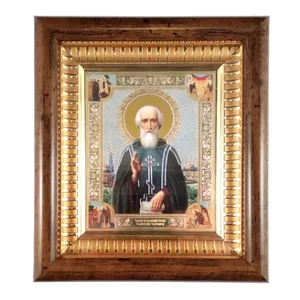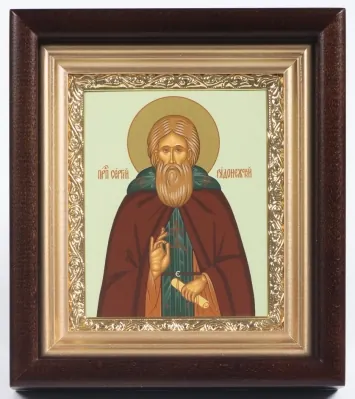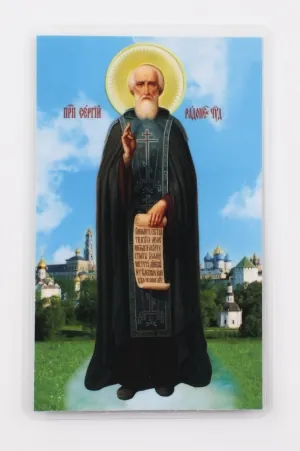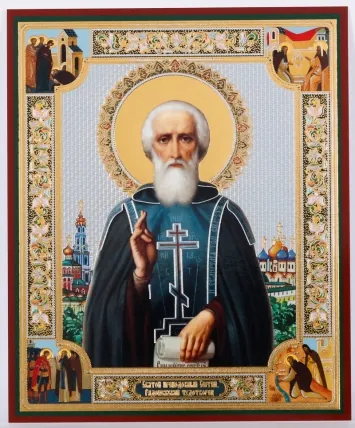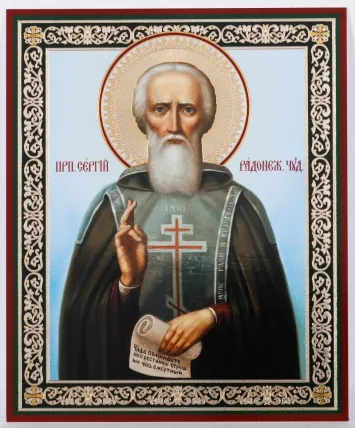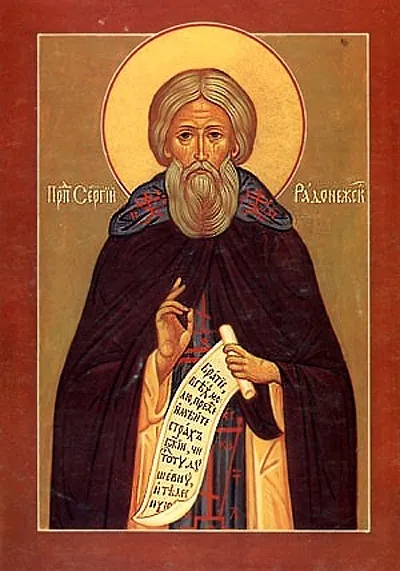
The Repose of Sergius, Abbot of Radonezh, Wonderworker (+1392)
The Venerable Sergius of Radonezh was born on 3 May 1314 into the family of the devout boyars Cyril and Maria, who lived in the village of Varnitsa near Rostov. His election by God was made plain early: even before the child was born, during the Divine Liturgy, his mother and all the people clearly heard the infant cry out three times in his mother’s womb. The newborn was named Bartholomew. From the very first days of his life the child amazed everyone by his fasting: on Wednesdays and Fridays he would not take his mother’s milk. Nor would the baby take food from his mother if she had eaten meat. When she noticed this, Maria gave up eating meat altogether. The saint was seven years old when he was sent to school. He thirsted with his whole being for learning, but could make no progress: the troubled child besought the Lord unceasingly to open his mind. Once his father sent Bartholomew into the fields to look for the horses. On the way he noticed an unknown hieromonk standing at prayer under an oak; he went up to him, bowed his head and waited obediently for the old man to finish his prayer. The monk blessed the child, kissed him and asked what troubled him. Bartholomew told him his grief, that he could not learn to read and write, and begged him to ask the Lord’s help for him. The stranger granted the child’s request: he prayed, and then made the sign of the cross over him and handed him a piece of altar bread taken from a reliquary: “Take it, child, and eat. This is given thee as a sign of the grace of God and for the understanding of Holy Scripture.” From that day the boy learned to read and write, and was granted as well a wonderful gift for understanding what he read. He avoided childish amusements and games, prayed earnestly and fasted strictly; humble, sparing of words, quiet and gentle, the boy also carried out his parents’ wishes without a word…
Around 1328 the future saint’s parents moved to Radonezh. When their elder sons had married, the Venerable Cyril and Maria (commemorated 18 January and 28 September) received the schema in the monastery of the Protection of the Mother of God at Khotkovo, and soon reposed in labours pleasing to the Lord. After this Bartholomew left the world and, with his elder brother Stephen, who had been widowed and then become a monk, settled ten versts from Radonezh by the river Konchura. The brothers cleared the forest, built cells with their own hands and raised a small church, which was consecrated in the name of the All-holy Trinity. So the foundation of Saint Sergius’s famous lavra was laid. Stephen could not bear the hardship of the hermit’s life and went away to the monastery of the Theophany in Moscow, while Bartholomew, left alone, was tonsured a monk with the name Sergius on 7 October 1337.
The venerable father made his labours stricter still: wild beasts often prowled in front of the saint’s cell, but did the blessed one no harm. Once the Venerable Sergius fed a starving bear with bread, after which the beast often came to visit him. The hermit would share his last piece of bread with it, and sometimes gave it all up, going hungry himself. For two years the holy father lived entirely alone, and then little by little those who wished to live the monastic life gathered round him. Once, when the blessed one was standing at prayer in his cell at night, commending his brotherhood to the Lord, a voice sounded: “Sergius!” The astonished saint crossed himself, opened the window, and against a blinding light saw a multitude of beautiful birds covering the lavra and its surroundings. The voice from on high went on: “Sergius, thy spiritual children shall multiply like these birds, and their virtues shall be as many-coloured and wonderful as the beauty of these winged creatures.” In 1354, after long and fervent entreaties, the monks of the house persuaded the saint to become their superior. Athanasius, bishop of Volhynia, ordained him hieromonk and appointed him abbot. The valiant ascetic governed the monastery wisely; he gave the brethren an example of devotion not only in word but in deed: he chopped wood, carried water, baked the altar bread, and always dressed very poorly. The abbot worked more than anyone, yet he also managed to help everyone in time of need. In the words of the saint’s disciple Epiphanius, the Venerable Sergius “was both first in everything and last; no one could equal him”. The newly founded monastery was in great material want: the services were held by the light of birch splinters, and the brethren communed from a wooden chalice. It happened that the whole brotherhood was left without a crust of bread and hard times of hunger came; but even then, to instil in his spiritual children hope in the almighty and all-good God, the blessed Sergius strictly forbade them to leave the house to beg alms for the monastery. The monks of the house had no personal property at all: they took everything as needed from the common property of the brotherhood, and took part equally in the monastery’s work.
The life of the blessed Sergius and his brethren, radiant with holiness, gradually drew the attention of their contemporaries, and soon the lavra became famous throughout Russia. Many boyars and princes among the saint’s spiritual children gave part of their property to the monastery, which made it possible to build a new and larger church. The means of the house grew, but Saint Sergius and his brethren still lived in their old poverty. The abbot spent rich donations on works of charity. He showed a special fatherly love towards orphans, the poor, the destitute and strangers who sought refuge at the monastery. In times of famine the saint opened the granaries of the house and gave out grain generously to the hungry… The blessed Alexis, Metropolitan of Moscow, wished before his death to hand over the hierarchal throne to the Venerable Sergius, but the saint firmly refused.
For his holy life and unwearying labours the Lord rewarded the blessed Sergius with the gifts of insight and of working miracles. Before the battle with the Horde the father, who foresaw what was to come, blessed the right-believing Prince Dmitry Donskoy (commemorated 19 May) with the whole Russian host, and foretold victory over the Tatars.
Before his death the holy father was counted worthy of a miraculous appearance of the Mother of God. The All-holy Virgin, radiant with heavenly light, accompanied by the holy Apostles Peter and John the Theologian, appeared to the blessed one in his cell and promised that the house he had founded would flourish. Saint Sergius committed his soul to the Lord in peace on 25 September 1392. His body was buried by the south wall of the monastery church, near the sanctuary.
In 1408, when Moscow and its surroundings were laid waste by the Tatar hordes, the Lavra of the Holy Trinity too was burned and deserted. On the night before the expected attack of the lawless, the Venerable Sergius appeared to his disciple and successor, Abbot Nikon, told him of the coming disaster, and at the same time reassured him that the trial would be temporary and that the house would be restored and would flourish and prosper still more. Later, before the building of the new church of the Holy Trinity began, the blessed father appeared to a devout layman and told him to tell the brethren: “Why do you leave me so long in the coffin, where the earth covers me and the water troubles me?” While digging the foundations of the church the workmen came upon the saint’s coffin, around which water was indeed standing.
On 5 July 1422, in the presence of the clergy, of nobles and of a multitude of people, the blessed father’s relics were brought up with honour. When the coffin was opened, a wonderful fragrance spread all around: not only the body but even the clothing of Sergius of Radonezh showed no trace of decay.
The holy Church keeps the commemoration of the Venerable Sergius, the valiant ascetic well-pleasing to the Lord and the reviver of monastic life in a Russia laid waste by the Mongols, twice a year: on 5 July, the bringing up of the saint’s relics, and on 25 September, the day of his repose.
“Lives of the Saints”, vol. III, Tbilisi, 2001.
The extended version of the Life of St Sergius of Radonezh