
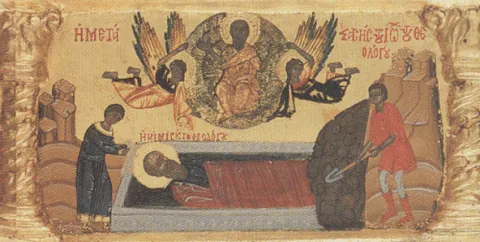
The Repose of the Holy Apostle and Evangelist John the Theologian (Beginning of the 2nd Century)
The holy Apostle and Evangelist John the Theologian was at first a disciple of Saint John the Baptist. The appearing of Jesus Christ, in whom the Forerunner of the Lord recognised the Messiah, made a wonderful impression on him, and together with the Apostle Andrew he followed the Saviour (John 1:35–40). Afterwards Christ called the saint, who “was busy with nets and fish on the lake”, together with his brother James, and promised to make him a fisher of men (Matthew 4:21). And he left everything.
For his fervent love and virginal purity Christ loved him above the others and drew him especially close, together with two other of the most chosen disciples.
John the Theologian saw with his own eyes the healing of the daughter of Jairus and the Transfiguration of the Lord on Mount Tabor.
At the Mystical Supper Peter, “though he was the first of the disciples”, did not dare to ask himself, and asked John to enquire of the Teacher “who it was that had come to that dreadful betrayal”. And he leaned on Christ’s breast and asked Him: “Lord, who is it that betrayeth Thee?” And the Saviour “at once made plain what was asked, and signified the betrayer by the bread”.
It is clear that when John, together with his brother, asked Jesus for the seat nearest to Him (Mark 10:35–36), “he asked it not as a lover of glory, but as a lover of Christ, for he wished that no other should be nearer than he to the Beloved”.
The holy apostle did not leave the Teacher when He was led in bonds from the garden of Gethsemane to the court of Annas and Caiaphas; he went with the Saviour into the high priest’s courtyard and was present at His interrogation; the blessed one also followed Christ on the way to Golgotha, stood at the foot of the Cross and wept together with the Mother of God. When the crucified Saviour saw His mother and “the disciple standing by, whom He loved”, He said to His mother: “Woman, behold thy son!” Then He said to John: “Behold thy mother!” (John 19:26–27). From that time on the blessed apostle cared for the All-holy Virgin like a loving son and served her faithfully.
When, after the Dormition of the Mother of God, her holy body was carried to the garden of Gethsemane for burial, John carried before the bier the branch of paradise that the Archangel Gabriel had brought her.
Until then the holy Evangelist preached in Jerusalem, and more than once endured persecution from the Jewish priests.
After the burial of the Mother of God John set out with his disciple Prochorus for Ephesus, the city that had fallen to his lot. On the way, at Joppa, a violent storm overtook them, and the ship on which they were travelling was wrecked. The sea cast all the passengers up on the shore; only John was swallowed by the deep. Prochorus lamented broken-heartedly over the loss of his teacher, and at last went on his way alone. On the fourteenth day he saw the waves cast a man up on the shore. When the blessed one went up to the stranger, he was seized with wonder and joy: it was John the Evangelist, whom the Lord had kept unharmed in the bosom of the sea all that time.
Teacher and disciple set out for Ephesus, where Saint John preached Christ tirelessly among the raging pagans. His preaching was accompanied by many miracles, and the number of those converted to the true faith grew ever greater. When the persecution of the Christians began in the empire, John was seized and, according to one source, brought before the court of the Emperor Nero (53–68), and according to another, of Domitian (81–96).
For his open confession of Christ the blessed one was sentenced to death, but the Lord protected His chosen one. The holy apostle was made to drink a cup full of deadly poison, but survived; he was thrown into a cauldron of boiling oil, but came out of that too unharmed. After this John was exiled to the island of Patmos, where he spent many years. By his preaching and his miracles John converted the whole population of the island to the true faith.
The Revelation of John
The blessed Evangelist went up a desolate mountain with his disciple Prochorus and fasted for three days. While he prayed the mountain shook and there was a terrible thunder. The terrified Prochorus fell down on the ground. John raised the blessed one up and told him to write down what he would hear from him: “I am Alpha and Omega, the beginning and the ending, saith the Lord, which is, and which was, and which is to come, the Almighty” (Revelation 1:8), said the Spirit of God through the apostle. So, around the year 67, the Revelation of John, or Apocalypse, was written, in which the future and the end of the Church and of the world are revealed.
After his release from long exile John the Evangelist returned to Ephesus. From there he watched over the life of all the neighbouring churches, often visited them, and guarded the Christian faith from corruption by pagan vain philosophy.
John the Evangelist is above all the apostle of love. Neither great age nor bodily weakness could quench his wonderful zeal.
To the last day of his life John the Evangelist gathered his disciples about him and tirelessly urged them to keep peace among themselves and to love one another. When the years weighed so heavily on the blessed one that he could no longer walk to the gatherings of the Christians and his disciples carried him, he could no longer preach as before, and only repeated these words: “Little children, love one another.” At last the disciples asked their teacher why he kept repeating the same thing to them, and John answered: “This is the Lord’s commandment, and if you keep it, it is enough for you.”
John the Evangelist was over a hundred years old when he passed into the Kingdom.
The Repose of St John the Evangelist
Once the blessed one went out of Ephesus with seven disciples, withdrew to a high rock near the city and prayed; then he lovingly bade them all farewell, had a grave dug in the shape of a cross, lay down in it and asked that earth be thrown in. The disciples kissed their dear teacher with tears, but dared not disobey, and slowly filled the grave. When the Ephesians learned of this, they came to the apostle’s tomb and dug it up, but found nothing in it.
Every year, on 8 May, a fine dust rose from the tomb of John the Evangelist, which the faithful gathered and were miraculously healed. For this reason the Church also marks the commemoration of the holy apostle on 8 May.
The Lord called His beloved disciple and his brother “Boanerges”, sons of thunder, and so pointed to their fiery zeal and strength of spirit. The iconographic sign of John the Evangelist is the eagle, the symbol of the soaring flight of theological thought. Of all the apostles of Christ the holy Church has given the name “the Theologian” to Saint John alone, the secret beholder of the divine providence.
“Lives of the Saints”, vol. III, Tbilisi, 2001.
“Little children, love one another”: the faithful will hear these words of Saint John once more, now in the last times. As Saint Andrew the Fool for Christ says (see the extended version of his Life), before the Second Coming of the Lord, when the Antichrist reigns, Saint John too, together with Saint Elijah and Enoch, will be sent to sinful mankind; they will encourage the Christians and denounce the Antichrist (Saint Theodosius of Jerusalem specifies that Saint Elijah and Enoch will preach in the lands of the Antichrist, and Saint John in the Caucasus); they will receive death at his hands, and the Antichrist will cast their bodies out “in the streets”; so they will lie three days and a half, and then the Lord will raise them from the dead and will Himself soon come in glory…
As Saint Andrew says: “Blessed is he who is not found fighting against God in those days, but keeps the faith of Jesus Christ.”



