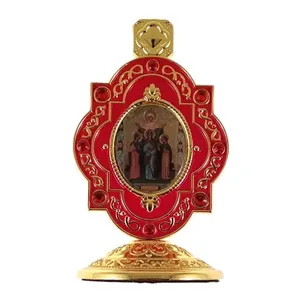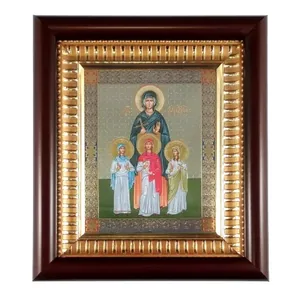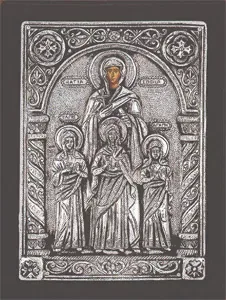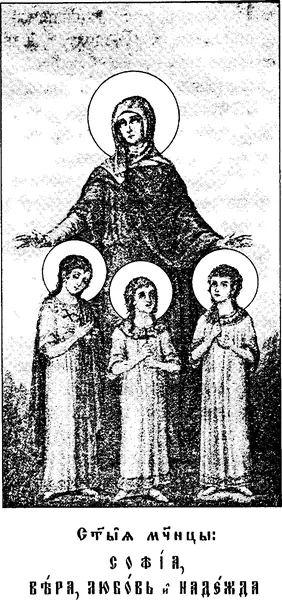
Holy Martyrs Pistis, Elpis and Agape and Their Mother Sophia (+c. 137)
The devout widow Saint Sophia lived in Italy and brought up her daughters in faithfulness to the commandments of Christ; she named them, after the three Christian virtues, Pistis (Faith), Elpis (Hope) and Agape (Love). During the persecution of the Orthodox by the Emperor Hadrian (117–138) the mother and daughters held firmly to their faith and confessed it openly before all. Antiochus, the head of the city, reported this to the godless autocrat, and he, filled with brutish rage, ordered the confessors to be brought to Rome at once. The brides of Christ were filled with joy, gave thanks to the Lord and asked Him to grant them strength to endure the torments. When the saints stood before the emperor, their calm astonished everyone: you would have thought they had been summoned not to torture but to a splendid feast. Hadrian demanded that the martyrs worship the idol of Artemis. Sophia answered for them all: we have come “hither to Rome for this, that we may keep our faith even unto death”. The lawless man gave them three days to think over their final answer, and then called the daughters aside, urged them with flattery to take pity on the mother who had reared them, and repeated his former demand. The girls answered firmly: “What is sweeter for a Christian than to suffer for Christ!” After this the tormentor separated the sisters from one another, hoping that in this way at least he would weaken the blessed ones, but he achieved nothing. The eldest, twelve-year-old Pistis, suffered first. The lawless stripped her of her clothes, bound her hands behind her back and beat her cruelly, then cut off her breasts. Milk flowed from the wounds instead of blood, but this miracle did not bring “that tyrant” to his senses: he ordered her wounds to be seared with red-hot tiles; Pistis was set in a pan full of pitch and fat placed over a fire, but the flames lost their heat and the bride of Christ took no harm. At last they resolved to behead her. Then the middle one, ten-year-old Elpis, was tortured. She too was stripped and beaten with dried sinews and thrown into the fire; when she survived unharmed she was hung on a stake and torn with iron hooks, then set in a cauldron full of boiling pitch; but the cauldron melted like wax, the boiling pitch spilled out and burned many of those gathered, while the holy martyr was saved. At last she too was put to death with the sword. After this the turn came to the youngest, nine-year-old Agape. She was beaten so cruelly that “the joints of her limbs were loosed from their fitting together”. When she had been tortured, the godless judge promised her that if she would only say in words that “great is Artemis”, she would escape being burned. But the girl waited neither for the executioners nor for the tormentor’s order: “so eagerly did she go in and stand in the midst of the furnace”. Angels of the Lord shielded the child from burning. The furious pagans pierced the blessed one’s thighs “with iron borers for wood”, and at last beheaded her. The cruellest torment fell to Sophia: she watched her children’s sufferings with her own eyes, but “nothing of faintness of soul or of a mother’s fear befell her”. The wonderful mother of wonderful daughters strengthened the martyrs by word and prayer, and afterwards laid their bodies in a reliquary, carried them by cart to her native city and buried them in a church she herself had built. For three days the blessed one did not leave the holy graves, and then the Lord received her soul too (+c. 137).