
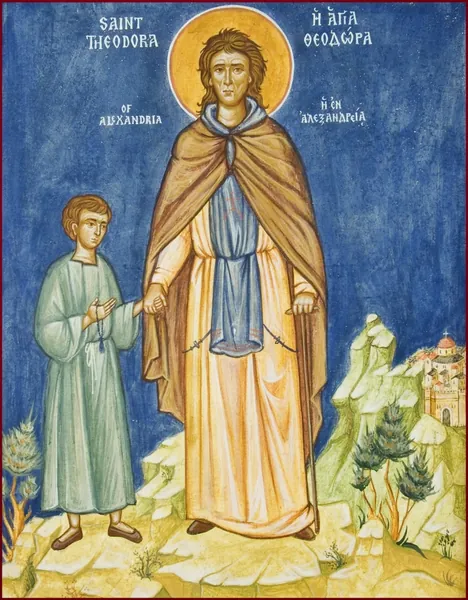
Venerable Theodora of Alexandria (+474–491)
The Venerable Theodora of Alexandria and her husband lived in Alexandria in the time of the Emperor Zeno (475–491). Peace and love reigned in their family, but through the devil’s wiles Saint Theodora fell into a terrible sin. A young man who was greatly attracted to Theodora managed to seduce her with the help of a false and flattering woman. Theodora betrayed her husband, and only when “the sin was accomplished” did she understand “what she had done to her soul”; at dawn she went to a women’s monastery and openly confessed her sin. After this, hoping in the all-merciful God, she decided to cleanse her defiled soul by monastic labour, prayer and fasting. She secretly left her family, dressed in men’s clothing and came to a men’s monastery, for she feared that her husband would find her in a women’s monastery. To test the newcomer’s firmness, the abbot would not even let the blessed one into the courtyard of the monastery. Theodora knew well that there would be many wild beasts in that desolate place, but she stayed at the gate without complaint to spend the night. And the Lord kept His chosen one unharmed. In the morning the saint fell at the abbot’s feet, introduced herself as Theodore of Alexandria and asked to be received into the brotherhood: “I have come to repent and weep for my sins.” The abbot was convinced of her sincerity and agreed.
Even experienced monks were amazed at Theodora’s hard labour, obedience and patience: she diligently watered the plants, ground the wheat, baked the bread, prepared food for the brethren… and at night, on her knees, she prayed fervently and asked the Lord for the forgiveness of her sins. Once the saint was sent to Alexandria to buy wheat. On her way back from the city night came on, and with the superior’s blessing Theodora put up the camels in the guest-house of the monastery of Enaton, stayed there herself and slept beside the camels. When everyone was asleep, the daughter of the abbot, who was staying at the monastery as a guest, charmed by her beauty, came to the saint and proposed: “Young man, lie with me!” When she received a refusal in reply, inflamed with lust, she sinned with another guest.
Six months later the abbot learned that his daughter was with child, and his daughter named the monk Theodore as her seducer. The father at once informed the superior of the monastery where the blessed mother was labouring; he in turn told Theodora what she was accused of. “Forgive me, father, for I have no part in such a deed,” the saint answered, and the superior, who knew his spiritual child well, believed her words without question. When the harlot gave birth to a child, the monks of Enaton brought it to the monastery where Theodora lived and began to reproach the brethren for their unclean life. This time the abbot himself took the slander for the truth and was terribly angry with the holy mother. The newborn was handed over to Theodora, and she was driven out of the monastery in disgrace. The Lord’s chosen one humbly took up this new trial and regarded it as the price of her former sin. The blessed one settled with the child in a shelter near the monastery. Shepherds gave her milk for the child, while Theodora herself ate herbs and drank salt sea water. Thus seven years passed. “And her nails became like those of a leopard, and her hair like a lion’s mane, and all her limbs turned yellow from the heat of the day and the frost and dew of the night.” The evil one brought terrible trials upon the blessed one, but the holy ascetic valiantly resisted him. At last, at the request of the monks of the monastery, the abbot brought Theodora back to the monastery, where she lived in seclusion for two years and brought up the child in the fear of God.
One night the abbot saw in a miraculous vision, among angels and holy martyrs, “a woman in ineffable glory,” who sat down on a golden throne prepared for her beforehand. And the angels accompanying her said to him: “This is thy monk Theodore, who was worn away by labours…” The astonished superior went with the brethren to the monk’s cell, and by that time she had already died, and “when they examined her, they found that she was a woman, and they marvelled, and fear fell upon them.” Soon the monks of Enaton too learned that their souls were burdened with a terrible slander; horrified, they knelt before the holy body and asked forgiveness. The news of the holy ascetic reached Theodora’s husband too. He also became a monk, settled in Theodora’s cell and pleased the Lord by hard labour. The blessed mother’s foster-child too followed her path and later became abbot of this monastery.



