
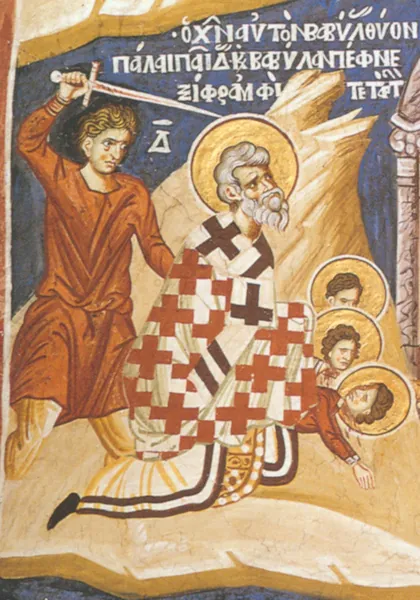
Holy Hieromartyr Babylas the Great, Bishop of Antioch, and with Him Three Youths, Urban, Prilidian and Epolonius, and Their Mother Christodoula (III)
The holy Hieromartyr Babylas the Great, Bishop of Antioch, with him three youths, Urban, Prilidian and Epolonius, and their mother Christodoula, suffered in the third century, during a cruel persecution of the Christians. Once the godless emperor (according to one account Decius (249–251), according to other sources Numerian (283–284)), after his loathsome idolatry, decided to attend the Divine Liturgy and to defile the church by entering it. When this was reported to the celebrant, the God-fearing hierarch Babylas, he stood in the way of the lawless ruler, “struck him on the breast with his right hand, and so held him back from entering the church.” The tormentor wished to take revenge on the saint on the spot, but he shrank from the indignation of the multitude of Christians gathered there, “bridled that evil boldness of his,” and went back to the palace.
The next day the emperor ordered the church of the Christians to be given to the flames and Bishop Babylas brought to him. To the lawless king’s question, in whose hope he had dared to insult his dignity and not let him into the church, the blessed father answered: “I did this in the hope of no one on earth, but of the King of heaven, who hath set me as shepherd of His sheep and doth not suffer me to sleep in negligence when the wolf is coming. Therefore I did not insult the king, for to do so is outside the law and not free of insolence; but I held back one who was coming in to defile and to corrupt the holy place.”
The emperor demanded that the holy hierarch bow down to the idols and so atone for his offence; otherwise he threatened him with death. But when he became convinced that the martyr’s firmness was unshakeable, he ordered his commander to put fetters on the holy father and lead him through the city, “through the midst of the theatre and all the places of spectacle,” and so take him to prison. The tormentor hoped that the saint would not bear being mocked by the crowd. He himself was the first to mock him: how well these bonds and fetters become thee, “for they befit that stately bearing of thine old age!” The blessed Babylas answered: “Thou speakest these words in mockery and flattery, but I am adorned by them more than thou, O king, art adorned by that flowered robe and purple and the splendour of thy crown.”
With the holy bishop were three youths, “old in the wisdom of their minds, who eagerly learned the service of God.” Even in the hardest moments of the trial they would not leave their teacher. When the emperor asked who the children were, Babylas answered: these are my spiritual children; if thou test them, thou shalt know “what are the seeds of my words, and still more of God who gave them to us.” The youths and their mother, Christodoula, the faithful handmaid of Christ, standing before the tormentor, did indeed show wonderful firmness. When the autocrat could by no means tempt the saints and persuade them to deny Christ, he ordered their bodies to be cut in as many places as each of them was years old. The eldest of the youths was given twelve wounds, the middle one ten, and the youngest seven. When the emperor saw the courage of the lambs of Christ, he gave orders for them to be beheaded.



