
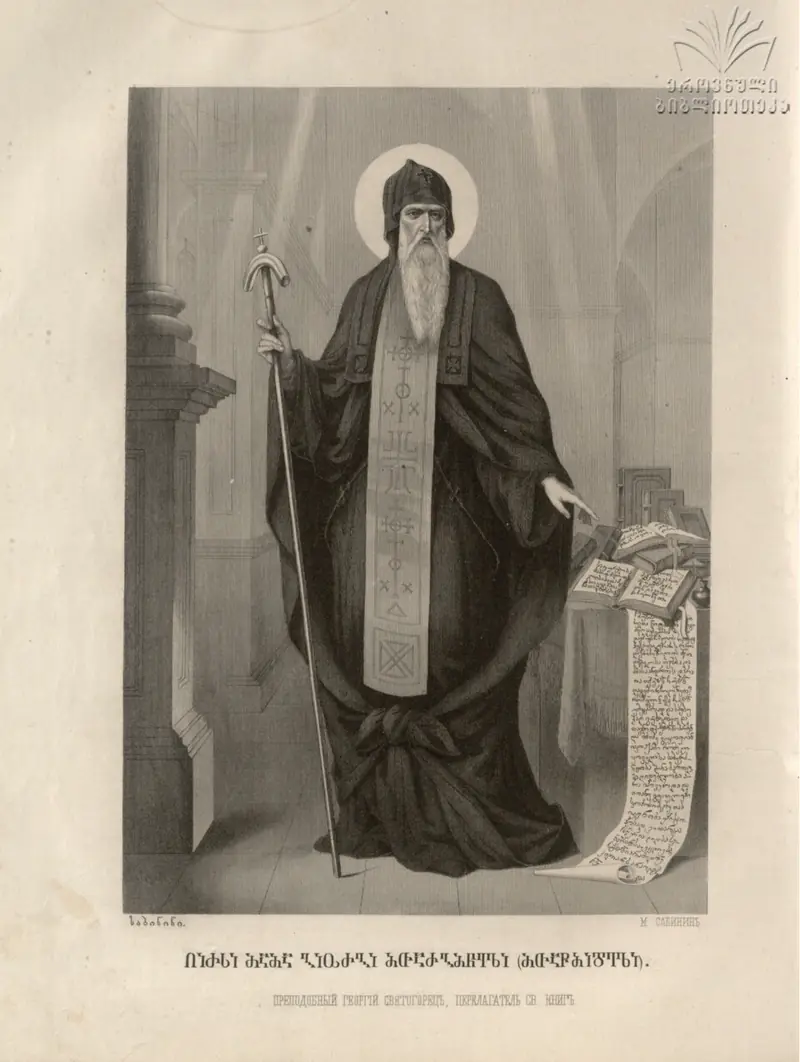
Saint George the Athonite (+1065)
The first and last letters say: “Christ, have mercy on the sinner George, a[men].”
With praises it befits us to sing thy glory, thou whom Christ the Saviour made illustrious! Like an arrow of lightning, like a tongue of fire, thou didst proclaim in theology the glory of the Trinity; thou didst clothe tribes and nations in light; thou didst make the Church exalted; thou didst loose the sabbaths and still the law, O radiant herald of the One Essence! Thou didst drive away the darkness and trample the enemies; thou beholdest the ranks on high, O holy one! Thou standest face to face with the God of all — set on us the promised crown. Make tender our hard hearts; make us all together dwellers in the Kingdom.
Saint George the Athonite was born in 1009 in Trialeti, into the family of Jacob and Mary, devout Christians and well-known servants of the state.
Until the age of seven George was brought up by his mother and father. “And from childhood he was full of the fear and love of God.” The seven-year-old boy was taken to the monastery of Tadzrisi and entrusted to the abbot, Saint Sabian (commemorated 31 December), who was renowned for his piety and wisdom. George spent three years at Tadzrisi.
When George was ten, his father took him to the monastery of Khakhuli and gave him to be brought up by his two brothers who were labouring there, the Venerable George the Scribe and Sabbas of Khakhuli (commemorated 19 December).
The uncles brought their nephew, adorned with every good quality, to the abbot of Khakhuli, the Venerable Macarius the Faster (commemorated 21 December), renowned for his holiness. The abbot, gifted by God with foresight of what was to come, rejoiced at the sight of the boy George and “called him the son of his soul”.
At that time there were labouring at Khakhuli Father Basil, son of Bagrat III (commemorated 27 June), known as “the ornament of the churches of the Georgians”; Hilarion of Tvali (commemorated 21 July), “whose virtues and labours it is impossible to tell”; the God-clad Anthony the Sacristan, “theologian, philosopher and translator of writings”; and many others, whose lives left an indelible mark on George’s formation. George himself amazed everyone with his intelligence and diligence: “the hymns of the year and all the orders of chanting he soon learned by heart”.
When Peris Jojikisdze, eristavi of Trialeti, invited George’s uncle, George the Scribe, to his palace as spiritual father, the old George took his nephew with him. Peris’s wife, amazed at the boy George’s goodness, “that godly woman, acknowledged him as her own son”, and “they spent a long time in a good and God-pleasing life”.
In 1022 Basil, the Byzantine emperor, falsely accused Peris too of the plot laid against him, summoned him to Constantinople and cut off his head. Peris’s wife remained in the capital for twelve years. The God-loving woman gave George “to be taught by men who were philosophers and rhetoricians, adorned with both ways of life”. The God-enlightened youth amazed everyone with his talent and insight.
Twelve years later, in 1034, by the emperor’s order Peris’s wife returned again to her homeland, to Tvartsatapi, and took George with her. George went to the monastery of Khakhuli, and at twenty-five “bowed his neck to that sweet yoke of monasticism. His spiritual teacher and trainer in the labours of monasticism, the great Hilarion, was still in the flesh, and from his hands he received the blessing of monasticism, for he was his first teacher and the cause of every good”.
In 1036, wishing to labour “in exile and apart from his own”, George secretly left the monastery and, disguised in a beggar’s rags, set out for Syria. “The father adorned with toil and labours” reached the Black Mountain with difficulty. After venerating the holy places there and visiting the fathers who laboured there, George “first of all began to seek a spiritual guide, for he knew that without a teacher there is no life for the soul and no progress in the monastic life”. And he found, shut away in the clefts of the mountain, a wonderful father — “a heavenly man and an earthly angel, wholly a stranger to and apart from the flesh and fleshly thoughts, and in mind departed unto God” — the Georgian monk George the Recluse (commemorated 3 July).
After three years of labour George the Recluse clothed George, now perfect “in stature, wisdom and understanding”, in the schema and sent him to Jerusalem to worship at the holy places, and on his return in 1040 commanded him to go to the Holy Mountain and undertake “the translation of the divine books from Greek into Georgian” — that is, to carry on the work of Saint Euthymius the Athonite (commemorated 13 May). The command startled George. “It is impossible for me, and befits such deified men as our holy father Euthymius was,” he said to his teacher. “My son, He who delivered that holy one from death and loosed his Georgian tongue is able to help thee too, for He greatly pities and loves our nation; and let us beseech that holy father Euthymius himself to help thee,” said George the Recluse, the worthy heir of Euthymius the Athonite, calming him, and he sent him to Athos.
The Athonite Georgians received the holy father with joy. George took upon himself the hardest tasks of the monastery, “making himself of no account in all things… as a simple and unlearned man”. As the writer of his life tells us, the Venerable George always walked with bowed head and looked at no one “save for necessary matters”. But his spiritual eyes “were ever beholding that invisible glory of God”.
George the Recluse, through his disciple Theodore, once again reminded George why he had been sent to Athos, and sent him a reproach.
George asked his teacher’s forgiveness, received the honour of the priesthood with reverence and fear, set his hand to translating the divine books, and soon became the abbot of the whole brotherhood. From this time begins the wide activity of Father George the Athonite. He gathered information about Euthymius and John, wrote their lives, translated the relics of the holy fathers and placed them in a splendid shrine, beautified the holy church and “completed it in every respect”.
Bagrat IV, king of the Georgians, having come to Greece to the Emperor Constantine Monomachos, offered the holy father a return to Georgia and the metropolitanate of Chqondidi, but George, who shunned worldly glory and turmoil, declined the king’s offer.
The office of abbot and the cares of the monastery took much time and labour, and often required leaving the monastery, and so very little time remained for his writing. George resigned the abbacy and went to the Black Mountain to George the Recluse. For the love of God, George the Recluse ordered his spiritual son to go back again. George submitted to his teacher’s blessing, returned to the mountain of Athos and took up his accustomed work. Even the bare list of the books translated by this wonderful father makes clear the immeasurable importance of his labour: the Great Synaxarion, the Selected Menaion of the year, the complete Apostle, the Selected Apostle, the Lectionary of the year, the monthly Menaia, the Festal Menaion, the Hexaemeron of Basil the Great, the Psalter, the Great Parakletike, the Lenten Triodion, the Pentecostarion, the Commentary on Genesis of John Chrysostom, the canons of the Sixth Council, the book of Gregory of Nyssa, and others.
Once the monks of Saint Symeon’s monastery, filled with envy by the evil one, wished to drive the Georgian fathers out of the monastery. “Deliver us from great distress and free us from vain men of foreign stock, for there are in our monastery some sixty men who call themselves Georgians, and we do not know what their faith is,” they complained to Theodosius, Patriarch of Antioch. The patriarch summoned Saint George the Athonite, who spoke Greek. The Venerable George preached Orthodoxy with such wisdom that he amazed his hearers. The patriarch was angry with the ill-intentioned monks of Saint Symeon.
A little later the patriarch was told again that the apostles had not preached in Georgia and that the Georgians were few in number, and so it was fitting for them to be under the authority of the Patriarch of Antioch. The patriarch informed Father George: “Let your king come to us and submit to our authority.” The holy father answered: “Thou sayest that thou sittest on the throne of Peter, the chief of the apostles; but we are the disciples of the First-called, who called his brother, and his flock, converted and enlightened by him; and one of the holy twelve apostles — I mean Simon the Canaanite — is buried in our land, in Abkhazia, at the place called Nikopsi. We have known the one God and have never denied Him, and our nation has never inclined to heresy… It is fitting that the one called submit to the one who called: for it is fitting that Peter submit to his brother Andrew, who called him — and that you submit to us!” And finally he added: “There was a time when Orthodoxy was not to be found in all Greece, and John, bishop of the Goths, was consecrated bishop at Mtskheta.”
The astonished patriarch smiled kindly and said: “See this old man, how alone he overcomes so great a multitude.” Afterwards Theodosius and the Antiochenes acknowledged both the apostolic origin of the Church of Georgia and the purity of its faith.
The God-loving King Bagrat often asked Father George to come to Georgia to labour. At first the blessed father refused, but at last, when “he had completed the translation of the divine books”, he fulfilled the wish of the king and the catholicos. At their command the holy father examined the state of the clergy at that time and set church life in order.
Five years later Father George returned again to the Holy Mountain. King Bagrat sent off the luminary of the Georgians with honour and a great offering. On his way to Athos the blessed father took eighty orphan children with him to bring them up. Having reached Constantinople, blessed George sensed the approach of his end and ordered the orphans to be made ready to be presented to the emperor. “If I do not see the emperor today, tomorrow will not be in our hands!” the holy father urged.
Father George “paid his respects to the emperor and said to him: ‘After God I commend these orphans into thy hands.’” Then he had the children sing the prayer of Saint Symeon the God-receiver, “Lord, now lettest thou…”, and the next day, on the feast of Saints Peter and Paul, he reposed.
The Athonite fathers carried the saint’s body to Athos and “buried him in a marble shrine together with George the Builder (commemorated 28 July), as a second builder and adorner of the churches”.



