
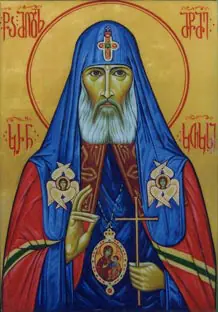
Hieromartyr Kirion II, Catholicos-Patriarch of All Georgia (+1918)
The Hieromartyr Kirion II (in the world Giorgi Sadzaglishvili) was born in 1855 in the village of Nikozi in the Gori district, into the family of a clergyman.
After finishing secondary school, the saint continued his studies at the Gori church school and the Tbilisi Theological Seminary. In 1880 he graduated from the Kiev Theological Academy with the degree of candidate of theology and was appointed assistant inspector of the Odessa Theological Seminary.
From 1883 to 1897 Saint Kirion was engaged in teaching at Gori, Telavi, Kutaisi and Tbilisi; in 1886 he was appointed blagochinny of the monasteries of Georgia and inspector of the schools of the Society for the Restoration of Christianity in the Caucasus; he founded parish schools, book-stores and libraries, and at the same time, under the pseudonyms Iverieli, Sadzagelov and Liakhveli, published articles in Georgian and Russian journals and newspapers on the history of the Church of Georgia, on folk literature and on Georgian literature.
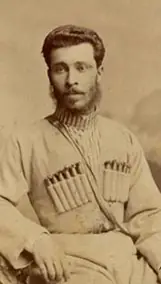
Giorgi Sadzaglishvili, 1881
In 1897 the Lord’s chosen one was tonsured a monk with the name Kirion and appointed abbot of the monastery of Kvabtakhevi. In this period, alongside his divine service, Kirion continues his scholarly work too: he collects examples of folk literature, studies the customs of the people, and works on the antiquities of churches and monasteries. He generously gives the Tbilisi Church Museum and the collection of antiquities of the Society for the Spreading of Literacy among Georgians rare manuscripts found in the damp cells of churches and monasteries and obtained from family collections.
In August 1898 Archimandrite Kirion was consecrated bishop of Alaverdi, which Georgian society greeted with great joy. Saint Kirion began at his own expense the repair of the cathedral of Alaverdi, which was on the verge of ruin, and set about studying the antiquities kept in the churches and monasteries of Kakheti. Together with other manuscripts he handed over to the Church Museum of Georgia a Gospel book from the time of Bagrat IV, copied in 1089, of which Georgian scholarship had known nothing until then. At the same time Kirion raised his voice against the seizure of Georgian churches by Armenians. He addressed a long, well-grounded memorandum to the Exarch of Georgia and demanded that these churches be returned to the Church of Georgia.
From 1901 Kirion is bishop of Gori. By this time the Georgian Exarchate had noticed that educated clergy were gathering round the holy hierarch who openly expressed their discontent at the abolition of the autocephaly of the Church of Georgia. The government often changed the bishop’s diocese: in 1903 he was assigned, in 1904 to Orel, in 1906 to Sukhumi. In Sukhumi Saint Kirion laboured much for the restoration of the churches and monasteries of Georgia. Soon he was transferred to the diocese of Kovno.
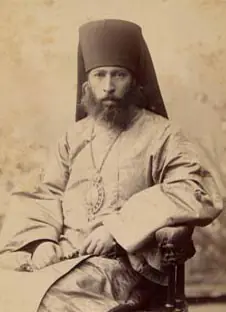
Kirion, Bishop of Alaverdi, 1898
In September 1907 the saint was not allowed to come to Georgia to pay his last respects to the body of the holy Ilia the Righteous. He managed only to send a telegram. In 1908, by a decree of the government, Kirion was deprived of his episcopal rank and arrested. The reason for such severity on the government’s part may have been Kirion’s unceasing struggle for the autocephaly of the Church of Georgia.
The persecution and oppression of Kirion grew ever stronger. On 28 May 1908 Exarch Nikon was murdered in Tbilisi, and the organisation of his murder was laid at the door of the persecuted hierarch. This slander outraged both Georgia and the progressive part of Russian society; in Europe a society for Kirion’s defence was even formed, and signatures were collected demanding his release. The holy hierarch met the trial that had befallen him in this spirit: “Who has ever picked a rose without thorns? We must bear suffering with love, for suffering is the fruit of love; the strength is in suffering.”
In 1915 the government ended the persecution of Kirion. He was appointed bishop of Polotsk and Vitebsk, but was not allowed to return to his homeland.
The saint was a very great benefactor. Through his material help some three hundred young Georgians received an education at institutions of higher learning in Russia and abroad.
As early as the 1890s, when the Georgian language was persecuted by the official authorities, Kirion together with Grigol Kipshidze compiled a history of Georgian literature.
In 1917 the autocephaly of the Apostolic Church of Georgia was restored, and at the insistent demand of Georgian society Bishop Kirion set out for his homeland in the summer of 1917. In the Aragvi valley some hundred horsemen met him and escorted him with great honour to the capital. In Tbilisi too a splendid welcome was arranged for the saint.
Kirion II, Catholicos-Patriarch of All Georgia, 1917
In September 1917, at the council of the whole Church of Georgia held in Tbilisi, Bishop Kirion was elected Catholicos-Patriarch, and he was solemnly enthroned on 1 October of the same year.
In the address given on the day of his enthronement at Svetitskhoveli, His Holiness and Beatitude the Patriarch said: “Beloved homeland, lot of the Theotokos, purified in the furnace of suffering and woe! Burned for thy sake, parted from thee, weeping for thee, ever yearning towards thee, today I come to rest in thy sweet bosom, not as a prodigal son but as one who shares the mysteries and as the conscience of thy Church… I know that thy attention is now turned towards me, and thou askest me: what hast thou brought me, with what balm wilt thou anoint my wounds, with what wilt thou comfort me, clothed in sorrow as I am? Give ear to me: ‘I came not to be ministered unto, but to minister unto thee, and to give my life a ransom for thee’ (Matt. 20:28). I have come not as a watchman appointed for hire, but as a faithful watchman, ever obedient.”
Kirion II sent letters to the heads of the Orthodox Churches of the world, in which he set out the history of the Church of Georgia briefly and with evidence, and demanded the recognition of the autocephaly of the Church of Georgia.
The work of the holy patriarch, who fought tirelessly to establish and revive the principles of faith and nation in Georgia, hampered the action of the evil forces gathered against the Church and the country, whose outbursts were taking an ever more dangerous and cynical form. At this time many churchmen and public figures were murdered. The first target of evil were those holy men whose authority among the people was very great. The religious and national work of Saint Kirion, who sat on the apostolic throne of the holy Church of Georgia, gave no rest to the enemies of the Church and the country; there began endless slanders, provocations, blackmail, threats, and… On 26 June 1918 the holy Catholicos Kirion was found murdered in the patriarchal residence of the monastery of Martqopi.
At the session of the Holy Synod of 17 October 2002 Kirion II, Catholicos-Patriarch of All Georgia, who ended his life as a martyr, was numbered among the saints.



