
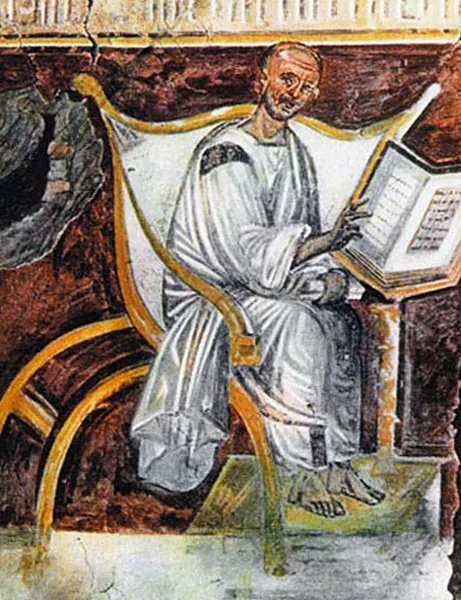
Blessed Augustine (+430)
Blessed Augustine, the greatest teacher of the Western Church, was born in November 354 near Hippo, in Thagaste, a small town of southern Numidia. His father, Patricius, was a pagan and was baptised only when Augustine turned seventeen, after which he soon died. He tried to give Augustine a good education, but never paid any attention to his morals and character. His mother, Monica, had received a truly Christian upbringing from her parents and was distinguished by a kindly nature and a virtuous, peace-loving life. Monica was twenty-three when Augustine was born; from his childhood she taught her son the name of Jesus and made him love it, but in spite of this Augustine gave himself up to immorality and a dissolute life. This was brought about by the vicious morals and customs of his time that surrounded him, a circle of bad friends, and a life without restraint. With a temperament typical of an African, the young Augustine sank into debauchery; he considered the Bible a dead book and read it as a polemicist. The gates of the spirit were shut to him, because he approached Holy Scripture without sincerity and obedience.
At seventeen Augustine went to Carthage to be educated. Here he easily fell into the net of the Manichaeans, who, though they often mentioned the Saviour’s name, were by their teaching and way of life enemies of the Church of Christ. Their teaching infected Augustine with the disease of seeking justification for his own sins. His sins seemed insignificant to him, and he regarded them not as the result of his own will, but as the tyranny of an outside evil power. The young Augustine sank so deep into this heretical swamp that he drew even his friends and acquaintances in after him. For nine years he was a Manichaean. Later doubt about the Manichaean teaching gradually settled in Augustine. He saw that they were more successful at destroying than at building. Augustine resolved to leave Carthage.
Blessed Augustine’s mother, Monica, grieved beyond measure over her son’s Manichaeism. She would not live with one who had gone astray, and no longer even shared his table. Monica wept for her son as for a dead man, and prayed unceasingly that God would turn him to the true faith. Seeing the mother’s zeal, one bishop comforted her thus: “Live as thou livest, for it is impossible that the son of these tears should perish.”
Having returned to his homeland, Augustine began to work as a teacher of grammar. At twenty-nine he met the Manichaean “bishop” Faustus, whom the Orthodox called a snare of death. In his dealings with him Augustine discovered many contradictions in the teaching and way of life of the Manichaeans. After his conversation with Faustus, Augustine set off for Rome. At this time he wrote: “Hasten thither whence the truth shines.” Augustine did not stay long in Rome: with his friend Alypius he went on to Milan to hear the preaching of Saint Ambrose of Milan. “God brought me to him, that through him I might come to God,” he wrote afterwards. Saint Ambrose received him with fatherly love. Hearing his preaching gave Augustine the greatest delight. Soon he began to study Holy Scripture under the guidance of the great hierarch. The word of God had a decisive influence on him. Augustine and Alypius became diligent and obedient pupils of the catechists, although in gifts and knowledge they far surpassed their teachers. In 387, a few days before Pascha, Augustine was baptised together with Alypius, distributed all his property to widows and orphans, and took up the monastic life. His last conversation with his mother is wonderful: “The one reason why I wished to live long in this world was that I might see thee an Orthodox Christian before I died. But God has granted me even more: today I see that thou hast risen above all things of this world and hast dedicated thyself to the Lord. What then is left for me in this world?” Five days later Monica commended her soul to the Lord.
In 391 Valerius, Bishop of Hippo, ordained Augustine presbyter. The blessed father’s work in this rank was many-sided and fruitful. He founded the first women’s monastery in Africa. Through his efforts a terrible custom was abolished in Mauretania, in which the inhabitants of the city divided into two armed parties and fought each other.
In the forty-fifth year of his life Augustine was consecrated bishop. Soon he occupied the see of Hippo. The blessed father devoted the thirty-five years of his episcopate to the struggle against Manichaeism, Donatism and Pelagianism. In this polemic he did not content himself with the pen alone, but also defeated the heretics face to face in disputations, and his conversations were afterwards spread among the faithful. Blessed Augustine’s house was always open to all. On his table these words were written: “Whoever loves to reproach the lives of others behind their backs, let him know that this table rebukes him.” His sermons were meant for simple fishermen and craftsmen, not for the aristocracy of Antioch or Constantinople. The simplicity of these sermons was very close to the spirit of the Gospel.
The Lord made Blessed Augustine worthy of many wonderful visions. One of the brightest events of his life was the vision of the Child Jesus, who wanted to pour the whole ocean into one small hole in the sand. It was just at this time that Augustine was trying to grasp with his own mind the mystery of the Holy Trinity. By this vision God showed the blessed father once more the limitedness and helplessness of the human mind. The saint himself also worked many miracles. Many sick people were healed through his prayer.
In 430 the Vandals burned Hippo. The only thing that by God’s will escaped the fire was Blessed Augustine’s library. Carthage too soon fell. The Church of North Africa found itself in a grievous state. Augustine was the last bishop of Hippo. He saw with his own eyes the death of his beloved city, after which he did not live long. He died on 28 August 430.
Many works came from Blessed Augustine’s pen (according to his biographer, their number exceeds one thousand and thirty). Especially notable are his Confessions, On the City of God, seventeen books against the Pelagians, commentaries on the book of Genesis, and others. He strove to make his writings accessible and profitable to all. “It is better that the grammarians should reproach us than that our thoughts should be incomprehensible to the people,” he used to say.



