
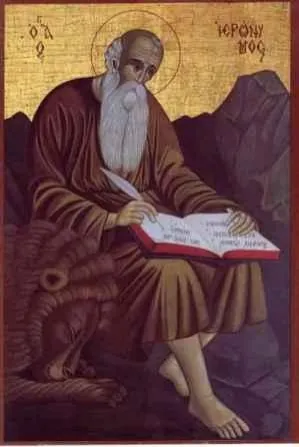
Blessed Jerome of Stridon (+420)
Blessed Jerome of Stridon was born into a Christian family living in the city of Stridon (Dalmatia and Pannonia). For his education his parents sent the young man to Rome, where he studied the secular sciences. On arriving in the capital Jerome at first lived amid the luxury of the city and youthful licence, but soon the desire ripened in him to change his way of life from the root. The future saint was twenty when he was baptised. After this he went to Gaul, where he finally decided to devote himself to God and become a monk.
Around 372 Jerome returned to his native city; he found his parents dead, and the care of his younger sister and brother fell on him as a burden. Burning with divine zeal, he had to put off becoming a monk. At this time he studied Holy Scripture diligently.
After settling his family affairs the blessed father set out for the East. He lived for five years in a monastery in Syria. Here Jerome worked chiefly on Holy Scripture and lived a strict ascetic life. Jerome studied the Hebrew and Chaldean languages thoroughly. At this time his correspondence with many people on various subjects began. A hundred and twenty of his letters have come down to us. Soon the unrest and discord that arose in Antioch among the supporters of the bishops Meletius, Paulinus and Vitalis made itself felt in the monastery where blessed Jerome was labouring too, and because of this he had to leave the monastery and go to Antioch. There Bishop Paulinus ordained the saint priest. Then Jerome went to Constantinople, where he conversed with the holy hierarchs Gregory the Theologian and Gregory of Nyssa, and in 381 he set out for Rome. Here he continued his scholarly work. The holy Pope Damasus I (366–384), who was also occupied with the study of Holy Scripture, drew the blessed father close to him, but the Roman Christians, irritated by Jerome’s denouncing words, came to hate him and three years later forced him to leave the city. With his brother Paulinian and his friends the saint made a pilgrimage to the Holy Land, visited the monks of the Nitrian desert, and in 386 settled in Bethlehem, near the cave where Christ was born, and took up strict labours.
This was the flowering of the blessed father’s creative work. The outstanding scholar of his time left the Church a rich written legacy: dogmatic and polemical and moral and ascetic writings, interpretations of Holy Scripture, and historical works. His chief work is a new translation into Latin of the sacred books of the Old and New Testaments. This translation, called the Vulgate, is in universal use in the Western Church.
Saint Jerome died in his cell in the cave at Bethlehem around 420. His holy relics were translated to Rome.



