
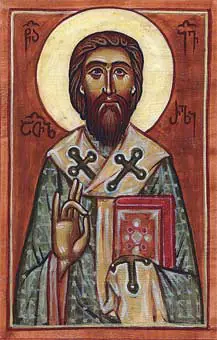
Saint Anthim the Iberian (+1716)
Saint Anthim the Iberian was one of the most learned men of his time; he knew many foreign languages — Greek, Romanian, Church Slavonic, Arabic and Turkish — and was well versed in theology, literature and natural science. He was endowed with a wonderful talent and was a brilliant master of every branch of art, especially painting, engraving, carving and wood-cut printing. He was known as a fine calligrapher, a skilled wood-carver and a gifted sculptor. He was a reformer of the literary Romanian language, a brilliant writer and an acknowledged orator.
Anthim the Iberian gave his life for the liberation of Wallachia, which had become his second homeland, from the yoke of the Turks and the Phanariots. Information about the childhood and youth of this remarkable man has survived only scantily. It is known that he was a native of Samtskhe-Saatabago. The richly gifted youth accompanied King Archil to Russia and greatly helped in setting up the Georgian printing press. On his return to Georgia Anthim was seized by mountaineers of the Caucasus and sold as a slave. He was ransomed from captivity by Dositheus, Patriarch of Jerusalem. Anthim used his time at the Patriarchate to perfect his education and his craft. Already a famous painter, engraver and calligrapher, around 1690 he went to Wallachia at the invitation of the prince of Wallachia, Constantine Brâncoveanu. As soon as he arrived in Wallachia, Anthim took charge of printing. Printing reached an unprecedented scale throughout the country and attained the highest level. The inspirer, organiser and patron of all this was a Georgian master exiled from Georgia, who everywhere and in everything stressed his Georgian origin and noted that he was “a Georgian by birth”. Anthim the Iberian was able to make Wallachia a centre of Orthodoxy that supplied the whole Christian East with books.
In 1694 Anthim was appointed abbot of the monastery of Snagov. Here he laid the foundation of a new press. In 1696 “The Service for 21 May, the Day of the Glorification of the Saints” was printed at the Snagov press. It bears the signature of the subdeacon Michael, afterwards the famous founder of the first Georgian press, Mihail Iștvanovici.
In 1705 Anthim, “chosen among the chosen abbots of Wallachia”, was consecrated bishop of Râmnic, and in 1708 metropolitan of Ungro-Wallachia. Anthim’s installation as metropolitan was the greatest happiness for the whole country. In this connection the abbot of one of the monasteries wrote: “A great man has come to the land of Wallachia; the divine Anthim, hierarch of Ungro-Wallachia, son of the wise race of the Iberians, has brought light. God has rewarded him with an unfailing spring of wisdom, that he might do good works and with his press bring profit to the people in this world.”
Under Saint Anthim’s direct guidance more than twenty churches and monasteries were built in Wallachia, of which the monastery of All Saints in the centre of Bucharest is especially worth noting. The oak door of the church’s main entrance and the Georgian ornaments carved in stone were made by Anthim the Iberian himself. The metropolitan also compiled a typikon for the monastery of All Saints. Anthim attached decisive importance to the question of the monastery’s independence: namely, he declared the monastery of All Saints independent of the Greek church.
From the day of his installation as metropolitan Saint Anthim began an unceasing struggle for the liberation of the Wallachian people from the oppression of foreign conquerors. On the very first day, standing before his flock, Anthim said: “You have kept Orthodoxy holy and unsullied, although you are surrounded and bound by the violence of foreign peoples and suffer countless hardships and misfortunes, which always come from those who rule over this land at their own will. Though I was unworthy and the least among the others, as David was the least among his brothers, God did not look upon my poverty and my being a stranger. Let every hardship that time and the hour allot us fall upon me together with you.”
His words proved prophetic. In 1714 the Turks executed the prince of Wallachia, Constantine Brâncoveanu, and in 1716 the last Wallachian prince, Stephen Cantacuzino, and raised to the throne the Phanariot Nicholas Mavrocordatos, whose whole activity was directed to defending Turkish interests in Wallachia.
In these hard days Anthim the Iberian gathered round himself a group of Wallachian boyars whose aim was to free Wallachia from the rule of both the Turks and the Phanariots. Concrete measures were planned too, but Nicholas Mavrocordatos ordered Anthim to renounce the metropolitanate voluntarily. Anthim sent back a categorical refusal. Then Mavrocordatos turned for help to Jeremiah, Patriarch of Constantinople. A council of bishops, at which not a single Romanian cleric was present, anathematised Anthim as “a conspirator and rebel inciting to revolution”, cut him off from the Church and declared him deprived of every priestly rank; but for Nicholas Mavrocordatos it was not enough to have Anthim the Iberian removed from the metropolitanate of Ungro-Wallachia, and he resolved to get him out of Wallachia. He brought it about that Saint Anthim was finally banished to Mount Sinai, to the monastery of Saint Catherine. The metropolitan, devoted to the Romanian people and loving them, was taken out of the city at midnight, because they feared unrest among the inhabitants; but Anthim the Iberian never reached Mount Sinai. Near Gallipoli, on the bank of the river Dulchia, which flows past Adrianople, Turkish soldiers hacked Anthim the Iberian to pieces and threw his holy remains into the river.
So ended the life of yet another Georgian saint, who devoted all his inexhaustible knowledge, talent and energy to the spiritual strengthening of the Wallachian people and the revival of their national culture.
In 1992 the Romanian Church numbered Anthim the Iberian among the saints and appointed 14 (27) September, the day of the saint’s death, as the day of his commemoration. The Georgian Church keeps his memory on 13 (26) June.



