
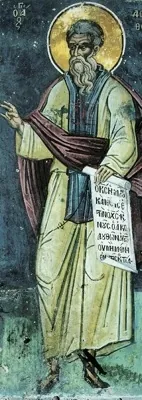
Venerable Abba Dorotheus of the Monastery of Seridus (+620)
The Venerable Abba Dorotheus (VI) was a disciple of Saint John (commemorated 6 February) and laboured in Palestine, in the monastery of Abba Seridus.
In his youth the future saint diligently mastered the sciences. “At first learning was very hard for me,” he later recalled; “when I went near a book, I felt as though I were falling into the jaws of a beast; but when I forced myself, the Lord helped me, and I grew so used to it that, from the warmth I felt while reading, I forgot what I ate, what I drank, how I slept. No one could draw me to a meal with any of my friends, and because of reading I did not even go out to talk with them, though I loved them all very much. When the philosopher dismissed us, I went to my lodging and did not know what I would eat, for I grudged spending time on preparing a meal.” So Abba Dorotheus drank in the wisdom of books. With still greater zeal the saint took up the monastic struggle after he went out into the desert. “When I came to the monastery,” he wrote, “I said to myself: if thou hadst so much love and warmth for outward wisdom, thou must have still more for the virtues! And this strengthened me.”
The Venerable Dorotheus’s first obedience was receiving and settling the pilgrims who came to the monastery. With the means of one of the brethren the Venerable Dorotheus built a hospital, in which he himself was one of those who served. He recalled: “I had only just been freed from heavy labour when, towards evening, wanderers came to the monastery. I spent the whole evening with the guests. Then camel-drivers came. I prepared for them too everything needful; it often happened that I was woken as soon as I had lain down to sleep, and meanwhile the time of the night vigil would come.” To fight against sleep, Abba Dorotheus asked one brother to wake him for the beginning of the service and begged another not to let him doze during the prayers. “And believe me,” the holy father said, “I honoured these brothers as though my salvation depended on them.”
For ten years the Venerable Dorotheus was a disciple of John the Prophet. Even before, he had sincerely revealed his thoughts to the holy father, and now he entrusted himself wholly to his will and felt no sorrow at all; at the same time he feared that he might not please the Lord, who has promised salvation to those who endure afflictions to the end, but the elder calmed him: “Do not grieve; thou hast nothing to be troubled about; those who live in obedience to the fathers are blessed with freedom from care and with peace.” The Venerable Dorotheus considered it the greatest happiness to serve the valiant ascetic. Besides the teachers of the monastery of Abba Seridus, Abba Dorotheus also visited other great fathers of his time, among them Abba Zosimas, and listened diligently to their counsels.
After the death of the Venerable John the Prophet, Dorotheus left the monastery of Abba Seridus and founded his own monastery, which he governed wisely until his death. To the holy father belong twenty-one instructions, several letters, and eighty-seven questions with written answers from the venerable fathers Barsanuphius the Great and John the Prophet; thirty ascetic discourses and a record of the teachings of Abba Zosimas have also survived in manuscript. The works of Abba Dorotheus are filled with great spiritual wisdom; they are distinguished by a clear, refined style and a simple language accessible to all. The holy father often turned to the counsels of Basil the Great, Gregory the Theologian and Gregory of Nyssa. Obedience and humility, joined with deep love of God and neighbour, are the virtues without which spiritual life is impossible: this thought runs through his writings. Behind them the personality of the author is clearly seen, whom the Venerable Dorotheus (commemorated 19 February) describes thus: “In his dealings with his fellow strugglers he was modest, obedient and affectionate; arrogance and insolence were foreign to him; he was marked by kindness and simplicity, and in disputes he loved to give way, which is the beginning of modesty, of good will, and of a like-mindedness sweeter than honey, the mother of all virtues.”
The teachings of Abba Dorotheus are a reliable guide for those who have set out on the spiritual struggle and for all who sincerely desire salvation.



