
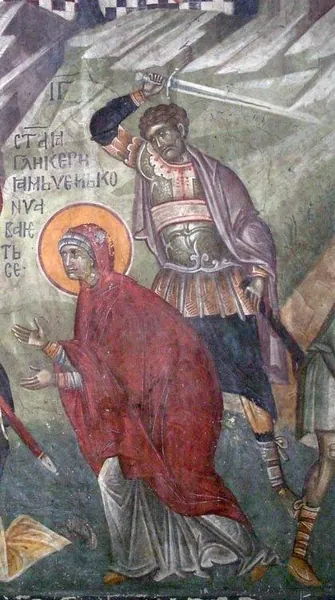
Holy Martyr Glyceria the Virgin and with Her Laodicius the Jailer (+177)
The holy Martyr Glyceria the Virgin and with her Laodicius the jailer (+177) met a martyr’s end for confessing Christ in the time of the Emperor Antoninus (138–161). Saint Glyceria was born into an aristocratic family. Her father Macarius was governor of the city of Rome, and later moved to the Thracian city of Trajanopolis. Glyceria was orphaned early. Her closeness to Christians brought the virgin to the true faith. She went to the church of God every day. The governor of the city, Sabinus, received the emperor’s order to require the Christians to perform the pagan rite of sacrifice. He appointed a day for the general worship of the idol of Zeus. Saint Glyceria firmly resolved to die for Christ; she revealed her wish to the Christians and asked them to pray for her. On the feast of Zeus the virgin, with a cross traced on her forehead, appeared in the temple. The saint stood in a place lit by the sun, took off her head covering, and showed everyone the holy cross traced on her forehead. The lamb of Christ fervently besought the Lord to bring the pagans to their senses and to shatter the stone idol of Zeus. Suddenly a crash was heard. The statue of Zeus fell to the ground and was shattered. The enraged Sabinus and the priests ordered the people to stone Glyceria, but the stones did not reach the saint: the Lord protected His chosen one. The confessor of Christ was shut up in prison. A Christian priest, Philocrates, visited her and encouraged her. In the morning the virgin was led out to be tortured. When the torture began, an angel suddenly appeared among the executioners. All of them, stricken with fear, fell prostrate on the ground. When the vision vanished, by Sabinus’s order the saint was taken back to prison; the doors were firmly sealed and stamped with the governor’s personal seal. Throughout her imprisonment an angel of the Lord brought the holy virgin bread and water. After many days Sabinus himself broke the seal, went into the cell, and was astounded to see the saint alive and well. Sabinus went to Heraclea and took Saint Glyceria with him. Dometius, Bishop of Heraclea, came out with his clergy to meet the saint, and they prayed for her strengthening. In Heraclea Saint Glyceria was thrown into a red-hot furnace, but the fire went out and the furnace grew cold. The governor, beside himself with fury, ordered the virgin to be flayed. Miraculously, at midnight an angel of the Lord came down from heaven and healed the martyr’s wounds. In the morning the jailer did not recognise Saint Glyceria; he thought the prisoner had escaped, and for fear of punishment decided to kill himself, but the saint stopped him. Shaken by the miracle, Laodicius believed in the true God and begged the saint to pray for him, that he too might die with her for the glory of the Lord. “Follow Christ and thou shalt be saved,” the holy virgin answered. Laodicius put Saint Glyceria’s fetters on himself; at the tribunal he told the governor and those present of the healing of the holy virgin by the angel, and publicly confessed Christ. The chosen one of God was beheaded at once. The Christians secretly carried away his body and buried it with honour.
Saint Glyceria was thrown to the beasts to be torn apart, but a lion meekly licked her feet. The saint besought the Lord to receive her soul. And a voice was heard from heaven, announcing that the doors of the Kingdom were open for the bride of Christ. At that moment a second lion was let out of its cage. It killed the saint but did not tear her body. Bishop Dometius and the Christians of Heraclea buried the holy Martyr Glyceria with honour. Soon healing myrrh began to flow from her holy relics.



