
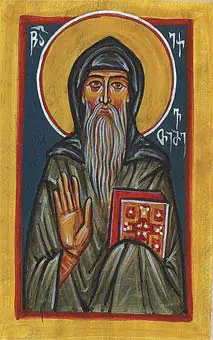
Venerable Euthymius the Athonite, the Translator (+1028)
The Venerable Euthymius of the Holy Mountain was born in the 960s. The saint’s life began in a wonderful and remarkable way: his father, Saint John of the Holy Mountain, had in the world been a general of David the Kuropalates, king of Georgia. Saint John left his home, his wife and child, his kinsfolk and the brilliant life of the court, because he had “that fire of the love of Christ burning fiercely in his heart”; he made his way to the lavra of Otkhta Eklesia and there received the blessing of monasticism from the fathers labouring in it.
John’s wife and son were taken into their care by his father-in-law Abuharb and his brothers-in-law. John went from Georgia to Mount Olympus and took a place in a monastery as keeper of the mules. At this time the Greek emperor gave the upper lands to David the Kuropalates, and in return, to secure his loyalty, demanded the sons of the aznaurs as hostages. Among the hostages was John’s young son, Euthymius.
John, on Mount Olympus, learned late that his son was in Constantinople; he could not bear it, went to the Greek emperor and begged his son back, and said reproachfully to his father-in-law: “What is this? Have you no sons? But this is plain: you had mercy on them as your own children, while my son you gave up as a hostage like an orphan! But may the Lord forgive you.” John took Euthymius to Mount Olympus. By this time Euthymius had entirely forgotten the Georgian language.
Soon the name of the Venerable John spread over all Olympus and its surroundings; “the Greeks and the Georgians paid him honour”, and so “he turned again to a stranger’s life”: he went with his son and some disciples to the mountain of Athos and shut himself up in the lavra of the Venerable Athanasius the Great (commemorated 5 July).
The grace of the Holy Spirit came down upon Euthymius from his childhood: once the boy fell gravely ill. His father lost hope of his son’s recovery, sent a man to the priest and asked him to give the dying boy communion, while he himself went to the church and fell down in prayer before the icon of the all-holy Theotokos.
When Saint John came back from the church to the cell, he at once caught the sweet fragrance of myrrh and saw that the boy, who a few minutes before had been lying on his deathbed, was sitting up entirely well. He told his father that while he had been away in the church a glorious queen had appeared to him and asked him in Georgian: “What is it, what ails thee, Euthymius?” “I am dying, my Lady,” Euthymius answered. Then the queen took him by the hand and said: “There is nothing wrong with thee; rise, fear not, and speak Georgian freely.” After this miraculous healing Georgian “welled up from his mouth like a spring, purer than that of all the Georgians”.
The Venerable John gave thanks to the Lord and explained to his son what this vision meant: “My son, the land of Kartli is in great want of books, and many books are lacking to it, and I see that God has granted this grace to thee. Now labour, that thou mayest multiply thy reward from God.”
Saint Euthymius joyfully set about fulfilling his father’s command, and soon amazed everyone by his labour. When the right-believing King David the Kuropalates read the books sent from the Holy Mountain, he was filled with joy, glorified God and said: “Thanks be to God, who in these our times has brought forth a new Chrysostom.” From time to time the king would send commissions to the Athonite father.
The writer of the Venerable Euthymius’s life, Saint George of the Holy Mountain, lists more than fifty translations and adds: “All these, and very many more books than these, did our God-clad father translate, and so did he increase the talent entrusted to him.”
After his father’s death Saint Euthymius became abbot of the Iviron monastery on Athos; the office of abbot brought Euthymius other tasks too, so the blessed father had to work on the books mainly at night, by candlelight. He gave no rest to a body already weakened by strict fasting.
Father Euthymius worked many miracles: while his father, the Venerable John, was still alive, a terrible drought struck Greece. Four months passed without rain, trees and vines withered, the earth cracked. Father John ordered his son: “Take the brethren and go to the church of the holy Elijah, and keep vigil through the night, and celebrate the Liturgy.” At the Liturgy, during the reading of the Gospel, a cloud appeared in the sky, and when Holy Communion began, the rain came.
On the feast of the Transfiguration, people who had climbed the mountain of Athos to pray saw with their own eyes Father Euthymius wrapped in a flame of fire. The people fell on their knees before him, but Euthymius calmed them: “Fear not, brethren, for a divine visitation has come to pass, and Christ has glorified His own feast.”
Father Euthymius established in his monastery a strict and just rule, which everyone was bound to keep.
The devil could not bear such God-pleasing labour of Father Euthymius and the brethren of his monastery, and — how astonishing it is — the evil power found someone to do its will even on the Holy Mountain, and twice sent a murderer against Saint Euthymius; but God’s providence protected Euthymius’s life, and both times he miraculously escaped death.
Saint Euthymius was abbot of the Georgian monastery on Athos for fourteen years, and then, since his work as a writer needed a great deal of time, in accordance with his father the Venerable John’s charge he handed over the office of abbot to Father George, while he himself shut himself up in his cell in order to give himself wholly to translation.
The Emperor Constantine VIII, who “had great faith and love towards him because of his worthiness”, summoned Saint Euthymius to the imperial court. The venerable father gathered the brethren, prepared a meal for them and asked them to pray for him; then he went to his friend, the priest Theophanes, with whom he had grown up from childhood. At parting the priest Theophanes embraced Saint Euthymius and said with tears: “Woe is me, wretch that I am, for I shall never see thee again in the flesh, O holy father!” The Venerable Euthymius confirmed what had been foretold.
The emperor received the venerable father with great honour. After the feast of Saint John the Theologian, Father Euthymius decided to go and see an icon he had entrusted to a painter. A newly bought mule was saddled for him. On the road a beggar clothed in black stood in his way and asked for alms. The venerable father put his hand into his pocket, but at the sight of the ragged beggar the mule took fright, bolted and threw the saint to the ground.
All Greece wept for the dying Father Euthymius.
Saint Euthymius reposed in prayer and in glorifying God, and “went before God into that light that knows no shadow, with all the saints who from the ages have been pleasing to God” (+1028).
Saint Euthymius was buried on the mountain of Athos “in a burial shrine in the church of the holy John the Baptist”.



