
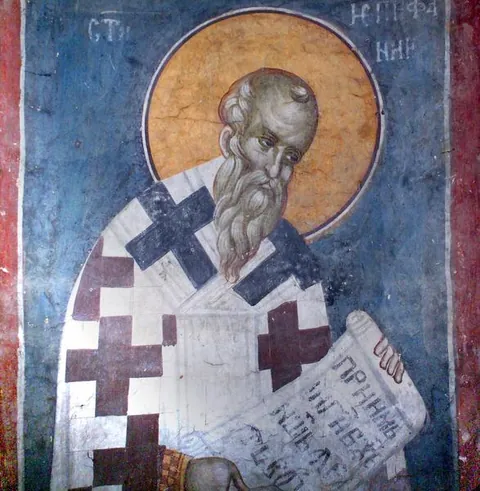
St Epiphanius, Bishop of Cyprus (+403)
Saint Epiphanius, Bishop of Cyprus (+403), was a Hebrew by origin and lived in Phoenicia. Once he saw a monk named Lucian give his garment to a beggar. Moved by the monk’s kindness, Epiphanius asked him to explain Christianity to him; then he was baptised and went to the monastery Lucian had founded. There he laboured under the guidance of an experienced monk, Hilarion, and his obedience was the copying of Greek books. For his virtuous life Saint Epiphanius was granted the gift of wonderworking. To avoid human glory he withdrew into the desert of Spanydrion. He was seized by brigands and held captive for three months. By his grace-filled words the saint converted one of the robbers to the true faith. When Epiphanius was set free, that robber followed him. Saint Epiphanius brought him to the monastery and baptised him with the name John. News of Saint Epiphanius’s righteous and God-pleasing life spread among the people, and so he made for the desert again, this time with John. Disciples came to the saint here too, and some stayed there. So a new monastery was founded.
Some time later Saints Epiphanius and John decided to go to Jerusalem to venerate the holy places. The inhabitants of the city of Lycia sent the monk Polybius to Saint Epiphanius and asked him to take the episcopal see. The ascetic, endowed with the grace of foresight, learned of their wish beforehand and secretly left the place: he went to the desert of Paphos, to Saint Hilarion (commemorated 21 October), under whose obedience he had been in his youth. The saints spent two months in unceasing prayer; then Saint Hilarion sent Saint Epiphanius to Salamis, where bishops had gathered to choose a new hierarch. The Lord revealed to the eldest bishop, Papius, that they should choose as bishop the monk Epiphanius, who had come to the city. The saint was sought out. Saint Papius brought him into the church and told him the will of the fathers of the council. Saint Epiphanius was forced to consent. So Saint Epiphanius took the see of Salamis in 367.
For his holy life Epiphanius received the grace of seeing the descent of the Holy Spirit on the Holy Gifts while celebrating the Liturgy. Once, while celebrating the holy Mystery, Saint Epiphanius did not see this miracle. He called one of the faithful and said to him quietly: “Go out, my child; today thou art not worthy to be present at the celebration of the holy Mystery.”
At the end of his life Saint Epiphanius was summoned to Constantinople, by order of the Empress Eudoxia and Theophilus, Patriarch of Alexandria, to a church council that was to judge the great father of the Church, Saint John Chrysostom (commemorated 14 September and 13 November). The saint would not take part in the unlawful council and left Constantinople. During the voyage he felt that death was near, left his last instructions to his disciples, and two days later died. The inhabitants of the city of Salamis mourned their hierarch bitterly, and on 12 May 403 buried him with honour in the church the saint had built.
The Seventh Ecumenical Council called Saint Epiphanius a father and teacher of the Church.



