
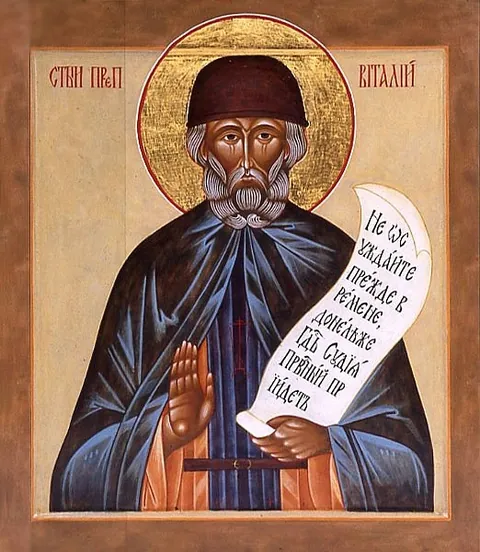
Venerable Vitalis (609–620)
The Venerable Vitalis (609–620) was a monk of the monastery of the Venerable Seridus; he came to Alexandria in the time of the holy Patriarch John the Merciful (commemorated 12 November).
Having reached the age of sixty, the monk took on an unusual labour: he wrote down in his list of commemoration the names of all the harlots of Alexandria and prayed fervently for them. The venerable father worked diligently from morning till evening and received twelve copper coins in payment; he bought himself a piece of bread, and the rest of the money he gave to one of the harlots, asking her not to fall into sin that night. Then he shut himself in with the harlot and prayed all night and read the psalms while the woman slept, and in the morning quietly left. In this labour he spent every night. He went to all the harlots in turn, begging each of them to keep secret the saint’s visits to them. The people of Alexandria did not know the true reason for the monk’s conduct, and in their indignation insulted him.
The Venerable Vitalis’s holy prayer saved many fallen women: some went to a convent, some married, some took up honest work; but none of them dared to name the reason for their amendment, for they were bound by the oath they had given Saint Vitalis. When one woman broke her oath and began to defend the monk, she was tormented by the devil. After this the Alexandrians no longer doubted the venerable father’s “guilt”.
Several Alexandrians denounced the Venerable Vitalis to the holy Patriarch John the Merciful, but he did not believe the slanderers and said to them: “Judge no one, and monks above all. Do you not remember what happened at the Council of Nicaea? Some priests and bishops denounced one another in writing to Constantine the Great. He burned the letters without reading them and said: ‘If I saw with my own eyes a hierarch or a priest fallen into sin, I would cover him with my own garment, so that no one else should see his sin.’” So the wise hierarch put the slanderers to shame.
The saint went on with his hard labour: a sinner and fornicator in the eyes of the people, he called fornicators to repentance.
Once, as the venerable father was coming out of a brothel, he ran into a young man who was going in to the harlots. The young man struck the saint in the face and told him that he was dishonouring the name of Christ. The Venerable Vitalis answered him: “Believe me, because of me thou shalt receive such a blow that all Alexandria will gather at thy cries.”
Some time later the Venerable Vitalis died. A terrible evil spirit appeared to the young fornicator and struck him in the face. The young man fell to the ground, tore his clothes, and shouted so loudly that a great crowd of people gathered.
A few hours later the young man came to his senses and ran to the saint’s cell, shouting: “Have mercy on me, servant of God, for I have sinned against thee.” At the door of the cell the young man was completely healed, and he told those who had gathered about his meeting with the Venerable Vitalis; then he knocked, but received no answer. When they broke down the door, they saw that the monk, kneeling before an icon, had fallen asleep in eternal sleep. In his hand the saint held a paper scroll on which was written: “Men of Alexandria, judge nothing before the time, until the Lord come, the true Judge.”
The woman tormented by the evil one, who had been punished for breaking the oath given to Saint Vitalis, came to the cell. At the touch of the saint’s body the woman was healed, and she told those gathered of the saint’s goodness and labours.
Saint John the Merciful rejoiced that he had not believed the evil tongues. He buried the saint’s remains with great honour. After this many Alexandrians vowed not to judge others.



