
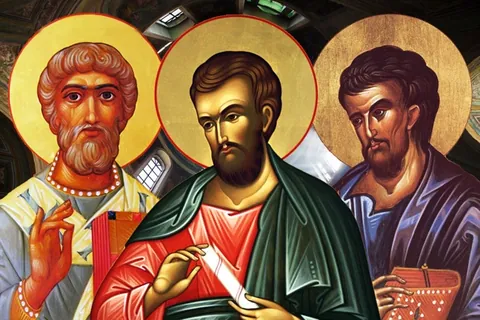
Apostles Nathanael, Luke and Clement (I)
Saints Nathanael, Luke and Clement (I). Saint Nathanael, that is, Bartholomew, a native of Cana of Galilee, was one of the twelve apostles. When the Holy Spirit came down upon the apostles on the fiftieth day, it fell to him and to the Apostle Philip (commemorated 14 November) to preach the Gospel in Syria and Asia Minor. With the holy Apostle Philip went his sister, the virgin Mariamne. In the cities of Syria and Asia they endured many afflictions. In one village the saints met Saint John the Theologian and set out with him for Phrygia. In Hierapolis the apostles by their prayer destroyed a huge viper, which the pagans worshipped as a deity. Saints Nathanael and Philip, with his sister, confirmed their preaching with many other miracles as well.
In Hierapolis lived a certain Stachys, who had been blind for forty years. Through the apostles’ prayer he was healed, believed in Christ and was baptised. This became known throughout the city, and a great crowd of people thronged to the apostles’ lodging. The governor of the city ordered Nathanael and Philip to be imprisoned and Stachys’s house to be set on fire. At the trial the pagan priests accused the apostles of deceiving the people and insulting the gods of their forefathers. The governor of the city thought that the saints’ garments had magical power, and ordered them to be stripped. To the eyes of the pagans the virgin Mariamne turned into a fiery torch, and no one dared come near her. The saints were sentenced to crucifixion. When Philip was nailed to the cross head downwards, the land shook, the earth split open, and swallowed up the governor of the city, the priests and the onlookers. The godless who were left alive took fright and decided to release the saint, but the apostle had already died. The holy Apostle Bartholomew and the blessed Mariamne made Stachys bishop of the city, and themselves set out elsewhere.
The blessed Mariamne went to Lycaonia to preach the word of God and died there in peace (commemorated 17 February). Saint Nathanael, who is Bartholomew, set out for India; he translated the Gospel of Matthew from Hebrew into the local language and converted many pagans to the law of Christ. Later he visited Greater Armenia, where he worked many miracles and healed the king’s daughter of an evil spirit. The grateful king offered the apostle a reward, but he answered that he sought only the deliverance and salvation of men’s souls. Then the king was baptised together with his healed daughter and many of his subjects. Hundreds of the inhabitants of the cities of Greater Armenia followed their example. Egged on by the embittered pagan priests, the king’s brother Astyages seized the apostle in the city of Alban (present-day Baku) and crucified him head downwards. Saint Bartholomew went on preaching from the cross. Enraged by the apostle’s zeal, Astyages ordered him to be flayed and beheaded. The faithful laid Saint Bartholomew’s body in a lead shrine and buried it. In 508 the apostle’s holy relics were translated to Mesopotamia, to the city of Dara. In 574 the city was taken by the Persians. The Christians took up Bartholomew’s relics and set out towards the Black Sea. The Persians attacked those carrying the holy burden. So that it should not fall into the hands of the enemy, the faithful let the shrine down into the sea. By God’s providence it floated to the shores of the island of Lipari. In the ninth century, after the Arabs conquered the island, the holy relics were translated to the Neapolitan city of Benevento, and in the tenth century to Rome.
By the will of God a portion of the holy relics of the Apostle Bartholomew came to Saint Joseph the Hymnographer (+883, commemorated 4 April). The venerable father took it to his monastery near Constantinople and built a church in the name of the holy apostle. Burning with a strong desire to give the saint still greater honour, Joseph fervently asked God for the grace to compose a canon in his praise. And behold, on the day of the commemoration of Saint Bartholomew the holy apostle himself appeared to the venerable father in the altar, called Joseph, laid the altar Gospel on his breast, and said to him: “May the Lord bless thee; may thy hymns sweeten the world.” After this the Venerable Joseph was granted the gift of composing hymns, and he composed more than three hundred canons.
The holy Apostle Luke was born in Antioch of Syria. A fellow labourer of the holy Apostle Paul (Philem. 24; 2 Tim. 4:11), he was a physician by profession. When he heard of the works of Christ, Luke came to Palestine and received the teaching of the Gospel from the Lord Himself. The holy apostle was sent to preach the Kingdom of Heaven during the Saviour’s earthly life (Luke 10:1–3), and after the Resurrection the Lord Himself appeared to him as he was walking with Cleopas towards Emmaus.
Saint Luke accompanied the Apostle Paul on his second missionary journey. After that they were never parted (2 Tim. 4:11). After the martyr’s end of the chief apostles Saint Luke left Rome and travelled, preaching, through Achaia, Libya, Egypt and the Thebaid. In the city of Thebes he ended his life by martyrdom.
Tradition ascribes to Saint Luke the painting of the first icons of the Mother of God: “May the grace of Him who was born of me be with this icon through my intercession,” the All-holy Virgin is said to have declared on seeing the icon. The holy apostle is said to have painted icons of the chief apostles Peter and Paul, and his name is linked with the Atskuri icon of the Mother of God, which the holy Apostle Andrew brought to Georgia.
In 62–63, under the guidance of the holy Apostle Paul, Saint Luke is said to have written his Gospel. The very first verses tell us that his aim was to describe more fully and in chronological order everything that was known of Jesus Christ and His teaching, and thereby to lay a firm historical foundation for Christian hope (1:1–4). He investigated the facts in detail, and in composing his Gospel made wide use both of the oral tradition of the Church and of the account of the All-holy Mary herself (2:19, 51).
In Rome, in 62–63, Saint Luke is said to have written the “Acts of the Apostles”, which is a continuation of the Gospels and tells of the labours and struggles of the holy apostles after the Ascension of the Saviour. In the narrative the main attention is given to the greatest event in the Church, the Council of the Apostles (51), which laid the dogmatic foundation for separating Christianity from Judaism and became the pledge of its independent spread throughout the world (Acts 15:6–29). The theological subject of the “Acts of the Apostles” is above all the providence of the Holy Spirit, which after the Ascension and Pentecost is at work, until Christ’s Second Coming, in the Church He founded.
The holy Apostle Clement was Bishop of Sardica. The holy Apostle Paul mentions his name in the Epistle to the Philippians (4:3). The apostle addresses a certain “true yokefellow” and asks him: “help those women which laboured with me in the gospel, with Clement also, and with other my fellowlabourers, whose names are in the book of life.”



