
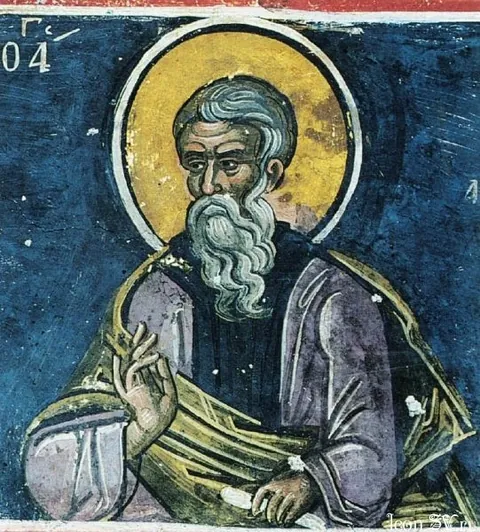
Venerable Theodore of Sykeon, Bishop of Anastasiopolis (613)
The Venerable Theodore of Sykeon, Bishop of Anastasiopolis (+613), was born in the middle of the sixth century in the village of Sykeon, near Anastasiopolis, into an Orthodox family. When his mother Mary conceived the child, she saw in a vision a star come down from heaven and settle in her womb. A clairvoyant elder explained this vision as the descent of divine grace upon the child she had conceived.
When the boy was six, his mother gave him a golden belt, as a sign that she wanted her son to be a soldier; but in her sleep the Great Martyr George (commemorated 23 April and 10 November) appeared to Mary and ordered her not to think of military service for her son, for he was appointed to the service of God. The saint’s father, Cosmas, who served at the court of the Emperor Justinian the Great (527–565), died early. The child was left in his mother’s care. Besides them the family included his grandmother Elpidia, his aunt Despinia and his little sister Blatta.
At school Saint Theodore showed remarkable gifts; he was distinguished by intelligence, was gentle and humble, and always tried to reconcile his quarrelling companions. A pious old man, Stephen, lived in their house. Following his example, Saint Theodore began strict fasting from the age of eight: during the days of Great Lent he took only a small piece of bread, and that towards evening. So that his mother would not force him to eat, the child came home from school only in the evening. At his mother’s request the teacher let the boy go home for dinner, but he went to the church of Saint George instead.
At ten Theodore fell mortally ill. He was taken to the church of Saint John the Baptist and laid before the altar. Suddenly two drops of dew fell from the fresco of the Saviour painted on the vault of the church, sprinkled the dying child, and healed him. After this miracle Saint George appeared to Saint Theodore night after night and led him to his church. His mother was afraid of her son’s nightly wanderings. Once in anger she dragged him out of the church by the hair and tied him to his bed. That same evening Saint George appeared to Mary and sternly ordered her not to hinder the boy. Elpidia and Despinia had the same vision. The women believed in Saint Theodore’s special calling and no longer prevented his ascetic labours, while little Blatta began to imitate her brother.
Once the youth went to receive a blessing from the desert-dwelling elder Glycerius. At that time there was a terrible drought. The elder said to Saint Theodore: “Child, bend thy knee and pray to the Lord to send us rain. So shall we know whether our prayers are pleasing to the Lord.” The elder and the boy knelt and raised a prayer. Storm clouds appeared in the sky and it rained. The elder told Saint Theodore that the grace of God had come down upon him, and that when the time came he must become a monk.
At fourteen Saint Theodore left home and shut himself up in the church of Saint George. His mother brought her son food every day, but the saint left it at the church door and took only prosphora. At such an early age Saint Theodore was granted the grace of healing. Through his prayer a possessed boy was healed.
The Venerable Theodore fled earthly glory and withdrew into solitude: near the church, under a large stone, he dug out a cave and asked a deacon to block up the entrance with earth, leaving only a small crack for air. The deacon brought him bread and water and told no one where the Venerable Theodore was.
The saint spent two years there in complete silence. His relatives mourned him, thinking that beasts had torn Theodore to pieces somewhere in the forest.
At last the deacon took fright that the Venerable Theodore would die in the narrow cave; he also pitied the weeping mother, and he gave away the secret. The saint was brought out of the cave half-dead.
His mother wanted to take her son home, but the blessed youth stayed in the church and within a few days was completely healed.
When the local bishop Theodosius learned of Theodore’s labours, he ordained him first deacon of the church of Saint George and then priest, even though the saint was only seventeen at the time.
Some time later the Venerable Theodore went to Jerusalem to venerate the holy places, and settled in a lavra near the Jordan to labour.
On returning to his homeland the saint went back to the church of Saint George. At his advice his sister, mother and grandmother became nuns.
The labours of the young hieromonk drew to him souls seeking salvation, and little by little a brotherhood gathered round the Venerable Theodore.
Saint Theodore continued his strict labours. At his request a smith made an iron cage without a roof, in which one could only stand. In this cage the saint stood, with a heavy chain on his neck, from holy Pascha to Christmas. From Theophany to holy Pascha he shut himself in a cave and came out only for the services on Saturdays and Sundays; throughout Great Lent he ate only vegetables and bread, and that on Saturdays and Sundays.
When the commander Maurice was returning to Constantinople from the Persian war, the Venerable Theodore foretold to him that he would become emperor. The prophecy came true. The Emperor Maurice (582–602) granted the saint’s request: every year he sent grain to the monastery to feed the local people.
The small church of the holy Great Martyr George could not hold the worshippers, and so through the saint’s efforts a new, splendid church was built. At that time the Bishop of Anastasiopolis died. The inhabitants of the city asked Paul, Metropolitan of Ancyra, to make the Venerable Theodore their bishop.
The metropolitan’s envoys and the people of Anastasiopolis brought the saint out of his cell by force and took him to the city.
After his consecration as bishop Saint Theodore laboured much for the good of the Church, but his soul longed for solitary prayer. Some years later the saint went to Jerusalem to venerate the holy places; he concealed his rank, settled in the Lavra of Saint Sabbas the Sanctified, and there continued his usual labours. Theodore left the holy monastery only when the Great Martyr George appeared to him and called him to return to Anastasiopolis.
The saint’s secret enemies wanted to poison him, but Saint Theodore ate three grains given him by the Mother of God and remained unharmed. The burden of the episcopate weighed heavily on the saint, and so he asked Cyriacus, Patriarch of Constantinople (595–606), to let him return to his monastery.
The holiness of the venerable father was so evident that when he celebrated the Mystery of the Eucharist the Holy Spirit spread over the Holy Gifts in the form of a radiant purple veil. Once, when the Venerable Theodore…
The whole Orthodox Church acknowledged the Venerable Theodore as a saint even in his lifetime.
Once, in one of the cities of Galatia, something terrible happened during a procession with litanies: the wooden crosses were shattered. The holy Patriarch Thomas of Constantinople (607–610, commemorated 21 March) summoned the Venerable Theodore to learn from him the mystery of this dreadful sign. The Venerable Theodore, endowed with the gift of foresight, explained to him that this foretold calamities that would very soon fall upon the Church, and prophesied the rise of the iconoclast heresy. The grieving holy Patriarch Thomas asked the venerable father to pray that the Lord would take his soul before this calamity came about.
In 610 the holy Patriarch Thomas died. Before his death he asked the Venerable Theodore for his blessing.
Saint Theodore of Sykeon peacefully commended his soul to the Lord in 613.



