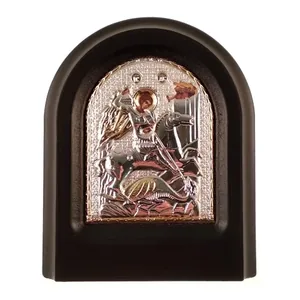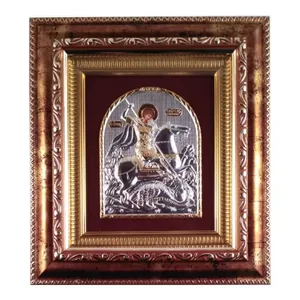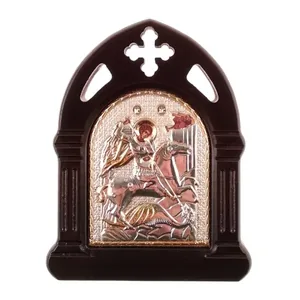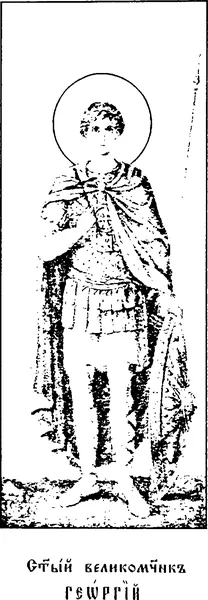
Holy Great Martyr George (+303)
The holy, glorious Great Martyr George, Victory-bearer and Wonderworker (+303), was born in the second half of the third century in Cappadocia, into a rich Christian family. His father met a martyr’s end. His widowed mother went from Cappadocia to her homeland, and there continued to bring up her son as a Christian.
The young George enlisted as a soldier in the Roman army. The tall, brave and fearless warrior soon attracted the attention of the Emperor Diocletian (284–305). He made Saint George his personal guard and also granted him the high rank of commander.
In the last years of his rule the idol-worshipping emperor declared a fierce war on Christianity. At a council of the senate in Nicomedia he gave the governors of the provinces full freedom to punish the followers of Christ, and for his part promised them his support.
When Saint George learned of this, he set his slaves free, gave away his property to the poor, appeared in the senate, publicly confessed Christianity, and called on everyone present to accept this true faith: “I am a servant of Christ my God, and I put my hope in Him. Of my own will I have come before you, to suffer for the truth.” “What is truth?” one of the nobles asked him. “Christ Himself is the truth, whom you persecute,” was the answer.
Stunned by these bold words of his beloved commander, Diocletian tried to persuade him to fall away from Christ and offer sacrifice to the idols. The holy confessor answered firmly: “No worldly glory can cool my desire to serve the true God.” By order of the enraged ruler the soldiers tried to drive him out of the hall with spear thrusts, but at the touch of the saint’s body the iron grew soft and bent. In prison they put stocks on his feet and a great stone on his chest, and kept him so until morning.
The next day the tortured Saint George was brought before the emperor again. “Thou wilt sooner grow weary of torturing me than I, tormented by thee,” he answered to every question of Diocletian. The enraged emperor ordered him to be tortured with the most terrible torments. The Great Martyr was bound to a turning wheel, under which boards set with sharp iron blades had been placed. His body cut to pieces, the saint first cried aloud to the Lord, and then chose to fall silent. Diocletian thought he had already died and ordered the body to be taken down from the wheel. He himself hastened to the altar of Apollo to offer a sacrifice of thanksgiving.
Suddenly it grew completely dark, thunder shook the land, and a little later a voice was heard from on high: “Fear not, George, I am with thee!” By the wheel appeared a young man clothed in unwonted light; he touched the martyr, said to him, “Rejoice!” and vanished. Saint George rose from the wheel completely unharmed and bowed down before the true God.
Seeing this, the astonished soldiers at once took Saint George to the temple, to the emperor. Diocletian could not believe his eyes when he saw the martyr safe and sound, and the soothsayer Athanasius too could not hide his amazement. Encouraged by the miracle, two high officials of the imperial court, Anatolius and Protoleon, who until then had hidden their Christianity, publicly confessed the faith, and Diocletian at once sentenced them to be beheaded. Even Diocletian’s wife Alexandra glorified Christ aloud, and was ready to share the lot of the nobles martyred before her eyes, had the guards not hurriedly taken her back to the palace by force.
After this the emperor became still more cruel. By his order Saint George was thrown into a deep pit and covered with unslaked quicklime, and when three days later the lime was removed and the saint was seen to be completely unharmed, by the emperor’s order red-hot iron boots studded with sharp nails were put on him, and he was driven with blows to the prison.
The next day, when Diocletian again wished to see Saint George, the martyr showed him his uninjured foot and said with a smile that he had liked the boots very much. For this he was beaten with dried ox sinews so savagely that the saint’s blood and flesh mingled with the earth, but even so they could not break his firmness. The emperor called on the pagan sorcerer Athanasius for help. Athanasius gave the martyr two cups filled with a potion: the first was to make him submissive, and the second was to kill him. The martyr calmly drank both and again glorified God.
On the soothsayer’s advice Diocletian ordered Saint George to raise a dead man, to prove the truth of the Christian faith. The saint was brought to a tomb. He cried out to the Lord: “O Lord Jesus! Show those who stand before Thee that Thou alone art God of all the world, that they may know Thee, our almighty King.”
The earth shook, the tomb opened, and the dead man rose. The witnesses of this miracle with one voice glorified God, and Athanasius himself at that very moment confessed the Christian faith, knelt before Saint George and asked him to forgive him his sins. The enraged Diocletian put to death both Athanasius and the man raised from the dead, and threw Saint George back into prison, so as to put him to death the very next day if he did not finally deny Christ.
That night the Saviour Himself appeared to Saint George. The Lord adorned the martyr’s head with a crown and said to him: “Fear not, be of good courage and be strong. Soon thou shalt see Me and receive the place prepared for thee.”
In the morning Diocletian once more proposed that the holy martyr bow down to the idols. Saint George agreed to go with the ruler to the temple of Apollo, and when the delighted emperor led him with honour into the sanctuary, the saint went up to the idol and made the sign of the cross, and all the idols were shattered of themselves.
The people were in uproar. The priests demanded the saint’s death. At the noise the holy Empress Alexandra came. When she saw that Saint George was being led to his death, she herself confessed Christianity and, sentenced to death by Diocletian, she joyfully went beside the beloved saint.
Before the execution Saint George besought the Lord with all his heart to forgive the tormentors, who knew not what they did, and asked Him to bring them to the knowledge of the true faith; then he obediently bowed his neck to the executioner’s sword. He met his end on 23 April 303. According to his wish, Saint George’s body was buried in the Palestinian city of Ramla, and in the reign of Constantine the Great it was translated to the great church built in the saint’s name in the city of Lydda.
Saint George was martyred at the age of thirty and entered the history of the Church as a victorious and invincible heavenly warrior.
The Church celebrates the memory of Saint George twice: on 23 April (6 May), the day of the saint’s death, and on 10 (23) November, the day of his torture on the wheel. (This latter feast is called Georgian, for it passed from Georgia to other local Churches. On this, see the reading for 10 (23) November.)