
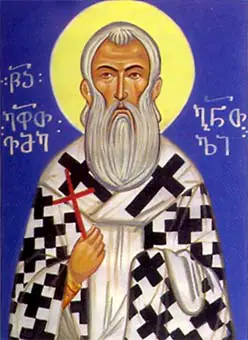
Venerable Euthymius of Gaenati (Shervashidze) (+1822)
The Venerable Euthymius of Gaenati (Shervashidze) was born in 1746. His father, Christopher Shervashidze, was prince of Guria. Euthymius’s forebears were close to the royal court of Imereti and always fought for the unity and independence of Georgia.
Until the age of twelve Euthymius grew up in Guria, and then Solomon I, king of Imereti, and Joseph, catholicos of western Georgia, took him to Imereti. For twenty years Euthymius was constantly at the side of the king and the catholicos, and knew all their commands and customs thoroughly. Euthymius preferred the service of the Church to a brilliant secular career and was tonsured a monk. Euthymius was soon ordained priest. Around 1778 he was consecrated bishop, and from that time until 1820 he governed the see of Gaenati with the rank of metropolitan.
In the time of Euthymius’s ministry the question of the country’s very existence and of its political orientation stood sharply before Georgia. All the spiritual and bodily strength of Saint Euthymius was directed to keeping Mother Church holy and to strengthening the country.
In 1787 Euthymius thoroughly renewed the church of Saint Nicholas in the Gelati complex; he took an active part in settling the affairs of Church and state.
After the kingdom of Kartli-Kakheti came under the protection of the Russian Empire (in 1783), relations between the kingdom of Imereti and Russia gradually grew strained. In 1790 Euthymius came to Tiflis with representatives of Imereti and tried to persuade King Erekle of the necessity of uniting Georgia, but unhappily the attempt came to nothing.
After the abolition in 1801 of the monarchy in Kartli-Kakheti and of the autocephaly of the Church of Georgia, the Russian government in 1810 abolished the royal throne of Imereti too, and Solomon II, king of Imereti, took refuge in the mountains. Through the mediation and great authority of Saint Euthymius a face-to-face meeting of Solomon II with the Russian general Simonovich was arranged at Persati, which in substance produced no good result.
As a result of the cruel policy of the Russian Empire, mass discontent among the people spread over all Georgia. In 1819 Imereti too rose in revolt, and the clergy took an active part in the rising. By order of the Russian government, on the evening of 4 March 1820, Metropolitan Euthymius was seized in the monastery of Gelati; at the same time Dositheus, Metropolitan of Kutaisi, was seized. According to a plan drawn up beforehand, sacks were pulled over the heads of both hierarchs, and they were carried off hungry and thirsty under the blows of whips. At Surami a woman brought the hierarchs water to drink. Saint Euthymius, worn out by the heat and the beating, brought up blood when he opened his mouth: his teeth had all fallen out from the beating.
Euthymius was taken to the city of Novgorod. The Russian Emperor Alexander received the saint with the honour befitting a hierarch. Euthymius called the emperor a new Nero and fearlessly rebuked him for taking away the freedom of the Church and nation of Georgia and for the torment of the defenders of the homeland. Saint Euthymius was sent to the Svir monastery in the Olonets province.
Saint Euthymius was on close terms with the Georgian princes living in Russia, and he managed to correspond with his spiritual father, the well-known churchman Hieromonk Iona Khelashvili.
On 21 April 1822, at nine in the evening, Saint Euthymius died. On 23 April a great multitude of people attended his burial. During the funeral service Vladyka Euthymius raised himself, “made the sign of the cross like one living, and lay down again in the coffin and fell asleep; great fear fell upon all who were there, and they praised God”. Euthymius was buried in the Svir monastery, in the sanctuary of the church of the Trinity.
On 1 April 2004 the remains of Saint Euthymius were brought to Georgia and buried in the monastery of Gelati.



