
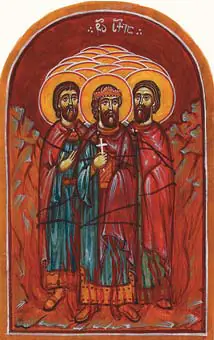
Holy Martyr Sukias and with Him 16 Georgians: Andrew, Anastasius, Thalelaeus, Theodoret, Eukyrion, Jordan, Quadratus, Lucian, Mimnanus, Nerangius, Polyeuctus, James, Phocas, Domentian, Victor and Zosimas (II)
The holy martyrs — Sukias, Andrew, Anastasius, Thalelaeus, Theodoret, Eukyrion, Jordan, Quadratus, Lucian, Mimnanus, Nerangius, Polyeuctus, James, Phocas, Domentian, Victor and Zosimas — were Georgian nobles. They served at the court of the ruler of Albania and held the honour due to them from the ruler.
In the reign of Artaxar, king of the Armenians (88–123), the saints came to Artashat, the capital of Armenia at that time. They were accompanying Satenik, the daughter of the ruler of Albania, who had been given in marriage to the king of the Armenians. Here Chrysus, a disciple of the holy Apostle Thaddeus and a presbyter ordained by him, was preaching. The Georgian nobles became his disciples and resolved to devote themselves to the service of the Lord. Chrysus took the new converts to Mesopotamia and baptised them in the waters of the Euphrates. At their baptism they saw Christ standing on a hill. The newly baptised Christians would no longer leave the place where they had been baptised; at the place where the Saviour had appeared they set up a cross and called it the Cross of the Annunciation.
After this men sent by King Artaxar came to Chrysus and asked him to order his disciples to return to Armenia. Chrysus answered: “Let them choose what profits them according to their own will.” The barbarians, enraged by the teacher’s firmness, cut down Chrysus and four disciples with the sword, but did not touch Sukias, because they feared the queen, to whom the saint was related.
Sukias and his fellow brethren buried those who had suffered for righteousness, while they themselves “abode in their solitude in an angelic life”.
After the martyr’s end of Chrysus, Saint Sukias became the spiritual father of the brotherhood. Soon they moved to the mountain of Sukaketi, which lay near the village of Bagdevand. The former nobles lived a strict ascetic life. Their food was the grass of the mountain, and their drink cold spring water. Living constantly under the open sky made the ascetics’ skin like fired clay, while their bodies became covered with hair, which protected them from every sickness.
Datianus, the new ruler of pagan Albania, learned that the nobles who were his subjects had been baptised and were living in solitude. He ordered his courtier Barlapa to go with an army to Sukaketi and bring Sukias and his companions with honour, and if they refused to obey, to cut the monks down with the sword.
In the forest of Sukaketi Barlapa sought out men who looked more like dumb savages than nobles. He passed the king’s command on to Sukias, and in answer the saint replied: “For the name of our Lord Jesus Christ, who is the Creator and Lord of all that is, we have willingly become dead and forgotten according to the flesh; and of what use to the dead is the honour of rule, when we await from Christ our God, with the angels and the saints, a glory undying and ageless, never to be taken away, and eternal?”
Barlapa, enraged by the saints’ firmness, ordered the brethren to be bound and fire kindled round them. The saints sang the twenty-first psalm: “But thou, O Lord, remove not thy help from me; look to my defence. Deliver my soul from the sword, my only one from the hand of the dogs. I will declare thy name unto my brethren; in the midst of the church will I sing unto thee.”
By Barlapa’s order the holy martyrs, already set on fire, were hewn in pieces with the sword, and their charred remains were scattered.
This took place in the year 123 (according to another tradition, in 130; according to an eleventh-century parchment of the Iviron monastery on Athos, in 100). The godless ruler forbade the burial of the saints’ remains. By the providence of God the holy relics, which lay unburied for 230 years, were preserved incorrupt. In the fourth century Christians gathered them, laid them in a shrine and buried them (the names of the saints were found scratched on the rock).
The holy Hieromartyr Gregory, the enlightener of the Armenians (+335; commemorated 30 September), built a church on the place of the martyrdom of Saint Sukias and his brethren and founded a monastery. Later a healing spring burst forth at this place.



