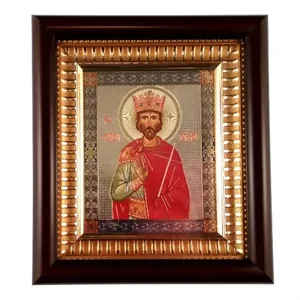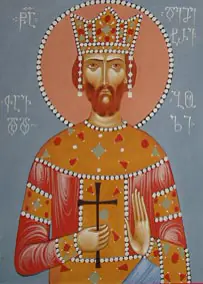
Holy King Demetrius the Self-sacrificing (+1289)
Holy King Demetrius the Self-sacrificing (+1289) was a descendant of the holy and right-believing Queen Tamar (commemorated 1 May and on the Sunday of the Myrrh-bearing Women).
From his earliest years the Lord trained the future king and martyr through trials. He was an infant when the Mongols killed his mother, the most virtuous Queen Gvantsa. According to tradition, before her death the queen entrusted little Demetrius to the wife of a noyan. The pagan woman adopted the prince, and for such obedience she received a miraculous healing from God: though childless, she soon bore a son.
At ten he lost his father, David Ulu. The Georgian nobles took the boy Demetrius, eleven or twelve years old, to Abaqa Khan at the Horde and asked him to confirm him as king of kings of Georgia. The khan heeded the Georgians’ request; the Georgian prince pleased him, “for he was comely and fair to look upon”, and he granted Demetrius confirmation in the kingship, but in return, to secure his own rights, “he sent Sadun with him, to whom King Demetrius granted the atabagate”. Sadun Mankaberdeli, a favourite of the khan’s court and the executor of his will, was a Kurd raised in Tbilisi who had become Armenian.
Having come to Tbilisi, the king sat upon the throne of David and Tamar. “The rite of anointing was performed by the catholicos, and the bishops, and all the lords of Georgia — from Hereti, Kakheti, Somkhiti, Kartli, and Javakheti, and Tao — who were gathered together.”
Filled with spiritual virtues, the king governed the country wisely and mercifully. “He had this custom: he would take money, and rise by night, and go about the city, and visit the poor, and the infirm, and the orphans, and give to them with his own hand; and all knew of the king’s alms, and for this reason the poor walked the streets by night, that they might meet the king.”
When the king was fifteen, for political reasons, he was married to the daughter of the emperor of Trebizond.
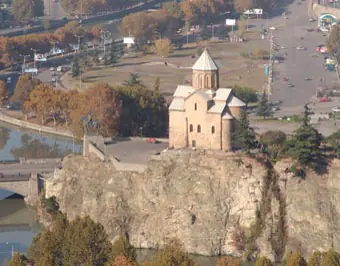
King Demetrius used the comparatively peaceful time for the good of Georgia: he built and renewed churches and monasteries, and strengthened several fortresses of strategic importance. “He built in the palace of Isani a monastery, a dwelling of the Theotokos of Metekhi, and adorned it with great ordering, and offered villages and vineyards, and appointed food for the monks, and ordered all things well”…
King Demetrius was given no time for more: the khan summoned him on campaign against Egypt. The king followed the khan with a great army, fought heroically and amazed the Mongols and the Egyptians, but came back with his host reduced by half.
In 1278 Demetrius accompanied the Mongol khan in the campaign against Gilan, and there too he astonished everyone by his wonderful bravery and valour. In 1280 Abaqa Khan again called the Georgians to war, this time against the new sultan of Egypt, Malik Mansur. Afterwards, in the bloody battle at the city of Amasia on 30 October 1281, the Georgian host again showed legendary heroism, but this heroism cost the lives of a great many Georgian warriors. From so many campaigns the country was impoverished and laid waste. Demetrius too was overcome by the evil one: he mingled with the pagans and put his trust in mortals. The interests of the country again demanded a sacrifice of the king: this time he took as his wife Solghar, the daughter of a Mongol noyan.
Georgia, bled white in the wars of others, found itself facing a new trial: civil strife began. The Georgians fell so low that they seized lands and villages even from the churches; instead of striving to destroy the common enemy who had crept in in the guise of a friend, the nation suddenly rushed down the road of decline, suddenly raised its hand against its neighbour, and forgot both God and the icon.
In vain did Nicholas, the upright and most virtuous catholicos of Kartli, rebuke his flock; in vain did Nicholas of Matskveri instruct the Christians carried off by the evil one — no one heeded their words; it was as if they vied with one another in pride, in greed and in disorder.
Demetrius too was faced with a new temptation: the young king could not withstand desire — love took hold of his heart; he resolved to be happy in his personal life at least once, and he carried off Natela, the daughter of Beka Jakeli. By her King Demetrius had “the best of all men of that time, not only of sovereigns but of all men” — George V, called by the people the Brilliant.
The Lord sent punishment upon His “peculiar people” for their sins: on Great Wednesday and Thursday the earth shook “for the reproof of our iniquities”. The people, preparing for the joy of Pascha, paid no heed to it. On Friday the earth shook again, and on Saturday it shook the land to its foundations and filled it with terror: churches and monasteries, mountains and hills were thrown down, the earth split open and black water like pitch burst out of it, and trees were torn up by the roots. The church of Atskuri collapsed, and the Lord miraculously preserved the icon of the Theotokos, which had been set down after the procession: the dome fell and covered, like a cap, the icon standing in the middle of the church. Mtskheta was ruined, and all Samtskhe. A countless number of people perished. Mourning and weeping took hold of all Georgia.
Catholicos Nicholas, shaken by the nation’s fall, could not stop or bridle the lawlessness that was surging up. Many times he rebuked and admonished the king, and since he could not persuade him, he left the catholicosate, “went away to his own patrimony”, and in the labour of a simple monk gave up his soul to the Lord.
To rebuke the king there came from the mountain of Athos the Venerable Basil the monk (commemorated 18 April), uncle of Catholicos Euphemius (Eqvtime III), “full of the divine order and made radiant by the grace of foreknowledge”; at the appearing of the Theotokos he came before King Demetrius, rebuked him for his lawless marriage and said to him: “If thou forsake these lawless marriages, I will be thy surety that thy reign shall prosper.” The king and the lords disregarded the holy elder’s words. Then Basil the monk foretold his future: “By an evil and dishonourable death shalt thou be slain by the mighty, and thou shalt be bereft of thy kingdom, and thy children shall be scattered, and another shall take hold of thy kingdom and plunder thy riches. And behold, lo, I say it to thee and to the lords, and I trust in the all-holy Theotokos that my word shall be fulfilled and come to pass, if thou abide in this lawlessness. Behold, I depart.”
The astonished king gave no answer to the God-wise elder, for he honoured holy men.
The king was also rebuked by the enlightener of the Leks, the Venerable Pimen the Fool-for-Christ, and his fellow-struggler Anthony (commemorated 16 March).
Outwardly the king seemed to submit to the Mongols and took part in their campaigns against foreign enemies, while in Georgia he went on building churches, going out by night and distributing alms to the poor with his own hand.
After the death of Abaqa Khan, Abaqa’s brother Ahmad and his son Arghun fought each other to the death for the khan’s throne. King Demetrius was forced to take part in the plots. The leadership of one of the plots laid against Arghun was imputed to Arghun’s first vizier, Buqa, who was related to Demetrius by marriage. The khan seized Buqa and cut off his head; the same fate befell his kinsmen and supporters.
King Demetrius was summoned to the khan’s court. The king understood what this summons from the khan meant; he called together the catholicos, the bishops, the fathers of the monasteries and of the desert of Gareji, gathered the court and declared: “God the Almighty, and our Lord Jesus Christ, and the all-holy Theotokos, whose portion we are, and the precious Cross bestowed upon us kings, have kept me and brought me to full age, and granted me the kingship, the sceptre and the purple of the kingdom, and with your help I have governed the kingdom, and until now my kingdom abides in peace. Now the khan is wroth… and now he calls me before him. I look for evil to befall me, unless I go away to the mountains, into the strongholds, and defend myself — and behold, all my kingdom lies before them: see how many Christian souls will perish by death, men and crosses will be broken in pieces… What profit is there in my life, if many souls die because of me and I myself depart this world with grievous sin? Now I desire to go before the khan, and let the will of God be done: if they kill me, I think the land will remain unharmed.”
The church of the Theotokos at Metekhi
The court gazed in astonishment at the king, full of life, “fair to look upon, with well-ordered hair and beard, and comely”, who was going to certain death to save the nation. All with one voice begged the king to take refuge in the mountains, but the king said calmly: “They are oppressed, and nowhere have they a comforter. I will lay down my life for my people and will not forgo going to the Horde.”
“There is no need, O king, to give up thy life, for many kings have fled and kept themselves safe. But now, if thou lay down thy life for thy people, we all, the bishops, will take thy sins upon ourselves, and before God we bear witness that thou shalt be numbered with the martyrs, as the Lord says in the Gospel: ‘Greater love hath no man than this, that a man lay down his life for his friends.’ And if it is good to lay down one’s life for one friend, how great is the profit of saving countless souls,” said Catholicos Abraham.
Hearing this, the king joyfully made ready to go to the steppe; he took with him Catholicos Abraham, the priest Moses, his son David and chosen eristavis. The noyan Siukol, sent by the khan, met Demetrius, took from him everything he had, bound his hands and brought him to the khan like one of the dishonoured.
No guilt of any kind could be found in the young king of the Georgians. The khan pondered. He knew that “if he did evil to the king, there would be no one left worthy of the kingship”; nor would it do to leave him unpunished, since Demetrius “was an adherent and counsellor of Buqa”. Then Khutlu-Buqa Mankaberdeli, the son of Sadun, a lackey and informer of the Mongols, stepped forward and said to the khan: “Be not troubled over this, for I will bring the son of David (Narin), king of the Abkhaz, whose name is Vakhtang, and grant him the kingship, that both kingdoms may obey thy command.” The words of the traitorous amirspasalar decided everything. Demetrius was ordered to write down all his riches; then they bound his hands, beat him with staves and threw him into prison. The Georgian nobles managed to visit the king in the dungeon and offered him escape. Gladdened by his subjects’ loyalty, the king again answered calmly: “I knew of my death from the first, but I have laid down my head and my life for my people. And now, if I go away, the innocent people will be slaughtered. What profit is it if I gain the whole world and lose my own soul?”
The Mongols took Demetrius to be questioned in the house of judgement called the divan-khane, and although they found no guilt in him, the khan resolved on death for the king of the Georgians.
The holy king received the sentence of death with joy, cheerfully greeted the Georgian nobles who had come to comfort him, and then entrusted his firstborn to none other than the traitor Khutlu-Buqa: “Take care of my little son David, that the khan, who is full of wrath, may not kill him.” The love and forgiveness shown by the anointed of God shook the heart of the faithless Khutlu-Buqa, and he burst into tears.
Before his death the king prayed, received Holy Communion and commended his soul to the Lord.
Suddenly a miracle sent by God shook everyone. The sun was darkened and a terrible darkness came down. This miracle so frightened the pagans that they gave up killing the prince.
By the khan’s order guards watched over the holy body of Demetrius. The catholicos and the priest Moses secretly recovered the body and, with the help of fishermen from Tbilisi, brought it back to Georgia.