
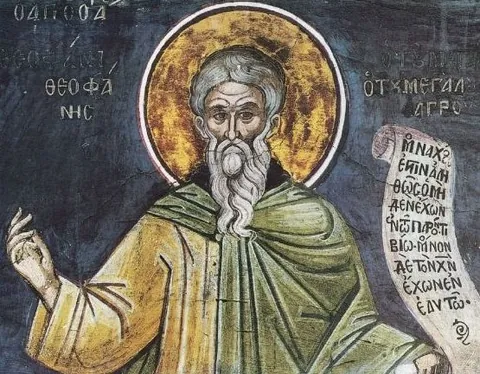
Venerable Theophanes of Sigriane (+818)
The Venerable Theophanes of Sigriane (+818) was born in Constantinople into a noble and well-known family. His father was a kinsman of the Byzantine Emperor Leo the Isaurian (717–741). When Theophanes was three, his father died. Theophanes grew up at court and became a distinguished courtier of the Emperor Leo the Khazar (775–780). Circumstances forced him to marry, but by agreement with his wife he kept his virginity, for the desire for the monastic life was burning in his soul. While staying in the monastery of Sigriane, Theophanes met the monk Gregory Strategius, who foretold to Theophanes’ wife her husband’s martyr’s end. Some time later Theophanes’ wife entered one of the monasteries of Bithynia as a nun, while Gregory tonsured Theophanes himself a monk. With Father Gregory’s blessing Theophanes set up a monastery on the island of Kalonymos in the Sea of Marmara. He withdrew into a cell and took up the copying of books. Then he founded another monastery in Sigriane and became its abbot. The venerable father built the monastery with his own hands and was an example to others in his love of labour.
Saint Theophanes was granted by the Lord the gift of healing. In 787 Theophanes was invited to the Seventh Council of Nicaea, which condemned the heresy of iconoclasm.
At the age of fifty the venerable father fell gravely ill and suffered until his death. Bound to his deathbed, he wrote the “Chronography”, a history of the Christian Church from 285 to 813. This work is still counted among the most important sources of church history.
After Leo the Armenian (813–820) came to the throne, iconoclasm flared up with new force. Theophanes, in deep old age, was pressed to accept the heresy, but he held firmly to the faith, for which he was thrown into prison. His monastery was burned. After twenty-three days of imprisonment the venerable confessor died (818). After the death of the lawless emperor the monastery was restored. The holy relics of Saint Theophanes were translated to the restored monastery.



