
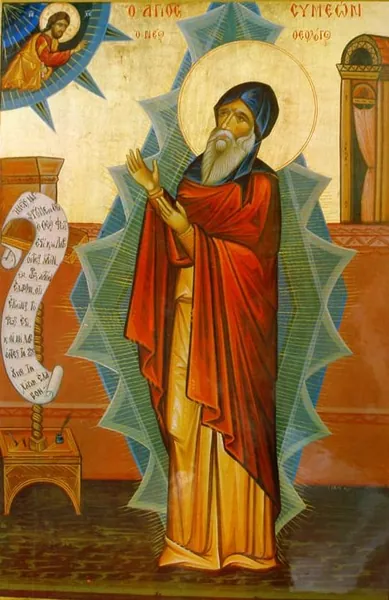
Venerable Symeon the New Theologian (+1021)
The Venerable Symeon the New Theologian (+1021) was born in 946 in the city of Malatia (Paphlagonia). He received his higher education in Constantinople. His father was preparing him for a brilliant career at court, and for some time he even held high office. At the age of twenty-five Symeon felt drawn to the monastic life; he ran away from home and made for the Studite monastery, where he came to know the holy elder Symeon the Pious and became his disciple.
The Venerable Symeon’s chief labour was unceasing prayer: “Lord, have mercy on us.” For longer prayer he would withdraw into solitude. Even at the Liturgy he stood apart, and often stayed alone in the church all night. To make the remembrance of death a habit, he spent whole nights in the cemetery. In times of spiritual ascent the Holy Spirit came down upon him in the form of a bright cloud and hid everything around from his eyes. In time the saint attained the highest spiritual illumination, which could be seen especially during the Liturgy.
In 977 the Venerable Symeon was ordained priest, and in 980 he was appointed abbot of the monastery of Saint Mamas. He remained in this rank for twenty-five years. During this time the venerable father set in order the neglected household of the monastery and restored the church.
The Venerable Symeon’s kindness was joined with strictness and with keeping the commandments of the Gospel. When his beloved disciple Arsenius killed some crows that were pecking at soaked bread, Saint Symeon ordered him to string the dead birds on a rope, hang this “ornament” round his neck, and stand in the monastery courtyard. In the monastery of Saint Mamas a bishop from Rome, who had accidentally killed his nephew, was doing penance for his sins. The Venerable Symeon showed him special kindness. The venerable father’s strict monastic discipline stirred up discontent among the brethren. Once angry monks attacked him during the Liturgy and all but killed him. When the Patriarch of Constantinople expelled these monks from the monastery and handed them over to the court, the venerable father stood surety for them, obtained their release, and gave them much help.
In 1005 Saint Symeon handed over the abbacy to Arsenius and withdrew into solitude within the monastery. Here he composed his theological works. In his writings the Venerable Symeon teaches us to labour for spiritual perfection, to struggle against the passions and sinful thoughts, and to seek inner stillness. He wrote instructions for monks, and discourses on the three forms of prayer and on faith. Besides this, the Venerable Symeon was an outstanding church poet and hymnographer. His are the “Hymns of Divine Love”, seventy poems filled with deep meaning.
The venerable father Symeon’s teaching on the “deification of the flesh”, with which he wished to replace the teaching on the “mortification of the flesh” (for which he was called “the New Theologian”), was hard for his contemporaries to accept. To many his teaching was strange and unacceptable. This led to a conflict with the higher clergy of Constantinople. The persecution of the Venerable Symeon began. The holy father went away to the shore of the Bosporus, to the cape of Paloukiton, and founded a monastery in the name of Saint Marina.
The saint died in 1021. Already in his lifetime he received the gift of wonderworking. Many miracles were also worked after his death. The life of the Venerable Symeon the New Theologian was written by his disciple Nicetas Stethatos.



