
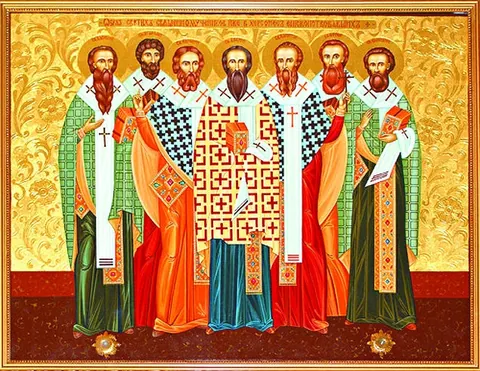
Holy Hieromartyrs, Bishops of Cherson: Basil, Ephraim, Capito, Eugene, Aetherius, Elpidius and Agathodorus (IV)
The holy Hieromartyrs, Bishops of Cherson: Basil, Ephraim, Capito, Eugene, Aetherius, Elpidius and Agathodorus (IV), preached the Gospel of Christ along the northern shore of the Black Sea, from the Danube to the Dnieper, the Crimea included, and ended their apostolic labour with martyrdom in the Taurian city of Cherson.
The first enlightener of Tauris (the Crimea) was the holy Apostle Andrew the First-called (commemorated 30 November). The further spread of Christianity here was helped by its very enemies: the Roman emperors settled state criminals in this region, and in the first to third centuries Christians were counted among them. In the reign of Trajan (98–117) Saint Clement of Rome (commemorated 25 November) was exiled to the stone quarries of Inkerman. He continued his preaching here, and here too he met a martyr’s end.
At the beginning of the fourth century an episcopal see was founded in Cherson. In the reign of Diocletian (284–305), in the year 300, Hermon, Patriarch of Jerusalem, sent bishops to every part of the world to preach the Gospel. Two of them, Ephraim and Basil, came to Cherson. Afterwards Ephraim went to the peoples living along the Danube, where he endured much suffering and humiliation for preaching Christ. As soon as the persecution began Saint Ephraim was beheaded (only the day of his death, 7 March, is known for certain). Saint Basil converted many idol-worshippers to the true faith, which roused the anger of the pagans. The holy confessor was seized, mercilessly beaten, and driven out of the city. Saint Basil made for the mountains and took shelter in a cave. He prayed unceasingly for the conversion of the people of Cherson. The Lord sent the unbelievers a miracle: through the saint’s prayer the only son of a well-known citizen of Cherson was brought back to life. The saint was brought back to the city with honour, and many believed in Christ and were baptised.
Soon, by order of the Emperor Maximian (305–311), the persecution of Christians was renewed. The enemies of Christ took up arms against Saint Basil too. On the night of 7 March 309 they burst into his house, bound him, and stoned him to death. The saint’s body was thrown outside the city to be torn apart by beasts and birds, but for a long while nothing touched the holy relics. Later the Christians secretly buried it in a cave.
A year later Saint Basil’s fellow labourers, the Bishops Eugene, Elpidius and Agathodorus, heard of his end; they left the land of the Hellespont, where they had been preaching, came to Cherson, laboured much, and at last shared the lot of those who had gone before them: on 7 March 311 the maddened pagans stoned them to death.
A few years later, already in the time of the holy Constantine the Great, Equal to the Apostles (commemorated 21 May), Bishop Aetherius came to Cherson from Jerusalem. At first he too met great opposition from the pagans, but then the holy emperor issued a decree by which the Christians of Cherson could freely hold divine services. Through the efforts of Saint Aetherius a Christian church was built in the city.
To express his gratitude to the emperor, Saint Aetherius went to Constantinople. On the way back he fell ill and died on the island of Amos, in Greece, on 7 March.
In place of Saint Aetherius the emperor sent Bishop Capito to Cherson. The Christians met him with joy, but the pagans demanded that he work a miracle. Entrusting himself to the will of the Lord, Capito, in his hierarchal vestments, stood on a blazing pyre and prayed for a long time, and then carried out red-hot coals in the fold of his phelonion. Astounded by the miracle, the pagans believed in the almighty power of the Lord. Saint Constantine and the fathers taking part in the First Ecumenical Council of Nicaea (325) were told of this miracle and of Saint Capito’s boundless faith. A few years later Saint Capito set out for Constantinople on the business of his diocese. A storm cast the ship onto the shore of the Danube. The local pagan inhabitants seized the ship and drowned all the passengers, Saint Capito among them. This happened on 21 December. Saint Capito’s commemoration was set on 7 March, the day of the other hierarchs of Cherson.
The preaching of the hieromartyrs established the faith of Christ in Cherson. It became a spiritual centre from which Christianity spread northwards, towards Russia.
In 987 the holy Prince Vladimir, Equal to the Apostles, was baptised in Cherson. This city became the cradle of Christianity for Russia.



