
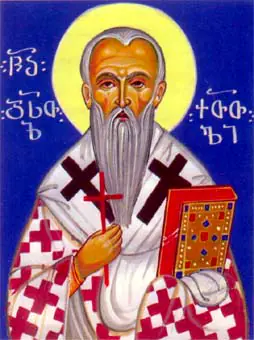
Venerable Dositheus of Kutaisi (+1820)
The Venerable Dositheus of Kutaisi (in the world David, son of Nicholas, Tsereteli) was born in Sachkhere around 1750. The family’s seat was in Sachkhere, and their places of prayer and burial were the monasteries of Mghvime and Jruchi. Dositheus’s grandfather, Papuna Tsereteli, was in the 1720s the sardar of the upper side of the kingdom of Imereti, and his father, Nicholas Tsereteli, was chief shield-bearer to King Solomon I and also the king’s interpreter. Dositheus had four brothers: Bezhan, Vakhushti, Giorgi and Kveli. The family, raised to high place at the king’s court, historically fulfilled an important task for the unity and strength of the country.
David chose the monastic life and settled in a monastery to labour there. David was soon tonsured and named Dositheus. Distinguished for holiness and wisdom, Saint Dositheus was consecrated in 1781 as hierarch to the metropolitan see of Kutaisi. The grace of the episcopate made this labourer, who gave himself to the Church and the nation, shine still brighter; he cared unceasingly for the spiritual enlightenment of his flock and strove in every way to strengthen in the people a way of thinking at once of faith and of statehood.
Vladyka Dositheus paid great attention to the estates of the catholicosate and the diocese. He was very close to the royal court of Imereti and actively supported the strengthening of the central power. The political events in the country and the internal strife obliged Saint Dositheus to take an active part in settling worldly affairs as well.
In 1783, on the basis of the Treaty of Georgievsk, the kingdom of Kartli-Kakheti came under the protection of Russia; the Russian government strove roughly to annex the remaining principalities of Georgia as well. In 1789 a delegation from Imereti, with Dositheus of Kutaisi and Euthymius of Gaenati taking part, visited Erekle, king of Kartli-Kakheti, and asked him to unite the kingdoms of Kartli-Kakheti and Imereti under his rule, which unhappily was not accomplished.
From 1795 Dositheus is mentioned as administrator of the catholicosate of western Georgia; on 26 April of that year Queen Darejan, wife of King Erekle, calls him catholicos in a letter to Vladyka Dositheus: “To Dositheus, their Holiness, catholicos of all Imereti and Odishi-Abkhazia…”; there is also a document of 1789 confirmed by King Solomon which states that “the catholicosate was bestowed on Dositheus, Metropolitan of Kutaisi”. But Dositheus was not consecrated catholicos, and he called himself only the administrator of the catholicosate.
The people, worn down by Russia’s policy of conquest, voiced their discontent loudly; in 1819 a rising broke out in Imereti, and the Russian government dealt cruelly with the rebels. All the supposed leaders and inspirers of the rising were seized. On 4 March 1820, by a special order of the Russian government, and in such a way that the event should not stir up fresh unrest, Dositheus of Kutaisi and Euthymius of Gaenati were seized. Sacks were pulled over the heads of both hierarchs, their hands and feet were bound, and they were carried off under the blows of whips; the other captured rebels were dealt with just as cruelly: some of them were hanged, and some were exiled to Russia for ever.
The tortured and beaten hierarchs were halted in the township of Surami, where a woman gave them water to drink. Saint Euthymius’s teeth had all fallen out from the beating, and blood was coming from his mouth. Saint Dositheus, seventy-one years old and cruelly beaten, died on the way on 5 March; he is buried at Ananuri, inside the church.



