
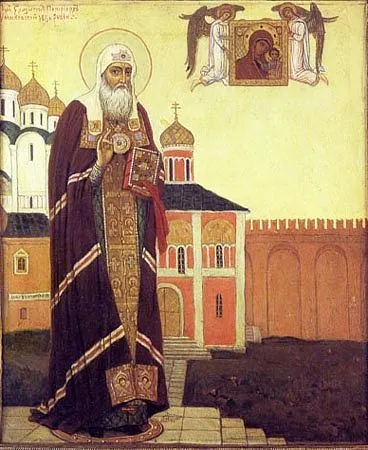
Hieromartyr Hermogenes, Patriarch of Moscow and All Russia, Wonderworker (+1612)
The Hieromartyr Hermogenes, Patriarch of Moscow and All Russia, came of the Don Cossacks. At first he served as a presbyter in Kazan, then was tonsured a monk and appointed archimandrite of the monastery of the Transfiguration of the Saviour. In 1589 Hermogenes was consecrated bishop as well and became the first Metropolitan of Kazan.
During the years of the saint’s ministry in Kazan the wonderworking Kazan icon of the Theotokos was revealed.
On 3 July 1606 Saint Hermogenes ascended the patriarchal throne of Moscow and All Russia.
The years of Saint Hermogenes’s patriarchate coincided with the invasion of Russia by the False Dmitry and by the Polish King Sigismund III. Saint Hermogenes rose with his fellow countrymen to defend the country and the Church. On 11 December 1610 the impostor was killed, but Moscow was still in danger: the Poles and traitorous boyars loyal to Sigismund III were running riot in it. The letters of Patriarch Hermogenes, sent to the towns and villages of the whole country, called the Russian people to free Moscow and elect a lawful king. The people of Moscow rose in revolt, and in response the Poles set fire to the city and shut themselves up in the Kremlin. With the help of the traitors they deposed Patriarch Hermogenes from his throne and shut him up under guard in the Chudov monastery. The besieged Poles sent envoy after envoy to the holy patriarch, demanding that he order the Russian militia to leave the city. The hierarch answered: “Why do you threaten me? I fear only God. If you leave Moscow, I will call on the Russian army to leave the city; but if you stay, I will bless them to rise against you and shed their blood in defence of the Orthodox faith.” Patriarch Hermogenes sent his last letter to the Russian people from prison: he blessed their struggle for liberation against the invaders. Because their actions were not coordinated, the Russian commanders could not take the Kremlin and free the spiritual father of the nation. For more than nine months he suffered in prison, where on 17 February 1612, exhausted by hunger, he met a martyr’s end.
The Russian people’s struggle for liberation was crowned with success. The grateful people buried the hieromartyr’s body in the Chudov monastery, and from there in 1654 translated it to the Dormition Cathedral in Moscow. The holy patriarch was canonised on 12 May 1913.



