
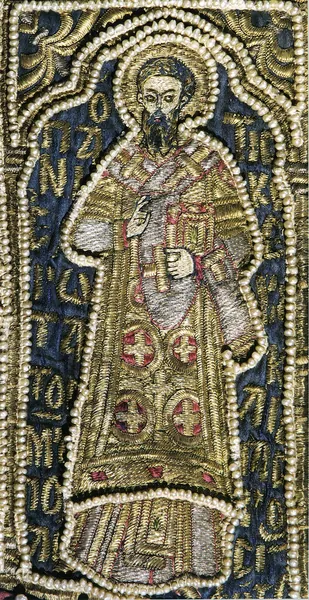
St Photius, Patriarch of Constantinople
Saint Photius, Patriarch of Constantinople, lived in the ninth century and came of a family of pious Christians. His father met a martyr’s end for defending the veneration of icons.
Photius received a brilliant education: according to his contemporaries, he had no equal in learning in his century. With this excellent teacher of philosophy, medicine, astronomy and theology the heir to the imperial throne, Michael, and the future enlightener of the Slavs, Cyril, Equal to the Apostles, studied various sciences. Photius held the post of first secretary of state in the senate, but the brilliant life of the court did not attract his soul, which was inclined to monasticism.
In 857 Bardas, co-ruler of the Emperor Michael, drove Patriarch Ignatius from the see of Constantinople and decided to appoint Photius in his place. The future saint considered himself unworthy of this high rank and refused, but they would not listen to him: in six days he was raised through the ranks of the hierarchy, and on the feast of the Nativity he was consecrated patriarch. Soon the supporters of the deposed hierarch began to stir up unrest. In 861 a council was convened to calm the disturbance, which confirmed the deposition of Ignatius and confirmed Photius as patriarch. Pope Nicholas I hoped that the new helmsman of the Church of Constantinople would carry out his will, but when his hopes were disappointed, he anathematised Photius. From this time until the end of his life the saint had to wage an unceasing struggle against papal arbitrariness and its attempts to encroach on the Orthodox Church of the East. In 864 Bulgaria turned to Orthodoxy of its own will. It was supposed that King Boris of Bulgaria was baptised by Patriarch Photius, after which he sent an archbishop and priests to the newly converted country. Then, with Saint Photius’s blessing, Saints Cyril and Methodius set out for Bulgaria to preach the teaching of Christ in the Slavonic language. The pope’s supporters managed to stir up mistrust of the eastern preachers in the country. Besides, King Michael, hard pressed by German attacks, was forced to seek help in the West and asked the pope to send his bishops to Bulgaria. The papal legates who came to the young country began to plant the teaching and customs of the Latins there, and at the same time maintained that the sacred acts performed by Patriarch Photius had no force, and anointed the baptised Bulgarians with chrism a second time. This was a great insult to the whole Church of Constantinople. A firm defender of Orthodoxy and denouncer of lawlessness, Saint Photius sent letters to the Churches of the East, in which he informed them of the pope’s actions and declared that the Church of Rome was separating itself from Orthodoxy not only in customs but in teaching too, and he called them servants of the antichrist.
In 867, after the murder of the Emperor Michael, Basil the Macedonian seized the royal throne. The hierarch Photius fearlessly denounced the murderer. For this he was deposed from the patriarchate and shut up in a monastery, and the government of the Church was entrusted to Ignatius again. The council convened to investigate the hierarch Photius’s actions was also attended by papal legates. They put before those assembled documents to sign, according to which the whole Church was to be subject to the pope’s judgement. The eastern bishops did not submit to the pope’s will and began a heated dispute with the legates. Summoned to the council, Photius listened in silence to the unjust sentence of his imprisonment. To the last question, whether Saint Photius would repent of his crime, the hierarch answered: “Perhaps you will think better of it.”
Afterwards events turned out so that the Latin clergy were driven out of Bulgaria, and Patriarch Ignatius again sent his own bishops to the country. In 879, after the death of Ignatius, a council was convened that again recognised Photius as the lawful chief shepherd.
In the time of the Emperor Basil’s successor, Leo, the hierarch Photius was accused of taking part in a conspiracy against the king and was deposed from his see in 886. The holy father was shut up in the Armonian monastery, where he ended his life of many sufferings.
The Orthodox Church venerates Photius as an ardent defender of the Church of the East against papal arbitrariness, as a deeply learned theologian who left us many works exposing the errors of the Latins and other heresies, interpreting Holy Scripture, and clarifying other questions of faith.



